

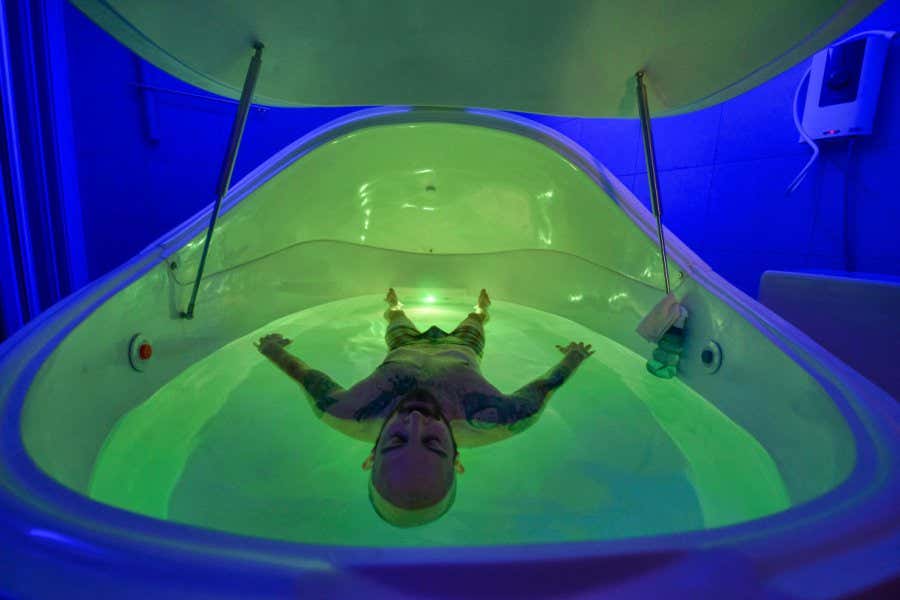
Often found in high-end spas, floatation tanks have shown promise for relieving PTSD
dave stamboulis / Alamy
A shipping container holding three mobile floatation tanks is en route to Maui, Hawaii, to tackle a mental health crisis caused by one of the deadliest wildfires in US history. While mostly found in high-end spas, floatation tanks have shown promise as a treatment for anxiety and post-traumatic stress disorder (PTSD). If the roll-out is successful, fleets of the tanks could be sent to disaster zones all over the world.
In August 2023, a series of wildfires erupted on Maui, the worst of which killed 102 people and destroyed thousands of homes and businesses. In the years since, risk of depression and anxiety have increased by more than half, and there are fears of an unfolding epidemic of PTSD.
“Maui does not have an infrastructure to deal with a mental health crisis of this magnitude,” says Justin Feinstein, a clinical neuropsychologist who set up the non-profit Float Research Collective. “People are self-medicating. There’s a lot of alcohol use; there’s a surge in suicide and PTSD.”
On 2 May, Feinstein announced at the Embodied Minds Summit in Los Angeles, that the float units would be available for free sessions for first responders and survivors of the 2023 wildfires, while also being used to collect long-term data on floatation as a mental health treatment.
Floatation therapy, also known as Float-REST (reduced environmental stimulation therapy), involves lying in a shallow pool that contains enough dissolved Epsom salts to support the body without effort. The water in the pool and the air above it are kept at body temperature, and with ear plugs to reduce noise and the lights switched off, the brain is cut off from all external sources of sensory stimulation.
The tanks were invented in the 1950s by neuroscientists to answer the question of whether the brain would shut down without this stimulation. The answer was no – people remained conscious, but they did report a sense of deep relaxation.
Feinstein has since spent more than a decade researching the therapy’s mental and physical effects. This work has suggested that it significantly reduces anxiety in healthy volunteers, and in people with anxiety disorder and other mental health conditions, such as depression and PTSD. It produces an effect that is roughly equivalent to taking benzodiazepines, a type of sedative, says Feinstein.
While the exact mechanisms are still unclear, floatation is thought to work by removing external sensory stimulation and reducing movement, allowing the body and brain to settle into a state of relaxation. Studies have shown that within minutes, breathing and heart rate slows and blood pressure falls, while brain activity shifts away from self-directed thoughts and emotional processing towards a restorative, sleep-like state.
Feinstein, who has lived in Maui since 2020, has worked with the UK-based company Floataway to design lower-cost modular float pods, which, unlike regular tanks, can be assembled anywhere in a matter of days. The Maui Calm Project will bring the tanks to the area and is set to start gathering data in the summer. If successful, the aim is to have a fleet of pop-up tanks that can be sent to disaster zones to potentially prevent PTSD.
Sarah Garfinkel at University College London, who has studied the bodily basis of PTSD, says that the focus on calming the body is a much-needed change in how we treat the condition. “A core feature of PTSD is hyperarousal, which is accompanied by increased reactivity of bodily responses,” she says. “Floatation is seemingly able to bring about a feeling of internal safety, which an important shift in the understanding and treatment of PTSD. I’m really excited by this work.”
Need a listening ear? UK Samaritans: 116123 (samaritans.org); US Suicide & Crisis Lifeline: 988 (988lifeline.org). Visit bit.ly/SuicideHelplines for services in other countries.
Topics: