

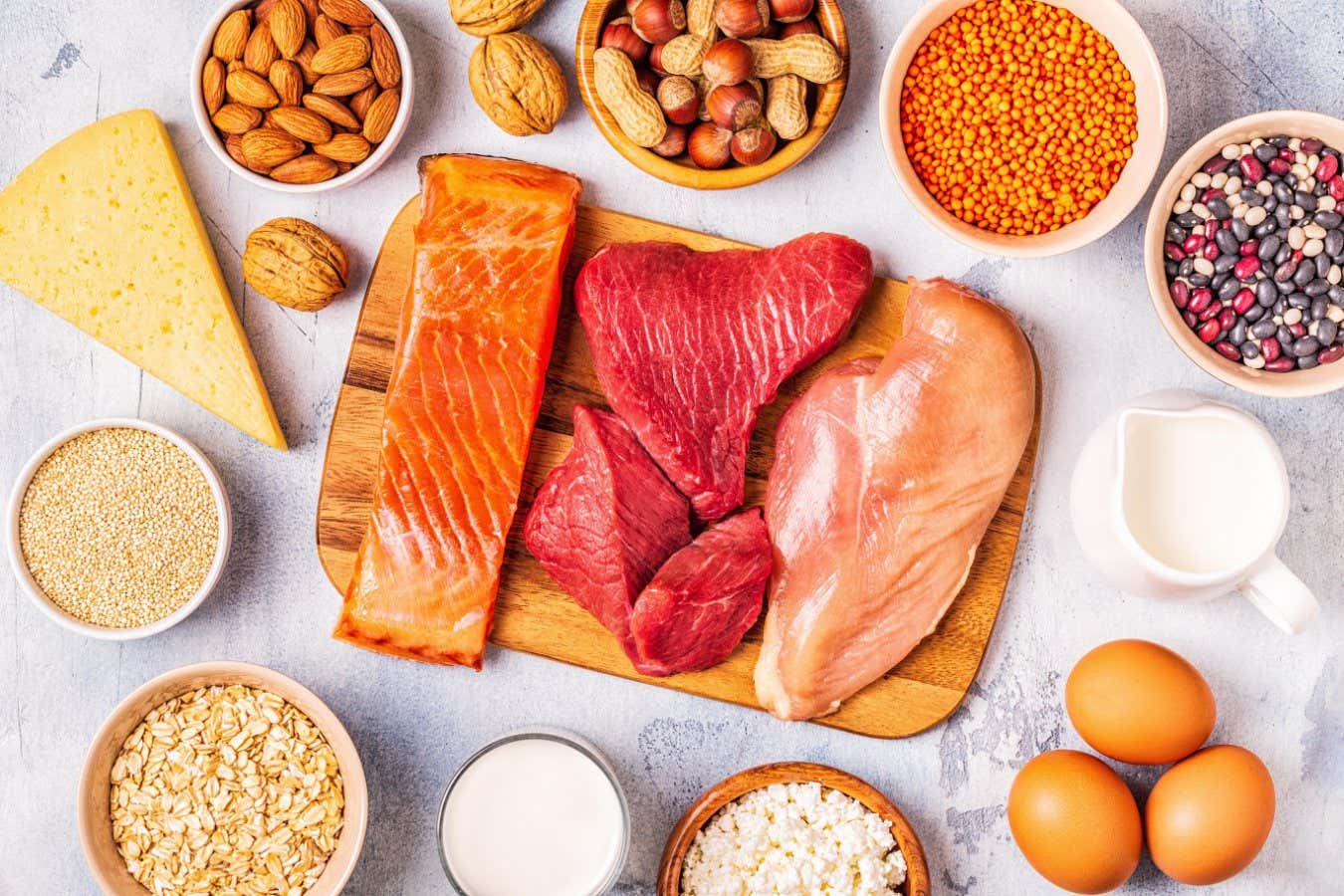
There are many sources of protein in your diet
Tatiana Bralnina/Alamy
From powders to popcorn to pancakes – supermarket shelves are awash with products stuffed with protein, but what is behind this nutritional trend? Donald Layman at the University of Illinois at Urbana-Champaign takes some responsibility for the craze, having conducted more than 100 studies over the decades, mostly focusing on one amino acid: leucine. Layman has consistently linked leucine, which is found in dietary protein, to muscle growth and repair. This helped make protein a wonder nutrient for young people seeking a honed physique and for older individuals looking to limit the muscle loss that naturally occurs with age. Here, he tells New Scientist the three most important things we should know about protein.
1. The protein craze is overblown
If you care enough to read an article about protein, you’re probably sufficiently conscious of your food choices to not be deficient in it. The latest US dietary guidelines recommend a target of 1.2 to 1.6 grams of protein per kilogram of body weight every day. This is easy to achieve if you consume a balanced, omnivorous diet without too much ultra-processed food.
While there’s no good evidence of our health being harmed if we consistently consume more protein than this, its benefits don’t consistently rise alongside a higher intake. In fact, the effect of protein on muscle growth and repair appears to plateau at daily intakes above 1.6 grams per kilogram of body weight per day, or at meals with more than 60 grams of protein.
I always say: if you see protein in foods where you don’t expect it, like popcorn, then it probably shouldn’t be there. That’s because the additional intake we get from a fortified product is usually pretty trivial for our health if it’s on top of a well-balanced diet. Putting the word “protein” on the front of a food package does not magically make its content healthy.
2. Understand the numbers behind what you are eating
If you track your protein intake, don’t confuse the recommended dietary allowance (0.8 grams of protein per kilogram of body weight per day in the US) with the dietary guidelines. The recommended dietary allowance is the minimum amount required to prevent protein deficiency; the dietary guidelines set out the goal for optimum health.
Our increased reliance on ultra-processed food has diluted the quality of our diet, which is partly why around half of US adults fall short of the recommended range suggested by the dietary guidelines. The goal of the dietary guidelines is to bring everyone up to an intake of 1.2 to 1.6 grams of protein per kilogram of body weight per day.
But some people may choose protein intakes that go beyond this, such as athletes and bodybuilders. Your specific requirement depends on your age, your physical activity levels, your body composition (your percentage of fat, muscle and bone) and the types of protein you are eating.
Working out your optimal requirement, and even how much protein you’re eating, isn’t a straightforward thing to do. Start by looking up the rough protein content of the foods you eat most often. A 100-gram chicken breast, for instance, has around 32 grams of protein, while an egg has 6 grams. This will give you a rough idea of whether you’re getting enough. For example, the optimal intake of a woman in her 30s who is a healthy weight and does a moderate amount of exercise would probably be 70 to 90 grams of protein a day. She would be halfway to achieving this if she started the day with a boiled egg and then had a chicken sandwich for lunch.
3. Your source of protein matters
If you’re vegetarian or vegan, it’s absolutely possible for you to get enough protein through careful dietary choices – but it’s not easy. Meat, fish, dairy and eggs are much more abundant in protein than plants. To match the amount of protein found in 100 grams of chicken breast, you need to eat three cups of cooked beans or more than 200 almonds.
Not only do plants contain less protein, but the protein they have isn’t as well absorbed by the body. For instance, the protein in chicken is basically 100 per cent absorbable, compared to about 75 per cent in beans and less than 60 per cent in almonds.
This is important, because protein deficiency doesn’t show up after a week or two. A lot of people turn vegetarian or vegan in their 20s and 30s, when you can often get away with a lower protein intake, but when you get into your 40s, the problems start coming home to roost. You might feel tired, and your hair and nails may be more brittle than you’d like them to be. Combining a plant-based diet with a low-calorie one – for instance, if you’re taking a GLP-1 weight-loss drug like semaglutide that suppresses your appetite – can put you further in the danger zone.
I usually recommend that vegans and older people consider protein shakes. Our appetite declines with age and our body becomes less efficient at using protein, which puts older people more at risk of hip fractures from falls if they lose too much muscle. A daily shake can be a good insurance policy.
As told to Alexandra Thompson
Topics: