

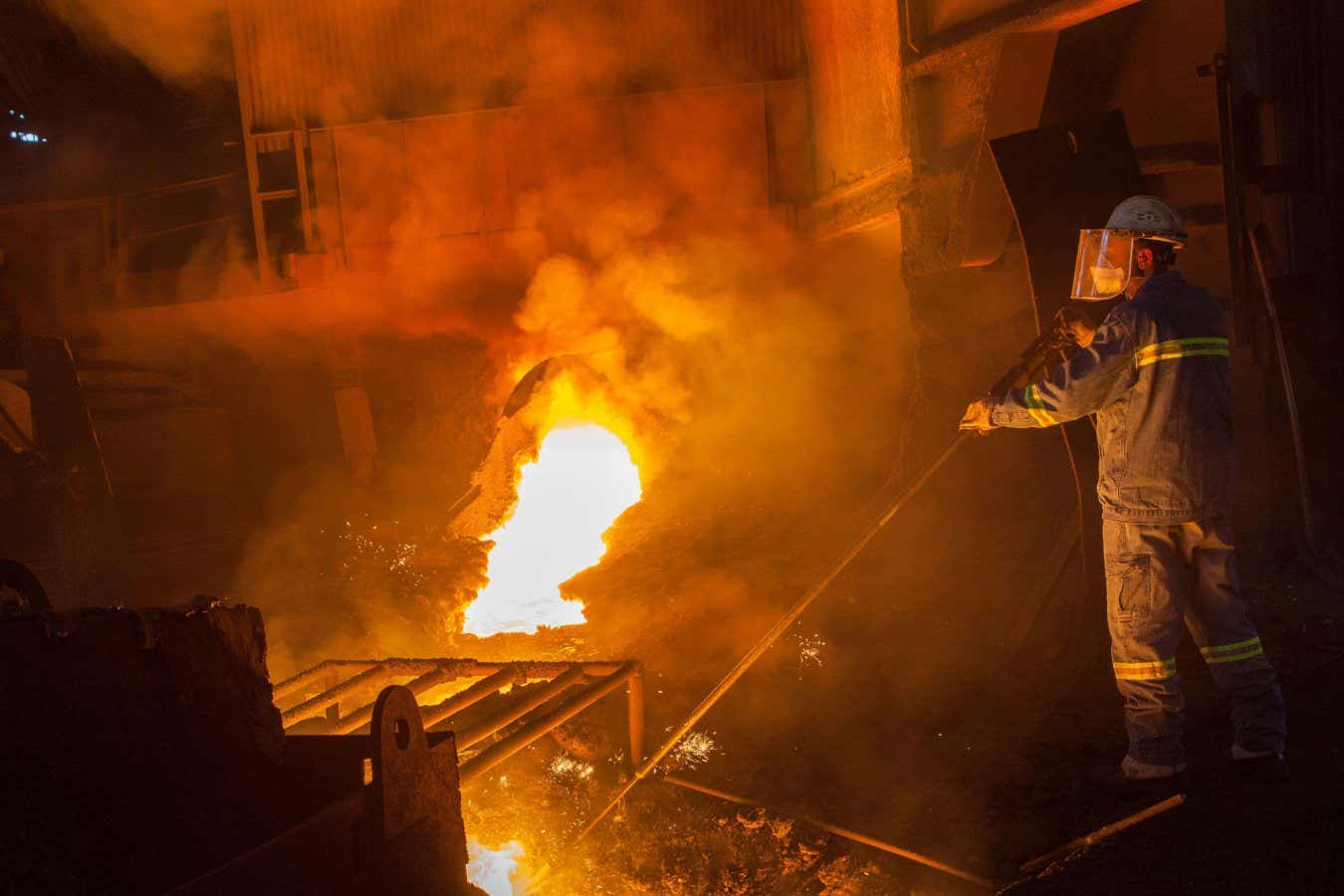
Steel made outside the European Union will be subject to a new import tariff
Yusuf Aslan / Alamy
Until now, countries lagging behind others in cutting carbon emissions haven’t faced any downsides apart from higher energy costs. All international climate agreements are effectively voluntary. But this is finally about to change. On 1 January, the European Union will start charging a carbon tariff on imported goods that effectively penalises climate laggards – the first to be introduced anywhere in the world.
Needless to say, the nations that will be forced to pay these carbon taxes aren’t happy about it. Tensions have been ramping up in the lead-up to the start of the EU’s carbon border tariff, or what it calls a carbon border adjustment mechanism. The trade disputes are likely to continue, but the tax is here to stay – and is the first of many, says Ellie Belton at climate think tank E3G.
“I think we can expect to see carbon border adjustment mechanisms popping up all over the world,” says Belton. The UK plans to introduce one in 2027 and Australia, Canada and Taiwan are also considering it.
The EU’s carbon border tax is essentially an extension of its carbon pricing. Since 2005, industries in the EU that emit a lot of carbon dioxide have had to pay for the privilege under the Emissions Trading Scheme. This scheme is being extended to cover more sources of emissions, and the current price is around €76 per tonne of CO2.
This means that, say, steel-makers in the EU have higher costs than those in countries where there is no carbon pricing. The idea of the adjustment mechanism is to restore a level playing field. In other words, the border tariff is set to match the EU’s internal carbon price.
With steel from countries that already have carbon pricing, the EU will charge only the difference between the prices. Besides steel, the border tax will apply mainly to iron, aluminium, cement, fertilisers, hydrogen and electricity.
The immediate aim is to ensure that heavy industries don’t simply move to other nations where they don’t get penalised for pollution, a phenomenon known as carbon leakage. “The EU has been very clear that it will not make any exemptions, because essentially you would then create a pollution haven where the dirtier production would relocate to,” says Belton.
On top of this, the policy aims to help limit global warming by effectively forcing other countries to do more to cut carbon emissions. It is already working, says Belton. Some nations, including Brazil and Turkey, are introducing their own carbon pricing schemes specifically because of the EU’s carbon border tax.
The EU’s decision to implement a carbon border adjustment mechanism was finalised in 2023, and a pilot scheme began in October 2023 under which companies liable for the charge had to make declarations. Firms have to start paying on 1 January, but the charges are being phased in gradually, with the full amount not kicking in until 2034.
Companies in the UK aren’t expected to have to pay the tax because of the country’s plan to introduce its own border tax in 2027. Negotiations are under way to make the UK scheme compatible with the EU one.
The ideal situation would be for all nations that introduce carbon border adjustment mechanisms to adopt the same system. This would increase their economic clout, meaning they would have more power to force others to act. It would also ease trade within the unified tariff bloc and reduce administrative costs for those exporting to this bloc. Unfortunately, this is unlikely to happen, says Belton, and it appears that a mish-mash of different carbon tariff systems will spring up around the world.
Topics: