

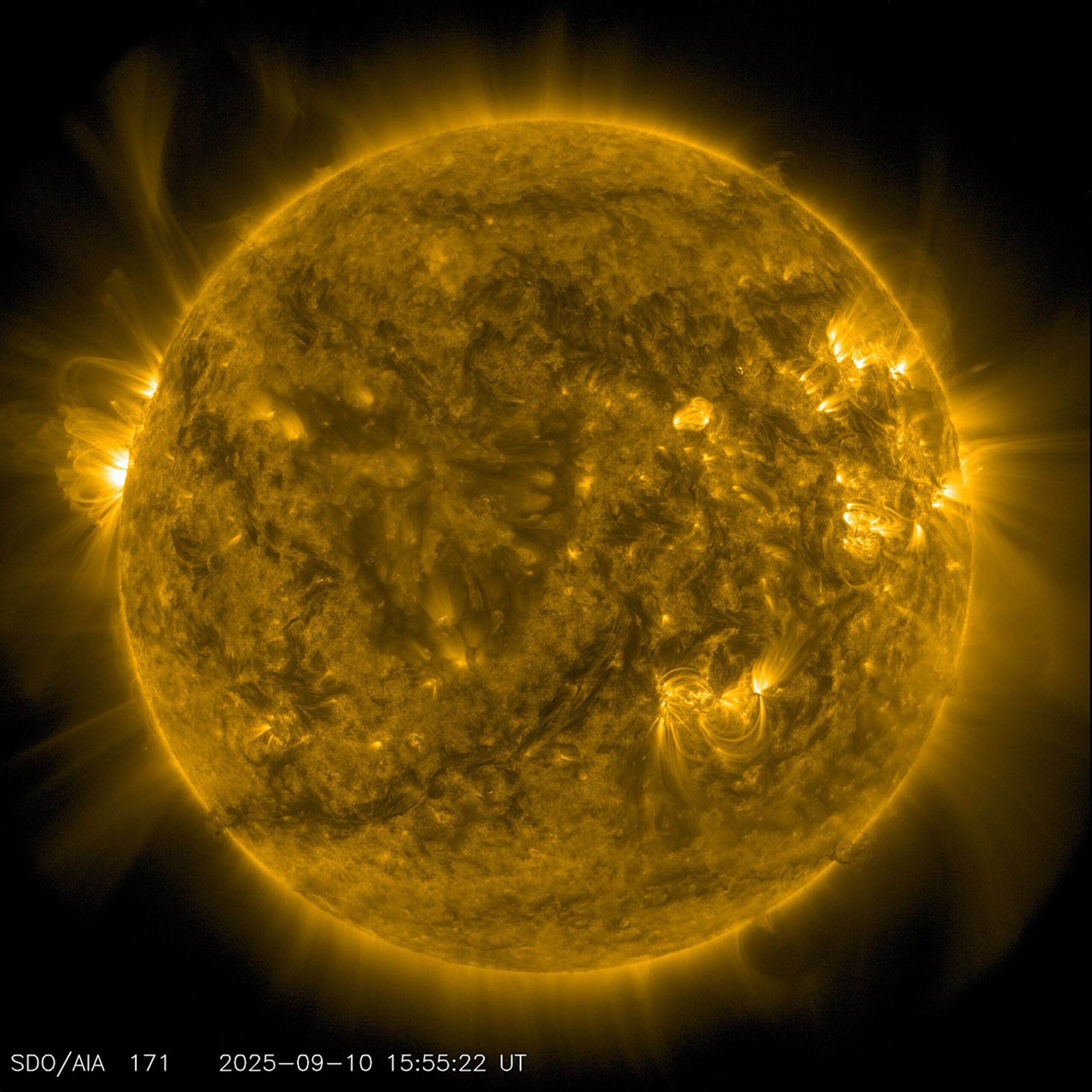
Sunlight needs only a little over eight minutes to cross the space between the Sun and Earth. The energy behind it may already have spent around 170,000 years moving outward from the Sun’s core.
That contrast sounds impossible until the route is divided into two environments. Space is transparent, so light can follow an almost straight path. The solar interior is dense plasma, where radiant energy is scattered, absorbed, and emitted again so often that its progress resembles a random walk.
I had come across the 170,000-year figure before. What I had missed was that following the energy is more accurate than imagining one ancient photon finally arriving at the breakfast table.
Fusion starts the energy flow
The Sun’s core is roughly 15 million degrees Celsius. At that temperature and under immense pressure, a series of nuclear reactions fuses hydrogen into helium. A small difference in mass is released as energy.
Some energy leaves in neutrinos, particles that interact so weakly with matter that most pass through the Sun in seconds. The rest helps maintain the hot plasma and radiation field inside the star. Radiation associated with the core begins at very high energies, but it cannot simply fly to the surface.
NASA’s guide to the Sun’s interior divides it into the core, radiative zone, and convection zone. NASA gives a travel time of about 170,000 years for energy carried by radiation to move from the core to the top of the convection zone.
That is a model estimate, not a directly timed trip.
The radiative zone creates the delay
Light still moves at light speed between interactions. The long delay comes from how short and directionless those intervals are.
The radiative zone reaches from outside the core to about 70 percent of the Sun’s radius. Matter there is so dense that radiation repeatedly interacts with electrons and ions. After an interaction, energy may be sent outward, sideways, or back toward the center. There is a net outward flow toward cooler layers, but no tidy route.
This is the random-walk problem. A person taking equal steps in random directions will cover far more ground than the straight-line distance between start and finish. More importantly, the number of steps needed rises roughly with the square of the distance. Doubling the target distance can require about four times as many random steps.
In a 1992 paper in The Astrophysical Journal, astrophysicists Robert Mitalas and Kimberly Sills calculated the diffusion time using step lengths taken from a model of the present Sun. Their average step length was just 0.090 centimeters. The resulting timescale was 1.7 times 100,000 years.
That calculation is the source of the familiar 170,000-year figure.
The same photon does not survive the whole route
Descriptions often say that a photon “bounces” from the core to the surface. It is a useful image, but it can leave the wrong impression.
Deep inside the Sun, photons can be scattered, absorbed, and re-emitted. Energy passes between radiation and plasma, and its distribution shifts as it enters cooler layers. It is therefore misleading to picture a single gamma-ray photon retaining its identity for 170,000 years before emerging as yellow sunlight.
An OpenStax explanation of energy transport in the solar interior gives a broader range of 100,000 to 1 million years from center to surface. That range is a useful reminder that the answer depends on the solar model, the interactions included, and exactly where the clock is stopped.
The 170,000-year estimate specifically describes radiative diffusion to the top of the convection zone. It should not be read as a birth certificate for an individual photon reaching Earth today.
There is a useful comparison hiding in the core. Neutrinos are also produced during the fusion reactions, but they barely interact with matter. Most leave the Sun within a few seconds, then need roughly the same eight minutes as light to cross to Earth. Instruments that detect solar neutrinos are therefore receiving a much more immediate signal from nuclear reactions than telescopes looking at visible sunlight.
That difference is one reason physicists were so interested in measuring solar neutrinos. The visible surface tells us how energy finally emerges after being processed through the star. Neutrinos offer evidence that fusion is happening in the core now, subject only to their short escape time and the light-speed trip across space.
Moving plasma takes over near the outside
At about 70 percent of the solar radius, radiation becomes a less effective transporter. The outer part of the interior is the convection zone, a layer roughly 200,000 kilometers deep.
Hot plasma rises, transfers energy into cooler regions, and sinks again. The motion is often compared with boiling water. Solar plasma is far removed from a pot on a stove, but the analogy captures the important change: energy is now being carried mainly by moving material rather than diffusing radiation.
Eventually the energy reaches the photosphere, the visible layer commonly called the Sun’s surface. The density there is low enough that photons can escape without immediately colliding again. Most solar radiation leaving the photosphere is visible or infrared, with a smaller ultraviolet component.
The photosphere is not a solid shell. It is the depth in the solar atmosphere from which visible photons have a good chance of escaping. Below it, repeated interactions keep radiation coupled to matter. Above it, the gas is transparent enough that photons can continue outward.
The visible photon leaving the photosphere is new. The energy flow behind it is old.
The final trip takes about 499 seconds
Earth is an average of about 149.6 million kilometers from the Sun. Light travels through a vacuum at 299,792 kilometers per second. Dividing one by the other gives roughly 499 seconds, or 8 minutes and 19 seconds.
The exact figure varies over the year because Earth’s orbit is not a perfect circle. The SOHO mission’s answer to the same calculation rounds the distance to 150 million kilometers and the time to about 500 seconds.
Nothing in interplanetary space produces a delay remotely like the Sun’s interior. Space is not completely empty, but it is transparent enough for an ordinary ray of sunlight headed toward Earth to travel in an effectively straight line.
This is the detail I keep returning to when sunlight falls across a room. The eight-minute crossing is only the final leg. Nearly all of the waiting happened before the light we see was emitted.
We cannot match a photon at Earth to a particular fusion reaction in the core. What models can give us is a timescale for energy moving through a star, followed by a distance that light crosses with simple arithmetic.