
Close Menu
    Trending
    • Starmer’s Collapse Is A Vote Against Policy Failure
    • Cynthia Erivo Pauses Show To Call Out Filming Fan
    • UK police arrest man after two people stabbed in Jewish area of London: Security group
    • How US and Iran are playing a crypto cat-and-mouse game over sanctions | US-Israel war on Iran News
    • Dodgers’ Edwin Diaz shares major injury update
    • Opinion | What Body Cam Footage Reveals About ICE’s Tactics
    • We obtained nearly 1,000 complaints about SpaceX’s Starlink. Here’s what they reveal
    • City birds appear more afraid of women than men, and scientists have no idea why
    Benjamin Franklin Institute
    Wednesday, April 29
    • Home
    • Politics
    • Business
    • Science
    • Technology
    • Arts & Entertainment
    • International
    Benjamin Franklin Institute
    Home»Science»Astronomers Spot Mysterious Bar-Shaped Cloud of Iron Inside an Iconic Nebula
    Science

    Astronomers Spot Mysterious Bar-Shaped Cloud of Iron Inside an Iconic Nebula

    Team_Benjamin Franklin InstituteBy Team_Benjamin Franklin InstituteJanuary 18, 2026No Comments3 Mins Read
    Share Facebook Twitter Pinterest Copy Link LinkedIn Tumblr Email VKontakte Telegram
    Share
    Facebook Twitter Pinterest Email Copy Link


    January 15, 2026

    2 min read

    Add Us On GoogleAdd SciAm

    Astronomers Spot Mysterious Bar-Shaped Cloud of Iron Inside an Iconic Nebula

    A distinctive nebula inside the constellation Lyra holds a never-before-seen cloud of iron atoms—and researchers aren’t sure why
    By Jackie Flynn Mogensen edited by Claire Cameron

    Nebula with iron bar

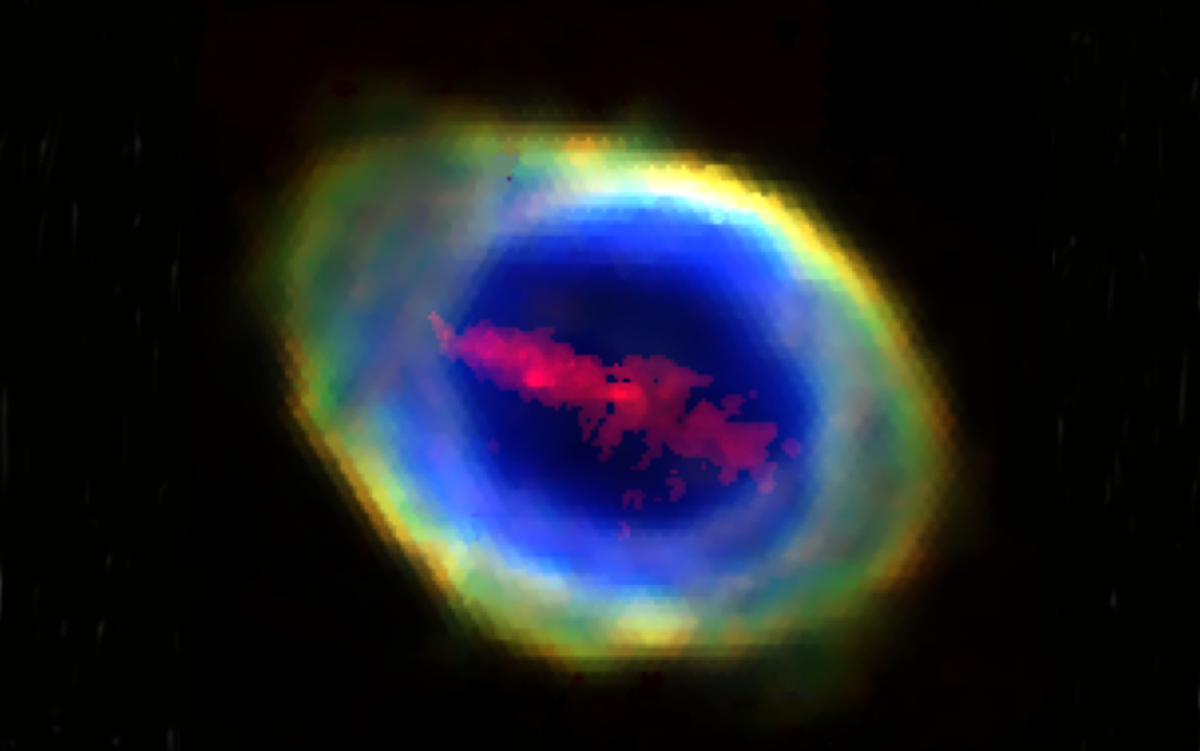
    The Ring Nebula is a sight to behold. Located in the constellation Lyra, this kaleidoscopic doughnut of gas is the dying echo of a star not too unlike our sun. And according to a new study, it also hosts a never-before-seen, massive cloud of iron atoms. Astronomers aren’t sure why.

    The cloud, which is in the shape of a bar, has slightly more mass than Mars. Astronomers spotted it using the William Herschel Telescope (WHT) in Spain using an optical spectrometer called the WHT Enhanced Area Velocity Explorer (WEAVE). The findings are detailed in a new paper in the Monthly Notices of the Royal Astronomical Society.

    “When we processed the data and scrolled through the images, one thing popped out as clear as anything—this previously unknown bar of ionized iron atoms, in the middle of the familiar and iconic ring,” said Roger Wesson, an astronomer at Cardiff University in Wales and lead author of the new paper, in a statement.


    On supporting science journalism

    If you’re enjoying this article, consider supporting our award-winning journalism by subscribing. By purchasing a subscription you are helping to ensure the future of impactful stories about the discoveries and ideas shaping our world today.


    An illustrative set of 8 individual WEAVE LIFU emission-line images of the Ring Nebula.

    How the bar got there is a mystery. The bar is located somewhere in the middle of the nebula and is about as long as 500 times Pluto’s orbit around the sun. It’s possible that the bar could tell scientists more about how the nebula formed. The researchers plan to conduct a follow-up study with WEAVE to try and answer some of these questions.

    Astronomers don’t know why it exists, but it likely is not the only one of its kind. “It would be very surprising if the iron bar in the Ring is unique,” Wesson said in the same statement. “So hopefully, as we observe and analyze more nebulae created in the same way, we will discover more examples of this phenomenon, which will help us to understand where the iron comes from.”

    It’s Time to Stand Up for Science

    If you enjoyed this article, I’d like to ask for your support. Scientific American has served as an advocate for science and industry for 180 years, and right now may be the most critical moment in that two-century history.

    I’ve been a Scientific American subscriber since I was 12 years old, and it helped shape the way I look at the world. SciAm always educates and delights me, and inspires a sense of awe for our vast, beautiful universe. I hope it does that for you, too.

    If you subscribe to Scientific American, you help ensure that our coverage is centered on meaningful research and discovery; that we have the resources to report on the decisions that threaten labs across the U.S.; and that we support both budding and working scientists at a time when the value of science itself too often goes unrecognized.

    In return, you get essential news, captivating podcasts, brilliant infographics, can’t-miss newsletters, must-watch videos, challenging games, and the science world’s best writing and reporting. You can even gift someone a subscription.

    There has never been a more important time for us to stand up and show why science matters. I hope you’ll support us in that mission.


    Source link

    Share. Facebook Twitter Pinterest LinkedIn Tumblr Email Telegram Copy Link

    Related Posts

    Science

    City birds appear more afraid of women than men, and scientists have no idea why

    April 29, 2026
    Science

    NASA chief Jared Isaacman hints at campaign to make Pluto a planet again

    April 29, 2026
    Science

    Cancer is increasing in young people and we still don’t know why

    April 29, 2026
    Science

    People are betting on measles outbreaks – and that might be useful

    April 29, 2026
    Science

    Striking photo essay examines deadly spread of dengue fever in Nepal

    April 28, 2026
    Science

    Watch Astrobotic’s latest record-breaking ‘ring of fire’ rocket engine test

    April 28, 2026
    Editors Picks

    Market Talk – December 9, 2025

    December 9, 2025

    Woman given 15 years for role supplying drugs linked to Matthew Perry death | Courts News

    April 9, 2026

    Mickey Rourke Reportedly Rejects Multiple Jobs Amid Eviction Struggle

    January 10, 2026

    NATO says working on ‘next steps’ to boost Arctic security

    January 12, 2026

    Aleppo’s residents caught between hope and fear amid Syria fighting | Syria’s War

    January 10, 2026
    About Us
    About Us

    Welcome to Benjamin Franklin Institute, your premier destination for insightful, engaging, and diverse Political News and Opinions.

    The Benjamin Franklin Institute supports free speech, the U.S. Constitution and political candidates and organizations that promote and protect both of these important features of the American Experiment.

    We are passionate about delivering high-quality, accurate, and engaging content that resonates with our readers. Sign up for our text alerts and email newsletter to stay informed.

    Latest Posts

    Starmer’s Collapse Is A Vote Against Policy Failure

    April 29, 2026

    Cynthia Erivo Pauses Show To Call Out Filming Fan

    April 29, 2026

    UK police arrest man after two people stabbed in Jewish area of London: Security group

    April 29, 2026

    Subscribe for Updates

    Stay informed by signing up for our free news alerts.

    Paid for by the Benjamin Franklin Institute. Not authorized by any candidate or candidate’s committee.
    • Privacy Policy
    • About us
    • Contact us

    Type above and press Enter to search. Press Esc to cancel.