
Close Menu
    Trending
    • Social media’s big tobacco moment is just a first step
    • The chips in your phone are probably broken – and that’s a good thing
    • North London Stabbing Is Being Treated as Terrorism, Police Say
    • Kris Jenner Denies Recent Facelift Reports
    • Kevin Warsh one step closer to becoming Fed chair after Senate committee approval
    • ‘We saw terrible things’: Mali refugees tell of atrocities amid attacks | Armed Groups News
    • The ‘Passing TD leaders by NFL franchise’ quiz
    • Meta isn’t doing enough to keep minors off of Facebook and Instagram, says the EU
    Benjamin Franklin Institute
    Wednesday, April 29
    • Home
    • Politics
    • Business
    • Science
    • Technology
    • Arts & Entertainment
    • International
    Benjamin Franklin Institute
    Home»Science»Ancient mammoth-tusk boomerang is twice as old as we thought
    Science

    Ancient mammoth-tusk boomerang is twice as old as we thought

    Team_Benjamin Franklin InstituteBy Team_Benjamin Franklin InstituteJune 26, 2025No Comments3 Mins Read
    Share Facebook Twitter Pinterest Copy Link LinkedIn Tumblr Email VKontakte Telegram
    Share
    Facebook Twitter Pinterest Email Copy Link


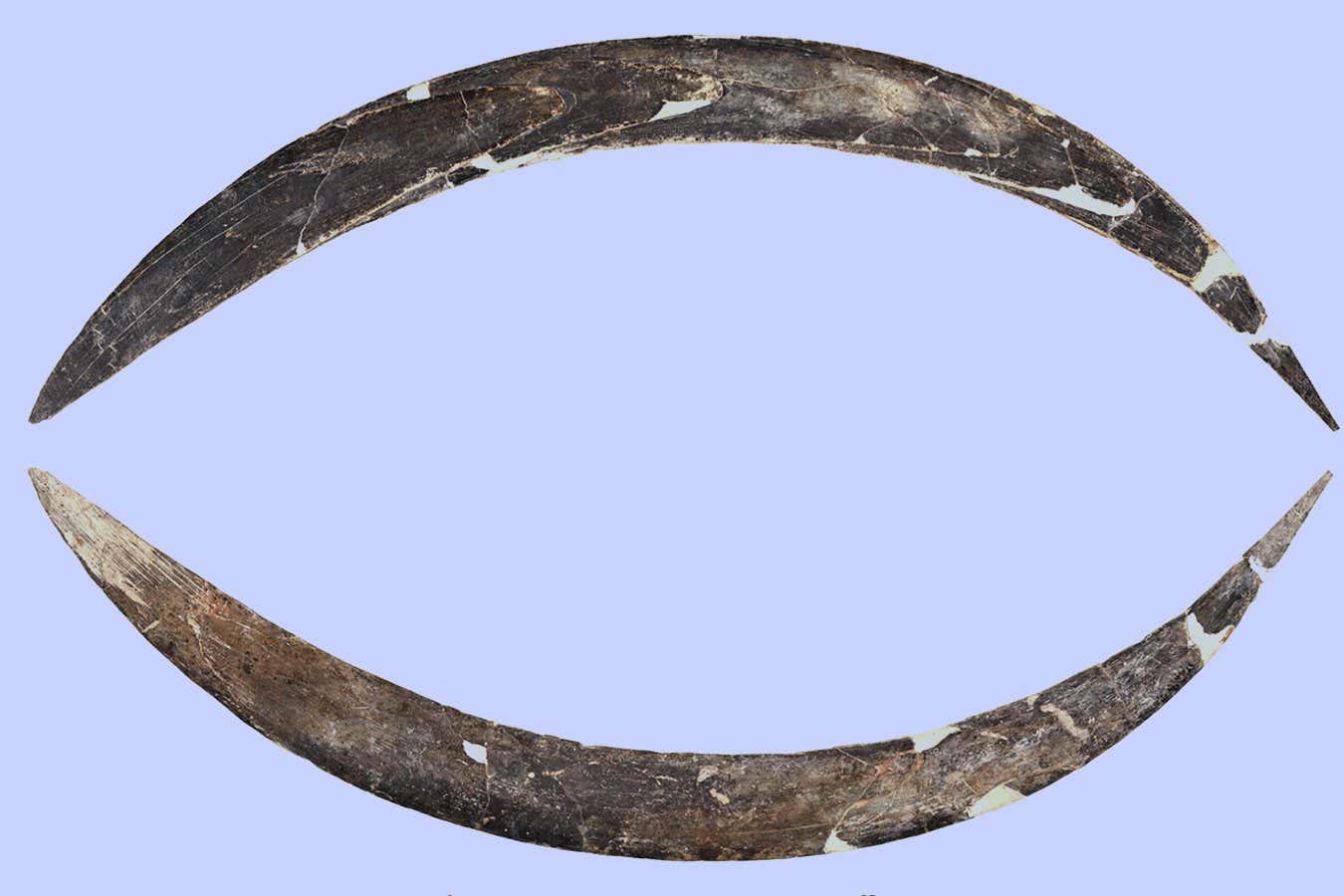
    An artefact made from a mammoth tusk is the oldest known boomerang

    Talamo et al., 2025, PLOS One, CC-BY 4.0

    The world’s oldest known boomerang may be 22,000 years older than previously thought, suggesting it was crafted during a period when early humans displayed an increase in artistry.

    In 1985, archaeologists unearthed a 72-centimetre-long ivory boomerang buried beneath six layers of sediment in Obłazowa cave in Poland. Later sediment sieving revealed a Homo sapiens thumb bone nearby, as well as antler tools, a bone bead and pendants made from fox teeth. In the 1990s, radiocarbon dating suggested the thumb was 31,000 years old – but surprisingly, the boomerang was dated to just 18,000 years old, several millennia younger than the artefacts in higher layers.

    Sahra Talamo at the University of Bologna in Italy suspected contamination. “Even a trace amount of modern carbon – from glue or conservation products – can throw off the radiocarbon date by tens of thousands of years,” she says. Analyses of the thumb’s carbon-nitrogen ratios showed signs of altered collagen, indicating that the preserved samples weren’t high enough quality for reliable radiocarbon dating.

    Re-dating the contaminated boomerang would have been futile – and would have damaged the precious artefact needlessly, says Talamo. Instead, she and her colleagues dated 13 nearby animal bones, re-dated the human thumb bone and used statistical modelling to reconstruct the timeline. Their results showed that the entire sediment layer – and hence the boomerang and thumb as well – dates to between 39,000 and 42,000 years ago.

    “In a way, this is an advertisement to museums that when you find something extraordinary, you should not cover it with glue or other restoration materials before completing all your analyses,” she says.

    Its new age means the ivory boomerang predates the second-oldest known boomerangs – made from wood by Indigenous Australians – by 30,000 years. Unlike simpler throwing sticks, such as a 300,000-year-old wooden implement found in Schöningen, Germany, boomerangs are curved and aerodynamically shaped, even if they don’t always return to the thrower, says Talamo.

    Indeed, although the ancient boomerang could most likely fly, its size and design probably made it unlikely to return to sender. Instead, it may have served a symbolic or ceremonial purpose, says Talamo, based on its decorative engravings, reddish pigment and smooth polish – combined with its placement beside a human thumb bone in a circle of imported stones.

    The finding offers a glimpse into early humans’ cognitive abilities and craftsmanship during a burst of artistic expression that occurred during the Early Aurignacian period, starting around 40,000 years ago. During this time, symbolic artefacts such as mammoth ivory figurines, rock art and aesthetically crafted tools first appeared in Europe, says Talamo.

    Topics:


    Source link

    Share. Facebook Twitter Pinterest LinkedIn Tumblr Email Telegram Copy Link

    Related Posts

    Science

    The chips in your phone are probably broken – and that’s a good thing

    April 29, 2026
    Science

    Chanda Prescod-Weinstein connects physics, poetry and pop culture

    April 29, 2026
    Science

    City birds appear more afraid of women than men, and scientists have no idea why

    April 29, 2026
    Science

    NASA chief Jared Isaacman hints at campaign to make Pluto a planet again

    April 29, 2026
    Science

    Cancer is increasing in young people and we still don’t know why

    April 29, 2026
    Science

    People are betting on measles outbreaks – and that might be useful

    April 29, 2026
    Editors Picks

    Ethan Hawke Makes Surprising Sex Confession At 55

    February 24, 2026

    Epstein urged media mogul to give up control of affairs, citing health | Business and Economy

    March 17, 2026

    Opinion | What if Iran Wins This War?

    April 4, 2026

    Why the greatest risk of AI in higher education is the erosion of learning

    February 22, 2026

    Cowboys keep RB Javonte Williams with big contract

    February 22, 2026
    About Us
    About Us

    Welcome to Benjamin Franklin Institute, your premier destination for insightful, engaging, and diverse Political News and Opinions.

    The Benjamin Franklin Institute supports free speech, the U.S. Constitution and political candidates and organizations that promote and protect both of these important features of the American Experiment.

    We are passionate about delivering high-quality, accurate, and engaging content that resonates with our readers. Sign up for our text alerts and email newsletter to stay informed.

    Latest Posts

    Social media’s big tobacco moment is just a first step

    April 29, 2026

    The chips in your phone are probably broken – and that’s a good thing

    April 29, 2026

    North London Stabbing Is Being Treated as Terrorism, Police Say

    April 29, 2026

    Subscribe for Updates

    Stay informed by signing up for our free news alerts.

    Paid for by the Benjamin Franklin Institute. Not authorized by any candidate or candidate’s committee.
    • Privacy Policy
    • About us
    • Contact us

    Type above and press Enter to search. Press Esc to cancel.