

Unlock the White House Watch newsletter for free
Your guide to what Trump’s second term means for Washington, business and the world
It was only a matter of time before Donald Trump’s war on what we used to know as the global economy spilled over from trade to other areas. Sure enough, while his trade war is set for a new phase next week — when the US president’s “liberation day” tariff schedule is supposed to come into effect — we have just witnessed the first skirmish on the second front, over taxes.
In 2021, countries led by the G7 and the OECD reached a compromise on how to reform tax rules for international companies. A failure to update an old web of bilateral tax treaties aiming to avoid double taxation had led, too often, to a situation of double non-taxation, with loopholes too easily allowing corporations to pretend their profits were made in low- or zero-tax jurisdictions. The “base erosion and profit shifting” efforts eventually arrived — in no small part thanks to Trump’s first Treasury secretary Steven Mnuchin — at new rules by which countries may tax companies active in their jurisdictions if those companies are inadequately taxed elsewhere.
But giving other countries taxing rights to US corporates’ profits was never going to go down well with the president. Insistence on tax sovereignty for America and opposition to extraterritoriality by others are a bipartisan matter in Washington. Given Trump’s pugilism, a conflict was bound to come to a head. The question is how other countries choose to respond.
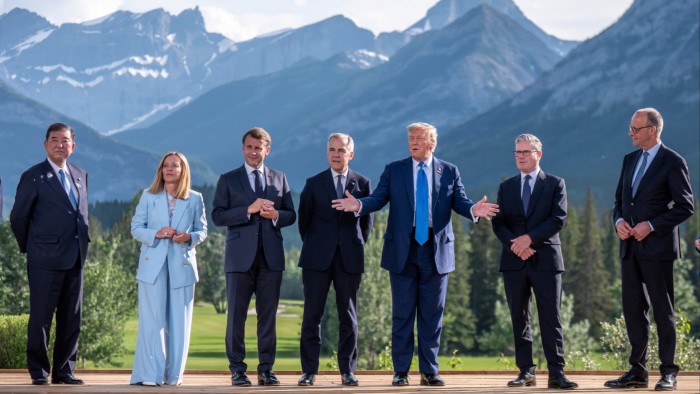
On Saturday, other G7 countries accepted a US demand for its companies to be exempted from two rules it sees as particularly unjustifiable. In return, Washington has arranged the removal of section 899 from the One Big Beautiful Bill Act. This section — which may have been inserted precisely to create leverage to force this outcome — would have imposed new US taxes on corporations from countries deemed to discriminate against American companies. The OECD has welcomed the agreement.
Giving in to the US may not have been the wisest choice. After all, it has demonstrated that blackmail can work. At the same time, it is never clear with the Trump administration what commitments it will stand by. In this case, the US Treasury has reassured counterparts that it is committed to addressing any “substantial” profit-shifting risks within its domestic system, “side by side” with the international scheme others have signed up to in full. But it is unclear how this commitment will be followed up and enforced.
The other G7 nations may, however, have reasoned that among many battles, this was not one to pick. That was certainly true of Canada, which surrendered quickly in another tax fight. It swiftly withdrew a digital services tax after Trump called off trade negotiations and threated higher tariffs on Canadian goods. DSTs will become flashpoints with European countries, too: the UK, France, Spain and Italy all have a version of it. The UK’s DST survived the first trade announcements with the US, but may still be in Washington’s crosshairs. The EU countries, shielded by the size of their big trade bloc, should find it easier to resist. As they seek a resolution to trade negotiations with Trump, they ought to resist any pressure to compromise on tax sovereignty for a quick deal.
What is clear is that business does not benefit from these kinds of tussles. Instead of a hard-won compromise, some multinational corporations will now have to face a more complex dual system that ostensibly will levy just as much tax. The very fact that tax rules have turned into legitimate targets for economic coercion adds a layer of policy uncertainty. Whether it was Trump’s intention or not, the cost of doing business across borders has just gone up yet another notch.