

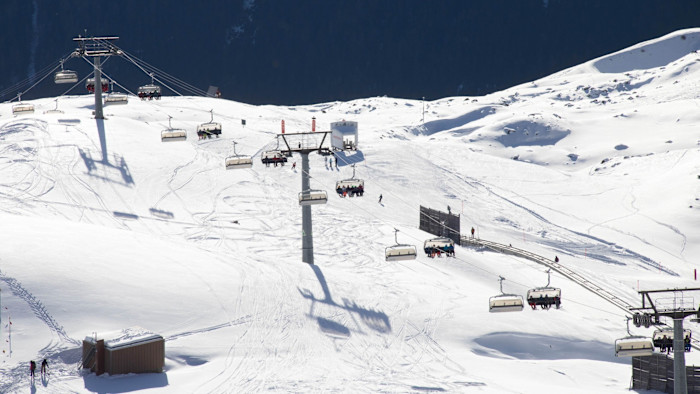
I have visited Davos many times since moving to Switzerland 13 years ago. It is easy to understand how it became a famous tourist resort.
My skiing skills were honed at Davos-Klosters while “pizza-ing” down its black diamond slopes. I have gazed at paintings in Davos’s lovely Kirchner Museum. And I have sipped stone-cold Chasselas wine in its weathered wood stübli. But I have never “done” Davos, the annual gathering of thousands of world leaders and prominent business people hosted by the World Economic Forum.
The event this year is likely to attract its usual share of critical media coverage, which has often focused on the hypocrisy of elites. It is the 56th annual meeting of the WEF and its usual statements of lofty ambitions focus on themes such as co-operation, investment and growth.
However, the aspirations for this year’s conference feel even more embattled than usual. There has been a change in leadership. WEF’s founder Klaus Schwab was cleared of misconduct allegations by a WEF inquiry only in August last year and the organisation has named BlackRock boss Larry Fink and Roche vice-chair André Hoffmann as interim chairs of its board.
President Donald Trump is expected to attend the conference, unlike last year, when the event took place just after his inauguration, but the White House has just announced US withdrawal from multiple multilateral organisations. The leader of the world’s second-largest economy, China’s Xi Jinping, will once again not attend, despite lauding his country’s rising “national power” at the end of last year.
But, while taking potshots at the event in Davos has become a popular annual pursuit, the resort itself is demonstrating a customary resilience.

“Davos hasn’t been killed by WEF, but it does spend one week a year being held hostage by it,” says Grant Maunder, a wealth management partner at UK-based Saltus and owner and operator of The Brecon and Cambrian hotels in Adelboden, Switzerland. “I’ve been in Switzerland since the 1970s and in my opinion, most people don’t come to the Alps to think about geopolitics, they come to forget it.”
Like last year, the conference is expected to host around 3,000 participants from nearly 130 countries. The Davos-Kloster tourism board says the resort has 28,000 guest beds in hotels, clinics and holiday apartments and expects every one of them to be occupied during the event. The resident population is just 11,000, according to 2024 official statistics.
But how did what was a little Swiss village, by no means the prettiest, become the place of pilgrimage for a capitalist conscience and the lectern of the world economic order?


In fact, the history of Davos — which now likes to call itself the highest city in Europe — is a masterclass in resourcefulness and reinvention.
Its many different and changing residents over millennia have included Rhaetians, a group of alpine tribes later colonised by Rome. Romansh, the descendant of their language, remains Switzerland’s fourth official language.
But Davos won its modern international fame in the mid-19th century after a doctor named Alexander Spengler claimed that the high altitude and clean mountain air of Davos could treat tuberculosis.

The town became home to a succession of sanatoriums and spas and was really put on the map after author Thomas Mann visited his wife at the Waldsanatorium in 1912. The trip inspired a seminal novel, The Magic Mountain, set in the years before the outbreak of the first world war but published in 1924.
The novel did for Davos what Mann’s Death in Venice did for that city: cemented its place as a playground of the elite. The Magic Mountain even gave us this observation, perhaps as relevant to the visitors of the WEF event in Davos today: “What good would politics be, if it didn’t give everyone the opportunity to make moral compromises.”
A further irony of the Magic Mountain prewar era is that many of Davos’s sanatorium patients who went there for the clean mountain air were both victims and beneficiaries of burning coal, the dirty fuel of the wealth-concentrating industrial revolution.


Little has changed in terms of uncomfortable truths. The WEF, for example, says it is committed to high standards of sustainability, but many of the illustrious participants at the Davos event will travel there by private jet. Switzerland is responsible for around 5 per cent of Europe’s private jet emissions, according to a Greenpeace report published in 2023.
More stories from this report
However, the resort has not only demonstrated an ability to rise above criticism, it has also been able to profit from good fortune offered by its visitors. It made its name as a ski resort — it was home to the world’s first T-Bar lift in the 1930s and the Parsennbahn funicular railway was the first mountain railway for skiers. The sanatorium business continued, but after a downturn in business precipitated by widespread availability of antibiotics after the second world war, Davos needed another new direction.
In 1971, along came a modest business gathering of the European Management Symposium with around 450 delegates. That event morphed into the World Economic Forum, eventually defining the town’s identity and turning it into the ultimate corporate retreat.

“Davos is not a luxury destination,” says architect and designer Andrin Schweizer, who grew up skiing in Davos and has owned a chalet in the area for 20 years. “It once was, when it was primarily known as a health resort for tuberculosis patients, but those days are long gone. Today it cannot be compared to [more glamorous] destinations such as St Moritz, Gstaad or Courchevel,” he adds.
“The destination [of Davos] becomes somewhat dependent on the image of the event,” he says, adding that some of its hotels are in urgent need of renovation.
But it might be reinvention, rather than renovation, that will be on the agenda in the not too distant future, with Swiss glaciers melting faster than ever before. It is a good thing reinvention has long been a speciality of Davos.