

Close Menu
    Trending
    • Cristiano Ronaldo, ‘The Bosnian Diamond’ headline the World Cup 40-and-over club
    • How housing market inventory is shifting across every state
    • What is a ‘normal’ memory slowdown, and when should I worry?
    • Ariana Grande And Ethan Slater Are ‘Still Friends’ Following Split
    • US says BYD, Baidu, Alibaba and other tech giants are aiding China’s military
    • Maine’s Platner faces test as four US states hold midterm primary votes | US Midterm Elections 2026 News
    • John Harbaugh, Giants urged to cut ties with former first-rounder
    • Why Repair Cafés are becoming more popular amid the anti-consumerism movement
    Benjamin Franklin Institute
    Tuesday, June 9
    • Home
    • Politics
    • Business
    • Science
    • Technology
    • Arts & Entertainment
    • International
    Benjamin Franklin Institute
    Home»World Economy»Data Harvesting In The Classroom
    World Economy

    Data Harvesting In The Classroom

    Team_Benjamin Franklin InstituteBy Team_Benjamin Franklin InstituteApril 23, 2026No Comments3 Mins Read
    Share Facebook Twitter Pinterest Copy Link LinkedIn Tumblr Email VKontakte Telegram
    Share
    Facebook Twitter Pinterest Email Copy Link


    I have said for years that governments and institutions always begin with what people will accept and then gradually expand from there. What we are now seeing in educational technology is perhaps one of the most disturbing developments, because it targets children under the guise of learning.

    Studies have now confirmed that roughly 90% of commonly used school apps are transmitting tracking data, even when they are not actively being used, and many contain hidden third-party trackers operating in the background. This is not simply about helping a student complete homework or communicate with a teacher; this is continuous data collection that records behavior, interaction patterns, and device activity regardless of whether the child is even aware it is happening.

    For many reading this, particularly those who did not grow up in a digital classroom, it is important to understand how pervasive these platforms have become, as students today are required to use them for nearly every aspect of their education. Assignments, testing, communication, textbooks, and grading have all moved into apps and online systems, meaning participation is no longer optional, it is mandatory. Parents assume these tools exist to support education, yet behind the curtain, they are functioning as data collection systems layered into the daily routine of children.
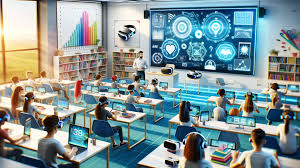
    digitalclassroom

    I see this as no different from what we witnessed with Pokémon Go, where people believed they were simply playing a game, but in reality, they were contributing to a massive data collection operation. The difference here is that children are not choosing to participate, they are required to, and instead of mapping physical locations, these systems are mapping behavior, attention spans, learning patterns, and interaction habits from a very early age.

    What is being built is not just an academic record, but a behavioral profile that follows the individual over time, capturing how they think, how they respond, how long they focus, and how they engage with information. Once that data is collected, it does not simply vanish, it becomes part of a broader ecosystem that can be analyzed, shared, and monetized in ways that are rarely disclosed in plain terms.

    Many of these platforms rely on third-party integrations, which means the data is not confined to a single provider but is distributed across multiple entities, each extracting value from it. This creates a web of data collection that is nearly impossible for parents to fully understand or control, and the more these systems are adopted, the more normalized this becomes.

    From my perspective, this is how control expands, not through force, but through normalization. When data collection is embedded into something like a game, people participate willingly, but when it is embedded into education, it becomes institutional. That is a very dangerous shift, because it removes the ability to opt out without consequence.

    We are moving into a system where data is the new currency, and the earlier it is collected, the more valuable it becomes. Starting that process in childhood creates a lifetime of behavioral data that can be used to predict, influence, and potentially control outcomes in ways that most people do not yet fully grasp.


    Source link

    Share. Facebook Twitter Pinterest LinkedIn Tumblr Email Telegram Copy Link

    Related Posts

    World Economy

    Market Talk – June 8, 2026

    June 8, 2026
    World Economy

    The Drumbeat Around Taiwan Grows Louder

    June 8, 2026
    World Economy

    Russia Needs 800,000 Workers | Armstrong Economics

    June 8, 2026
    World Economy

    The Jobs Report Everyone Will Misread

    June 8, 2026
    World Economy

    The Food Supply Has Been Compromised

    June 7, 2026
    World Economy

    Market Talk – June 5, 2026

    June 5, 2026
    Editors Picks

    At least eight people die in record-breaking heatwave across Europe | Climate Crisis News

    July 2, 2025

    Melissa McCarthy Flaunts Her Weight Loss In Low-Cut Dress

    February 21, 2026

    Evangeline Lilly Slams Disney Amid Massive Layoffs

    April 30, 2026

    US aims for international Gaza force deployment early next year, say US officials

    December 13, 2025

    Ukraine receives bodies of 1,000 soldiers from Russia | Russia-Ukraine war News

    January 29, 2026
    About Us
    About Us

    Welcome to Benjamin Franklin Institute, your premier destination for insightful, engaging, and diverse Political News and Opinions.

    The Benjamin Franklin Institute supports free speech, the U.S. Constitution and political candidates and organizations that promote and protect both of these important features of the American Experiment.

    We are passionate about delivering high-quality, accurate, and engaging content that resonates with our readers. Sign up for our text alerts and email newsletter to stay informed.

    Latest Posts

    Cristiano Ronaldo, ‘The Bosnian Diamond’ headline the World Cup 40-and-over club

    June 9, 2026

    How housing market inventory is shifting across every state

    June 9, 2026

    What is a ‘normal’ memory slowdown, and when should I worry?

    June 9, 2026

    Subscribe for Updates

    Stay informed by signing up for our free news alerts.

    Paid for by the Benjamin Franklin Institute. Not authorized by any candidate or candidate’s committee.
    • Privacy Policy
    • About us
    • Contact us

    Type above and press Enter to search. Press Esc to cancel.