

This grainy drone video shows what war looks like now.
Piloting a drone may look like a video game, but these soldiers are in real danger.
We joined a Ukrainian drone team at the front to understand this work, and how cheap drones have changed combat as we know it.
Drone operators wage their war from the air, but they rarely see the sky.
The Ukrainians in this small unit spent most of their time indoors, in a partially ruined building in the Kherson region, in the south of Ukraine. Units like theirs are all over the front on both sides, which means soldiers can barely advance without being spotted.
This unit’s commander, pilot, navigator and explosives technician were all born in or near Kherson. Now they are defending it.
THE PREP
Between strikes, the technician prepares explosives.
And the soldiers assemble and test drones, so they are ready for when orders come.
The cheap drones used in Ukraine are redefining combat as we know it. Soldiers there can barely advance without being targeted.
This drone team, part of the 34th marine brigade, works in two rooms. One is cluttered with wires, antennas, zip ties, duct tape and soldering irons to modify the drones. The other holds the explosives. A wood stove provides comfort in cold weather.
They prepare different explosives for different targets: pellet-packed charges for use against soldiers, and mixtures of TNT and mining explosives for bunkers.
As the soldiers ready their munitions, a surveillance drone operated by a separate unit is scouting for targets not far away across the Dnipro River in territory held by Russia.
Awaiting orders, the soldiers smoke and chat to pass the time.
Sergeant Serhiy, 46, once fought in the infantry but was wounded when his vehicle hit a mine. After that, he taught himself to pilot drones. He and the other soldiers asked to be identified only by their first names, in keeping with military protocol.
Part of his job is to look out for enemy drones. The team uses a device that intercepts video signals broadcast by Russian drones flying in from the other side of the river. If the Ukrainians see their own position on the screen, they know they are in grave danger.
The detector flickers to life. “It’s flying near us,” Sergeant Serhiy says of a Russian drone.
But then the signal blinks out — Ukrainian jammers have blocked it — and an explosion is heard some distance away as the drone crashes.
They are safe.
THE CALL
The command center orders the team into action over a secure phone call. A Ukrainian surveillance drone has spotted what looks like a Russian bunker.
The navigator receives a description of the target.
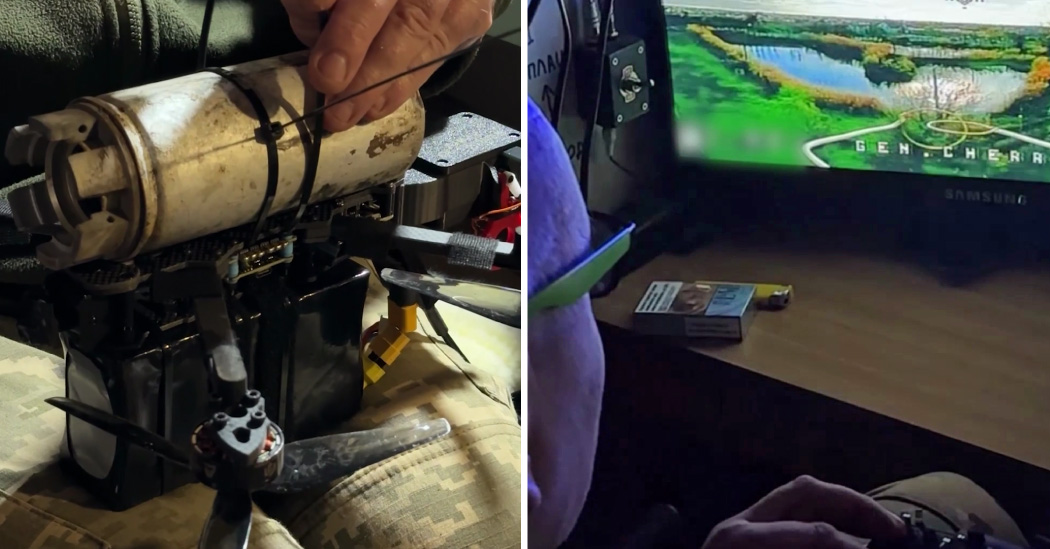
The team moves quickly. The explosives technician fastens a plastic bottle containing explosives, ideal for destroying a deep bunker, to the drone.
The battery and other pieces are fitted next. The drone is ready to go.
The drones are built from commercial models. The reliance on low-cost materials was born of necessity earlier in the war, when Ukraine ran low on artillery shells.
The Ukrainian military is the first major force in the world to create a separate branch for unmanned systems. But unmanned is a bit of a misnomer. Tens of thousands of soldiers serve in drone units, even as Ukraine’s army is critically short of personnel.
The Russian bunker is at a position on the front where Russian and Ukrainian soldiers are just a few hundred yards apart.
Tension builds in the room as the drone is tested. Its propellers whir briefly, confirming it’s ready to fly. It may look barely airworthy, but it is deadly.
Private Oleksandr ties a string between a safety mechanism on the drone and the wooden box from which it will take off. When it flies away, the string will disengage the mechanism — and the device will be armed.
Sergeant Serhiy and Corporal Oleh, the navigator, take seats in camp chairs before three large computer monitors.
Then comes the riskiest part of the operation. The drone has to be taken outside.
Private Oleksandr must leave the safety of the hideout for just a few seconds to prepare the drone for launch.
The only defense against being spotted by a Russian surveillance drone is speed.
Only about 10 minutes passed between order and launch.
After takeoff, the drone cannot be recovered. If the target is not found, Sergeant Serhiy will crash it in an open space.
THE FLIGHT
Because of GPS jamming, the drone team must rely on landmarks like trees and bends in the river to navigate.
While the craft used for this mission is called a first-person-view drone, flying it is a two-person job.
The pilot uses a remote control console while watching a video feed from the drone’s camera. The navigator watches videos from both the F.P.V. drone and a surveillance drone while receiving instructions from the command center.
Some pilots use virtual reality goggles, which provide a more immersive view. But because they used desktop monitors, Corporal Oleh could guide Sergeant Serhiy by pointing out geographic features on the screens.
It’s a few miles to the target bunker, across the wetlands of the Dnipro River.
Radio jamming interferes with the signal, but the unit maintains contact. A few minutes after takeoff, Sergeant Serhiy carefully steers the drone into a trench.
The strike is a success. The surveillance drone captures the explosion.
THE AFTERMATH
There is no cheering after a strike.
Some pilots are shaken by what they see. They witness the last moments of soldiers running for their lives or hiding in bushes.
Sergeant Serhiy says he is undisturbed. “They attacked my home,” he says of the Russians.
The Russian and Ukrainian drone teams sometimes taunt or insult each other by adding text to the unencrypted footage transmitted by their drones Each side knows the other can see the messages.
“It’s the only way we communicate,” Sergeant Serhiy says.
There are typically about 10 failed drone strikes for every successful one. Sometimes, drones lose signal due to radio jamming. Sometimes, they are shot down by Russian soldiers.
We watched the unit take aim at four targets that day. All four were successful. It was a day of precision and efficiency.