

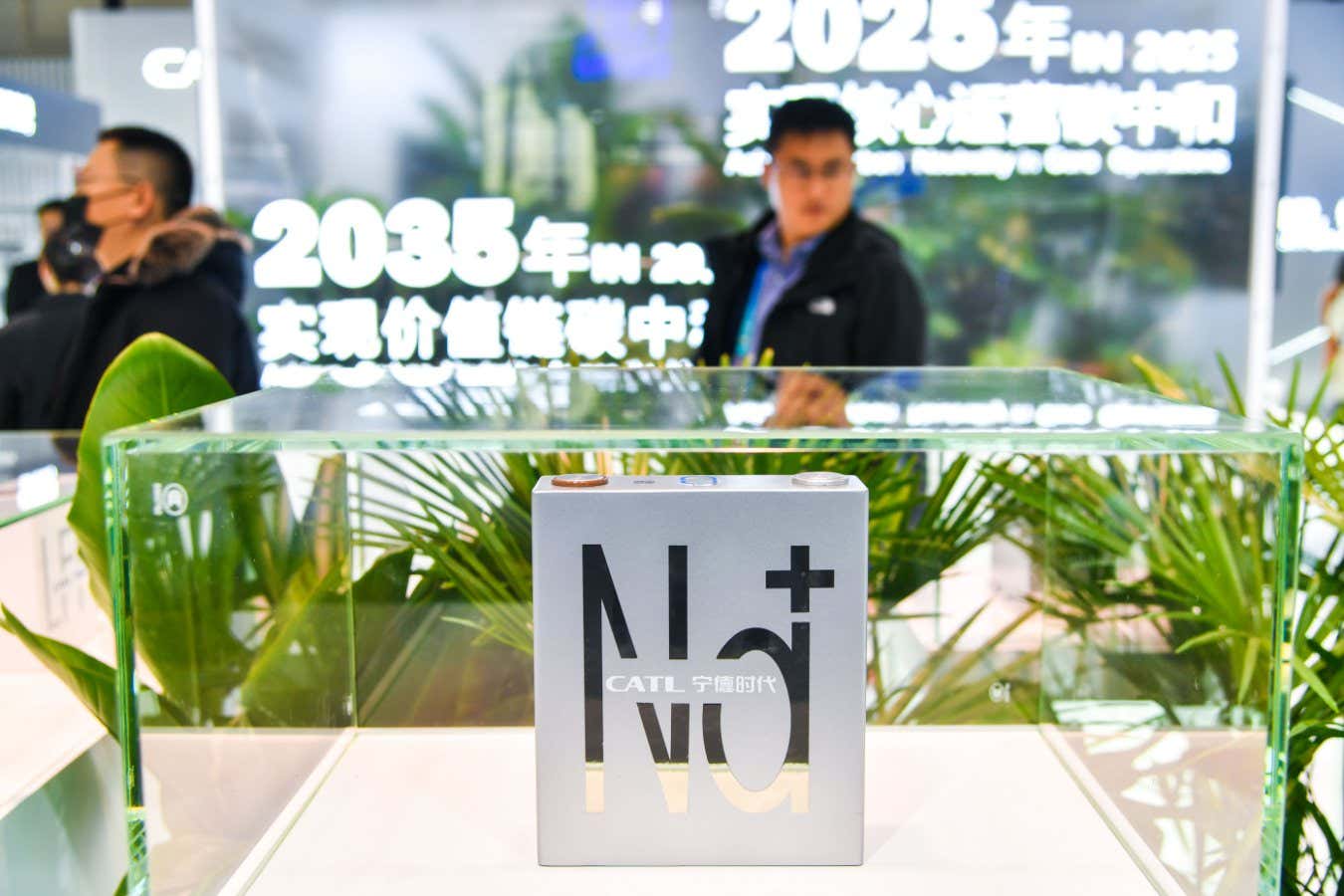
CATL’s sodium-ion battery on display at a trade show
VCG/VCG via Getty Images
On 5 February, a black sedan was speeding down an icy track in northern China at 95 kilometres per hour when its tyre burst, releasing a puff of white into the -32°C air. The car coasted to a stop without spinning into the snow. This was meant to demonstrate that even the harshest conditions were no barrier to the auto-maker Changan’s new line of electric vehicles, which includes the first mass-produced EV with a sodium-ion battery.
Changan’s Nevo AO6 model is expected to hit the market later this year with a new, more powerful generation of sodium-ion batteries made by energy storage giant CATL.
While most rechargeable batteries are made from lithium, a critical mineral, this kind of battery is made from salt, a much more abundant – and therefore cheaper – material. If sodium-ion batteries can perform almost as well at a lower price, they could challenge lithium’s dominance. And that could pave the way for other kinds of batteries, so that someday each type of device might have its own preferred battery chemistry.
“This is just the start of the battery revolution, in which we are going to see a plethora of new batteries coming to the market and targeting special segments,” says Maria Crespo-Ribadeneyra at Queen Mary University of London. “Sodium is the pioneer that can prove that a world beyond lithium is possible.”
While a predecessor of the sodium-ion battery was created by the firm Ford in 1966, companies only began to seriously develop the technology in the past 15 years, as electrification of the power grid and automobiles hiked demand for lithium-ion batteries. It works the same way, but sodium, rather than lithium, is dissolved in the electrolyte, and the electrodes are different compounds.
But because sodium is three times heavier than lithium, sodium-ion batteries with the same storage capacity weigh more. Their potential was long seen as limited to electricity grid storage, since the extra bulk doesn’t matter at a large facility, or to mini EVs with a small battery range.
A handful of sodium-ion grid storage plants have been built in China, Germany and the US. General Motors, the largest US auto-maker, just partnered with the start-up Peak Energy to build more. Peak Energy is also selling sodium-ion batteries to data centres, which can use them to store electricity at times of day when it is cheap. The company Eleven Energy has also started installing sodium-ion home batteries in the UK.
Now, sodium-ion specs have improved to the point that the technology could break into the general EV market. A recent study by Moritz Schütte at Aachen University in Germany and his colleagues found that a sodium-ion battery by the manufacturer Hina rivals Tesla’s lithium-ion batteries on most parameters, although it would still be a third heavier.
But CATL claims its sodium-ion battery has an energy density of 175 watt-hours per kilogram, which can compete with the lithium-iron-phosphate batteries in low-cost models from Tesla and others. And while sodium-ion batteries still haven’t quite beaten lithium batteries on price, that could change as they expand, according to Schütte.
“The ramp-up of the sodium-ion batteries is fast,” he says. “That means the production cost is getting lower and lower. The materials are getting more advanced with every generation. We don’t know where it ends, at which energy density.”
Sodium has other advantages, too. Lithium processing is energy-intensive and often has a large carbon footprint. China controls most of this industry, and supplies could be disrupted in a geopolitical conflict, such as over Taiwan. What’s more, at sub-zero temperatures, lithium ions move through the electrolyte more slowly, which is why phones lose charge in the cold. In the heat, lithium electrolyte can erupt in flames or explode.
But sodium ions generate less heat in electrochemical reactions, reducing fire risk, so less money can be spent on cooling. They also form weaker bonds with the electrolyte, so they don’t slow down as much in the cold.
At the launch in freezing northern China, CATL said its sodium-ion EV battery retains 90 per cent capacity at -40°C (-40°F). When the battery was sawed in half, it didn’t catch fire and even continued to power a lightbulb.
Elliot Richards, a Shanghai-based EV vlogger who attended the launch, calls the sodium-ion battery the “lithium killer”. While high-end cars are likely to continue with lithium, sodium could dominate budget EVs, models for hot and cold climates, cargo lorries, and grid and home energy storage, he says.
“We’re all underestimating probably how much this will impact everyone’s daily lives,” he says. “It’s going to be a lot cheaper to own [an EV] than a combustion car; it’s going to be a lot cheaper to get batteries into your home; it’s going to be a lot cheaper for the energy provider to deliver energy to your house.”
Topics: