
Close Menu
    Trending
    • Inside The Drunken Night That Sparked Row Among Spice Girls
    • US Senate candidate’s implosion forces Democratic reckoning
    • Is Syria stable enough to engage with the world? | Syria’s War News
    • Must-draft players in new Yahoo College Fantasy Football leagues
    • Here’s What It Really Takes to Support Other Entrepreneurs
    • Resuscitated human retinas respond to light 10 hours after death
    • Map: 3.5-Magnitude Earthquake Shakes Central California
    • Ukraine & Zelensky’s Ultimate Corruption
    Benjamin Franklin Institute
    Thursday, July 9
    • Home
    • Politics
    • Business
    • Science
    • Technology
    • Arts & Entertainment
    • International
    Benjamin Franklin Institute
    Home»Science»Evocative photos of Canadian Arctic win New Scientist Editors Award
    Science

    Evocative photos of Canadian Arctic win New Scientist Editors Award

    Team_Benjamin Franklin InstituteBy Team_Benjamin Franklin InstituteJuly 3, 2026No Comments3 Mins Read
    Share Facebook Twitter Pinterest Copy Link LinkedIn Tumblr Email VKontakte Telegram
    Share
    Facebook Twitter Pinterest Email Copy Link


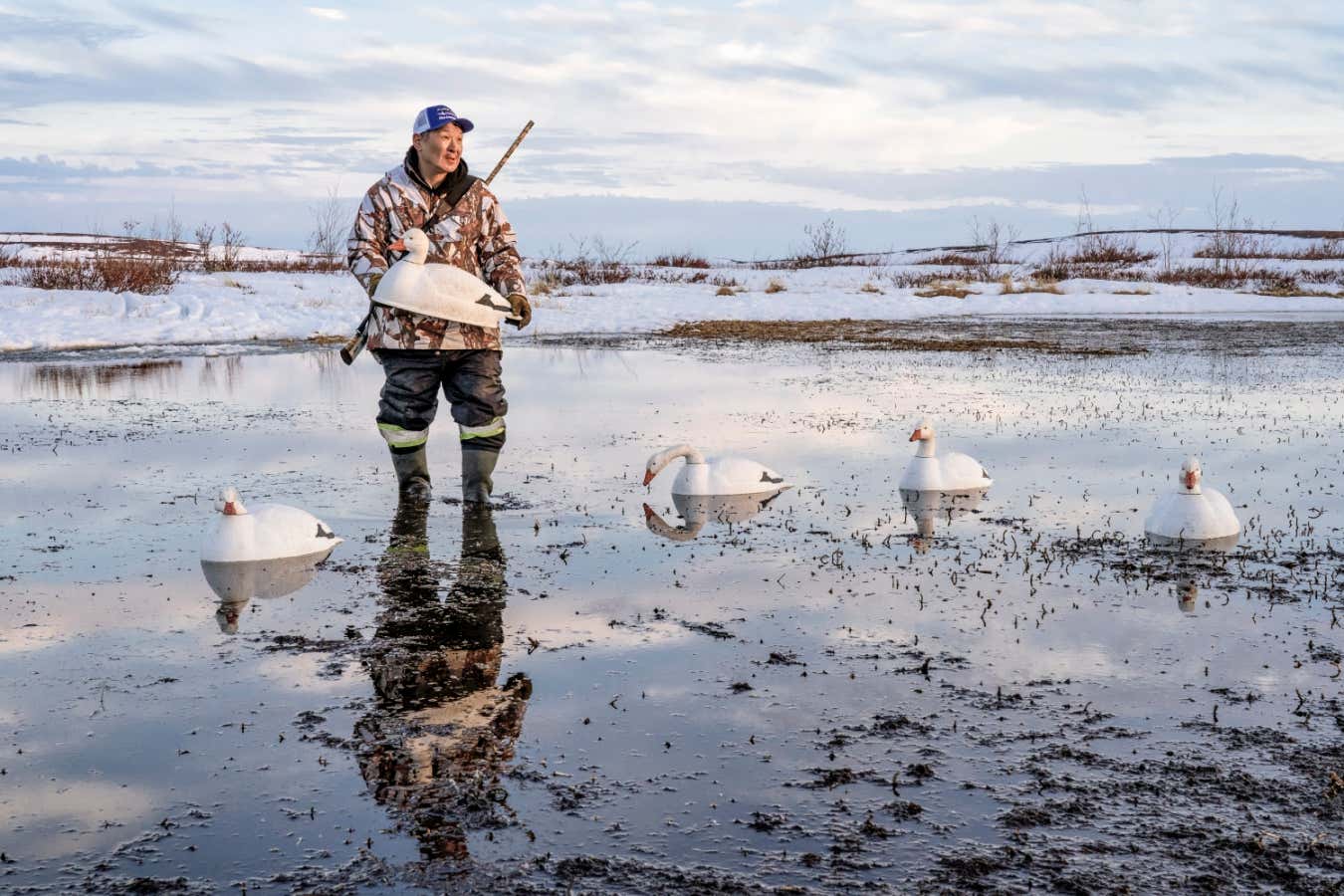
    A hunter in Tuktoyaktuk in Canada’s Northwest Territories uses decoy geese to lure birds

    Natalya Saprunova

    The realities of a changing global climate collide with years of tradition in Natalya Saprunova’s icy blue photograph, above, part of a series that won the New Scientist Editors Award in the Earth Photo 2026 competition.

    The image shows a hunter from an Inuit community in Tuktoyaktuk on Canada’s Arctic coast holding a goose decoy meant to lure migrating birds. In the background, a pale sky touches banks of melting ice and murky water already studded with several faux birds. Indigenous peoples in the region used to make these decoys from reeds, but it isn’t just the materials they work with that have now changed – rising temperatures have affected the actual birds, shifting their migratory patterns and making them harder to hunt. Saprunova documents this and other related changes in her winning series, focusing especially on the melting permafrost.

    Below, an Inuit resident of Victoria Island handles fish, another essential resource for the local community, and another animal whose behaviour has changed with the changing climate. Because permafrost thawing accelerates coastal erosion, it also introduces harmful compounds like mercury into the habitats of commonly eaten fish, endangering food supplies.

    New Scientist. Science news and long reads from expert journalists, covering developments in science, technology, health and the environment on the website and the magazine.

    In Ulukhaktok, on Victoria Island, a resident deals with fish – a vital food source for the community

    Natalya Saprunova

    Taking a wider view in the image below, Saprunova captures the texture of changes to the Arctic landscape itself, a web of sunken polygons filled with water and occasionally studded with conical, ice-cored hills. As permafrost melts, the land becomes uneven and makes it harder for animals like caribou to traverse their home. “The thaw is not just melting ice, it is reshaping the map upon which animals and people have always relied,” writes Saprunova in her submission for the prize.

    New Scientist. Science news and long reads from expert journalists, covering developments in science, technology, health and the environment on the website and the magazine.

    Near Tuktoyaktuk, the permafrost thaw is transforming the landscape

    Natalya Saprunova

    The situation is even more dire when she photographs the hamlet of Sachs Harbour where whole cliffs of permafrost are disappearing. A rugged, uneven cliff laced with cracks is shown dangerously close to homes, below. The contrast between these neat residences and the eroding land conveys the urgency of climate catastrophe in the Arctic. Canada has the longest inhabited Arctic coastline in the world and some of its inhabitants stand the grim chance of becoming the country’s first climate refugees.

    New Scientist. Science news and long reads from expert journalists, covering developments in science, technology, health and the environment on the website and the magazine.

    An eroding permafrost cliff in Sachs Harbour, Banks Island

    Natalya Saprunova

    Accordingly, Saprunova photographs Pelly Island, below, which is known to be disappearing. The permafrost that once comprised it is now melting away and releasing greenhouse gases into the atmosphere, which could, devastatingly, speed up both the rise in global temperatures and the further melting of the island. A cliff of black rock looks monstrously barren, as a nearby tiny human figure looks at the water. Exposed veins of gray and white rock only underline how much climate change is wounding their world.

    New Scientist. Science news and long reads from expert journalists, covering developments in science, technology, health and the environment on the website and the magazine.

    Pelly Island, also known as the disappearing island in north-western Canada

    Natalya Saprunova

    Images from this series will be shown at an exhibition at the Royal Geographic Society in London until 24 July.

    Topics:

    • climate change/
    • photography


    Source link

    Share. Facebook Twitter Pinterest LinkedIn Tumblr Email Telegram Copy Link

    Related Posts

    Science

    Resuscitated human retinas respond to light 10 hours after death

    July 9, 2026
    Science

    A worm that lived half a billion years ago preferred turning right

    July 9, 2026
    Science

    The 4 best science-fiction shows of 2026 so far

    July 9, 2026
    Science

    A surprisingly detailed look at the physics of a lugworm’s poop

    July 9, 2026
    Science

    The allergy culprit histamine also boosts our memory

    July 9, 2026
    Science

    Does time come from the entire universe running computations?

    July 9, 2026
    Editors Picks

    Why Belichick reportedly did not make Hall of Fame on first ballot

    January 28, 2026

    North Carolina turns to NBA champion Michael Malone as next HC

    April 7, 2026

    Market Talk – June 29, 2026

    June 30, 2026

    Venezuela seeks jail terms for supporters of US oil tanker blockade

    December 23, 2025

    Prince Harry ‘Hurt’ By Royal Wedding Snub, Blames William: report

    June 4, 2026
    About Us
    About Us

    Welcome to Benjamin Franklin Institute, your premier destination for insightful, engaging, and diverse Political News and Opinions.

    The Benjamin Franklin Institute supports free speech, the U.S. Constitution and political candidates and organizations that promote and protect both of these important features of the American Experiment.

    We are passionate about delivering high-quality, accurate, and engaging content that resonates with our readers. Sign up for our text alerts and email newsletter to stay informed.

    Latest Posts

    Inside The Drunken Night That Sparked Row Among Spice Girls

    July 9, 2026

    US Senate candidate’s implosion forces Democratic reckoning

    July 9, 2026

    Is Syria stable enough to engage with the world? | Syria’s War News

    July 9, 2026

    Subscribe for Updates

    Stay informed by signing up for our free news alerts.

    Paid for by the Benjamin Franklin Institute. Not authorized by any candidate or candidate’s committee.
    • Privacy Policy
    • About us
    • Contact us

    Type above and press Enter to search. Press Esc to cancel.