

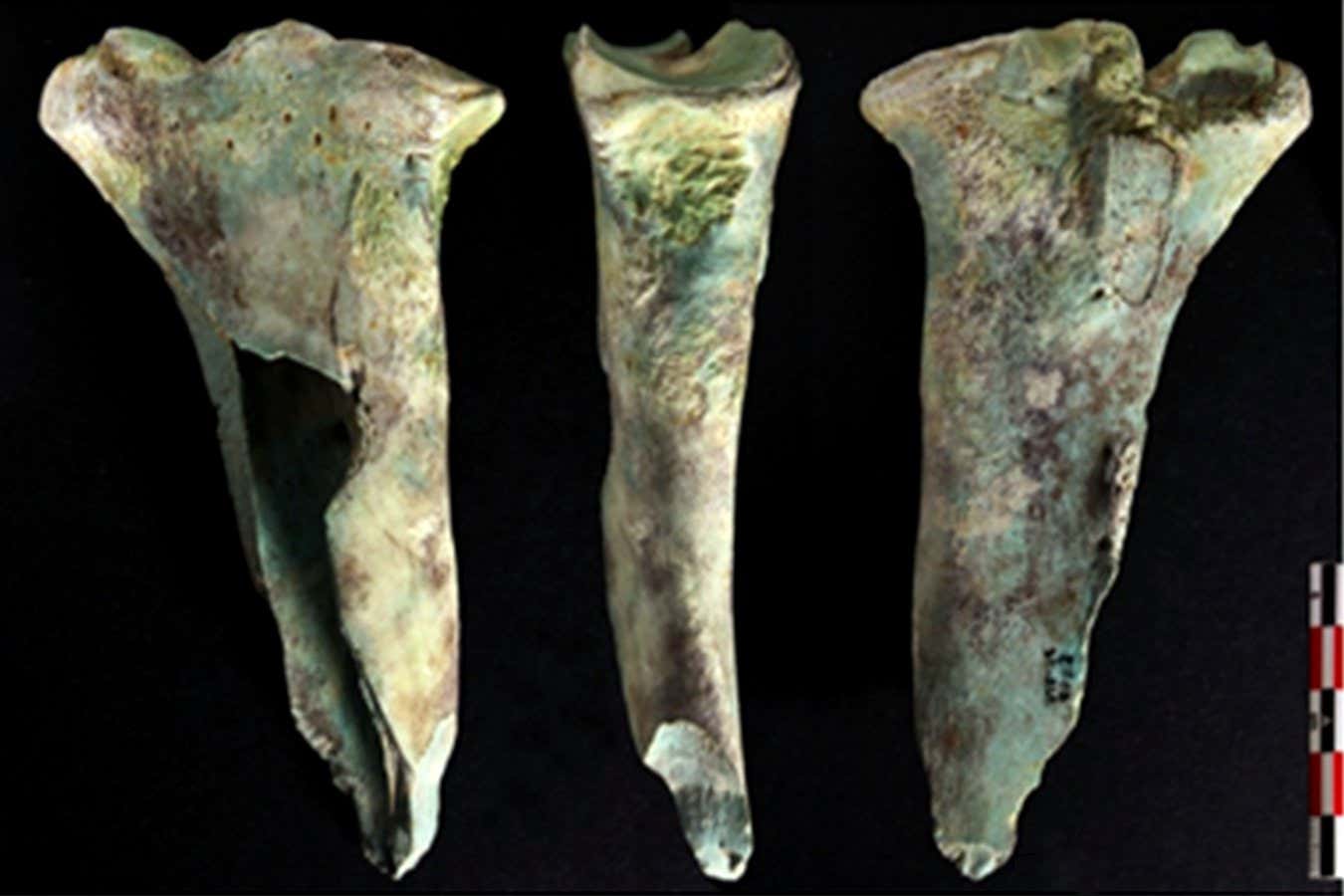
Wedges made of limb bones may have been used for splitting soft, copper-bearing rock
O. Zagorodnia
Even with the technology to make metal tools, people in Bronze Age Britain still used animal bone tools alongside metal ones to obtain copper, a practice spanning at least nine centuries between 3700 and 2800 years ago.
A study of 150 bones from the Bronze Age copper-mining complex at Great Orme in North Wales, UK, suggests the bones were deliberately chosen and shaped for specific mining tasks essential for copper extraction, especially in softer rock.
“It’s exciting because it challenges assumptions that Bronze Age mining was dominated by metal and stone tools; instead, we are seeing a more diverse and adaptable toolkit,” says Olga Zagorodnia at the British Museum, London, who conducted the work with Harriet White, an independent archaeologist.
Since the first archaeological excavations at the site in the early 1990s, over 30,000 bone fragments have been discovered. Previous studies focused on species identification, finding that over half belonged to cattle, with others mainly coming from sheep, goats and pigs. But it was suspected some bones were used as tools. A 2011 study identified wear related to use as a tool and technological features on a small number of them.
Now, Zagorodnia and White have taken a close-up look at the wear marks on 150 of the bones’ surfaces with high-resolution microscopy. They then performed experiments that mimicked mining activities with replica bone tools in order to compare the wear marks they produced with those on the ancient bones.
“One of the most striking aspects was how quickly use-wear developed, which helped validate what we were seeing under the microscope,” says White. “When we carried out experiments in splitting bone leading to circular fracture patterns, we could observe those same fractures in the archaeological examples, which really connected us to the past people at the site.”
The results suggested that the bones had been deliberately fashioned into several distinct tool types. These included wedges made of limb bone, possibly used for splitting soft, copper-bearing rock. Intentional tapering and polish on certain bone sections suggested that the implements were attached to handles and used in a similar way to metal picks, a finding that has never been reported before.

Scoops made from scapula or pelvis bones may have been used for raking or handling loose ore
O. Zagorodnia
Meanwhile, ribs were possibly used for scraping soft, sandy limestone. They might also have been used as stirrers or scrapers during processes that used water to separate and concentrate copper from the ore. The team also identified scapula or pelvis-based scoops, which may have been used to rake or shovel loose ore.
“What we may be seeing at Great Orme is not a new invention, but the continuation of a long-standing technological tradition [predating metal-working],” says Zagorodnia. Bone was a readily available material in pastoral societies and it was much less labour- and resource-intensive to make a tool from bone than from metal, according to the researchers.
The findings at Great Orme parallel other prehistoric mining sites in Europe where bone mining tools have also been found. “Communities in Bronze Age Britain and Europe were not simply replacing bone with metal materials; they were used alongside each other,” says White. “It suggests a deep practical understanding of material properties and a flexible approach to technology. It also points to organised mining practices, with specialised tools and likely skilled workers.”
“Both authors have brought a level of scientific discrimination not previously seen to this unique field of artefact study,” says Simon Timberlake, a freelance archaeologist based in Cambridge, UK. “The only way we can understand the people who helped change the technology of the Stone Age to the Metal Age is through the study of the tools they used.”
Immerse yourself in the early human periods of the Neolithic, Bronze Age and Iron Age on this gentle walking tour. Topics:
Human origins and gentle walking in prehistoric south-west England