

Feedback is New Scientist’s popular sideways look at the latest science and technology news. You can submit items you believe may amuse readers to Feedback by emailing feedback@newscientist.com
Moon wanderings
Readers may have heard that the Artemis II crew successfully travelled around the moon and back to Earth this month. A lot has been said about the mission, some of it delightful and some of it baffling.
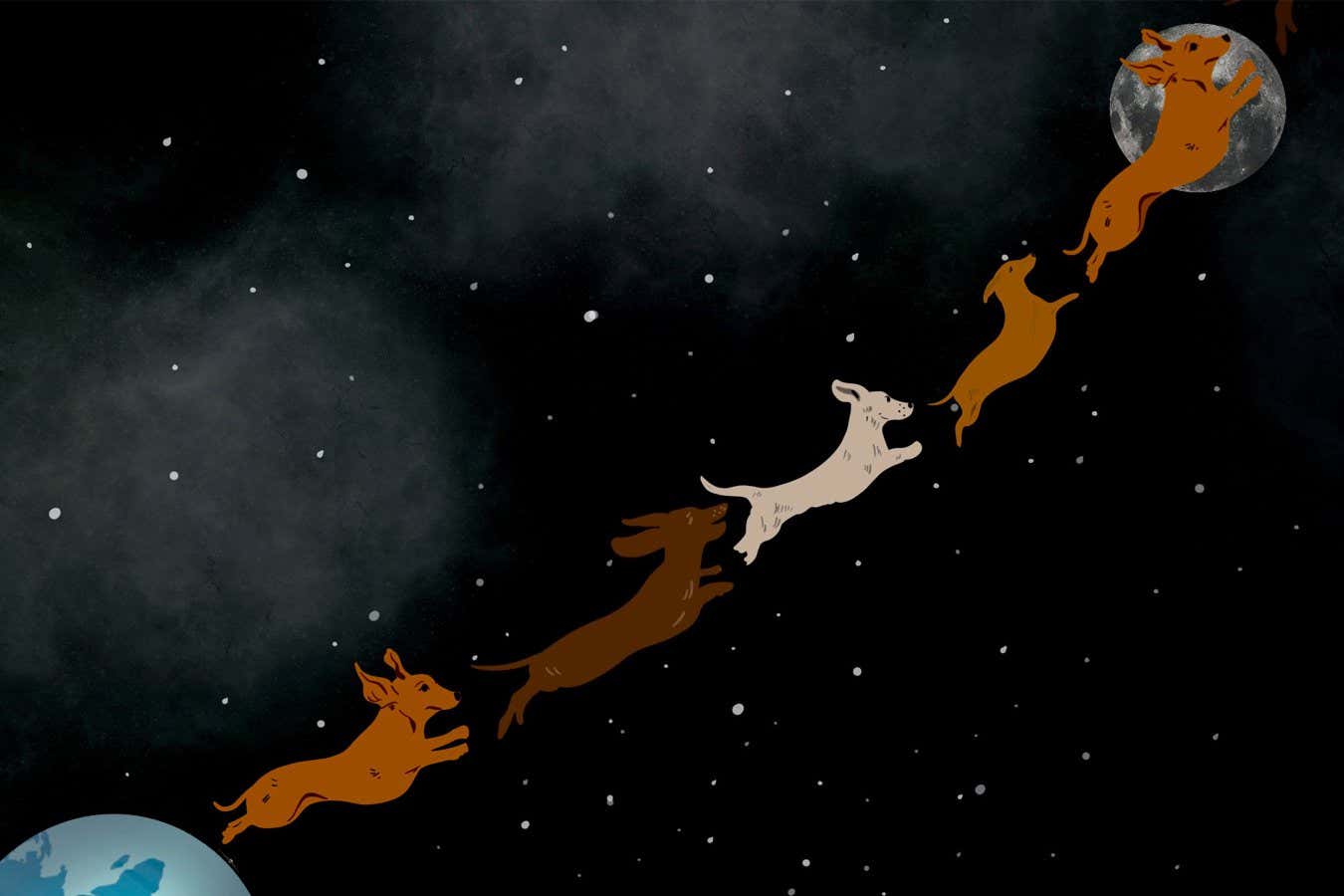
A key aspect of Artemis II is that, at the most distant point of their journey, the astronauts were 406,771 kilometres from Earth, further than anyone has ever gone before. Reader Helen von den Steinen wrote in to tell us about an “absurd unit of measurement” used by The New York Times to convey the scale of that gap. This unit was, of course, wiener dogs.
“If you took 22-inch dachshunds and laid them nose to tail, you’d need a very cooperative pack of almost 728 million dogs to cover the distance,” we were informed. In case anyone hoped to check that, they also offered the important caveat that there are “only around 900 million dogs, of any breed, in existence”.
Not content with that, the paper switched to dog walks. “If you took one of the dachshunds on a brisk 3-mile-per-hour walk, you’d need to walk for more than 84,000 hours to get there”, they write, which “translates to nearly 10 years of continuous walking”. Finally, they imagined constructing “a chain of 2.37 billion Nathan’s Famous hot dogs to cover the distance”. A competitive eater who can devour 76 hot dogs every 10 minutes would need to eat nonstop for almost 594 years to consume the entire chain, they write, eating over 700 billion calories in the process.
Helen admired “the way they effortlessly transition between live dogs and hot dogs as if they are some comparable measurement”. Feedback shares this admiration, and wonders how much dachshunds vary in length and if this was accounted for. Further to this, perhaps it might be helpful, when trying to convey immense distance, to start with something long like San Francisco’s Golden Gate Bridge and do multiples of that, but let’s not get too sensible about this.
We also note, without comment, the inevitable online remarks about the trip being faked, for example from writer James Delingpole, who wrote on X that the crew had been “sequestered in some ritzy hotel” for the duration of the mission.
Moving swiftly on, we should like to finish by turning to the work of reader Richard Simmons. He was following up on a bit in these pages about the moon possibly being made of cheddar, in the sense of money, because of the allegedly growing lunar economy (11 April). Richard wondered exactly what kind of cheese the moon might be made of. After dismissing green cheese and other options, he settled on Selles Sur Cher. This is a French variety, described as “a close-textured disc coated in a dusting of charcoal ash”. Based on the photos from Artemis II, Richard says, “it has the correct colour and surface texture”.
Shedloads of marathons
During a previous discussion about the exact size of a “shedload”, reader F. Ian Lamb introduced the concept of an “endogenous relative scaling unit”, or ERS unit (28 March). This refers to a unit that isn’t absolute, but rather varies in size depending on context or even individual perception. Feedback wondered at the time if shedload was the only example of an ERS unit or if there might be more out there.
Reader Andrew Winkley suggests “marathon”. Clearly, in the context of long-distance running races, it has an unambiguous meaning, set in the 1920s: 42.195 kilometres, or 26.22 miles. But, as Andrew points out, it is also used to measure time, and here things get fuzzy. Consider a “24-hour dance marathon”, “a marathon study session down the library” and “a marathon booze-up”. As Andrew says, “what constitutes a marathon in this context would depend on the activity”. And, Feedback might add, the person’s tolerance for the activity in question.
Declassified
At this point, the limitations of AI are well-established, so savvy users are carefully choosing applications where its problems can be controlled or don’t matter.
Just kidding, someone wants to use it to classify government documents. Reporter Matthew Sparkes ran across a paper on arXiv called “Retrieval augmented classification for confidential documents”. The authors note that classifying documents is a lot of work: “requiring users to manually label each document’s confidentiality level is labor-intensive, disrupts work continuity, and often results in inconsistent or subjective labeling”. Hence their proposal to use a large language model instead.
They tested their model on transcripts of US diplomatic cables published by WikiLeaks some years ago. Their best model was able to classify them as “unclassified”, “confidential” and “secret” with 96 per cent accuracy.
Matt identifies the immediate issue: if the tool is 96 per cent accurate, then, presumably, “4 per cent of top-secret info will be leaked”. Feedback stared at this for a while and had some further thoughts. First, the researchers don’t compare the AI to expert humans, so we don’t know if it does a better or worse job.
Second, we found ourselves wondering: in which direction does the AI err? When you are classifying government documents, it may be best to err on the side of caution, to avoid, say, revealing the launch codes for all your country’s nuclear missiles. We couldn’t find any information about such asymmetric errors in the study.
Still, what could go wrong?
Got a story for Feedback?
You can send stories to Feedback by email at feedback@newscientist.com. Please include your home address. This week’s and past Feedbacks can be seen on our website.