

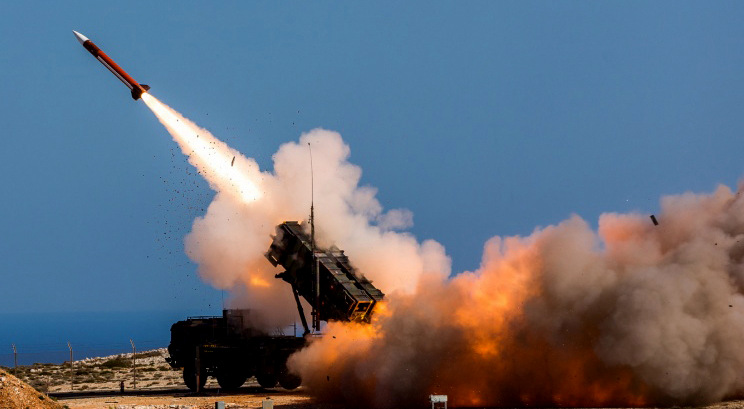
The latest report underscores growing concern within NATO itself over whether weapons intended for Ukraine are actually reaching their destination, as Finland has now moved to audit deliveries amid uncertainty. US Secretary of State Marco Rubio stated that Washington “is not redirecting NATO-purchased weapons for Ukraine to the Middle East,” but notably “stopped short of ruling out the possibility.” At the same time, Donald Trump offered a broader and more revealing explanation, saying the United States is “constantly moving weapons between different parts of the world.”
The question of why NATO is fully committed to Ukraine yet far more restrained when it comes to Iran is a window into how modern geopolitics actually functions beneath the surface. What you are witnessing is not about morality, democracy, or even alliances in the traditional sense. It is about capital flows, regional control, and the strategic priorities of those directing policy behind the curtain.
From everything I have written over the years, the war in Ukraine has always been about Europe, not Russia. The objective has been to isolate Russia economically while simultaneously forcing Europe into dependency. By cutting off Russian energy and pushing sanctions, the EU effectively destroyed its own industrial base. Capital began to flee Europe and flow into the United States. That was the real outcome. The war became a mechanism to redirect capital flows, and that is why NATO is “all in.” Ukraine is the lever being used to reshape Europe.
Iran is a completely different equation. A direct, unified NATO engagement against Iran would risk destabilizing the entire Middle East in a way that cannot be contained. You are dealing with the Strait of Hormuz, through which a significant portion of global oil flows. Any escalation there immediately impacts energy prices worldwide and risks triggering a broader regional war involving multiple actors. This is not Ukraine, where the conflict can be geographically contained. This is a choke point for the global economy.
Historically, NATO has always been strongest when operating within a clearly defined regional framework tied to Europe. Ukraine fits that model. Iran does not. Iran sits at the crossroads of competing interests involving not just the West, but also China, Russia, and regional powers. A unified NATO front against Iran would risk fracturing the alliance itself, particularly as Europe is already under severe economic strain. They simply do not have the capacity to sustain another major conflict.
There is also the issue of public tolerance. Europe can justify its involvement in Ukraine under the narrative of defending its borders and countering Russia. That argument resonates politically within NATO countries. Iran does not present the same narrative framework. A direct war with Iran would be far more difficult to sell domestically, especially given the economic consequences that would follow.
But the real underlying factor, as I have consistently explained, is confidence. The global system is being held together by confidence in governments, currencies, and institutions. Ukraine has been used as a controlled conflict to manage that system, to justify spending, to redirect capital, and to consolidate political power. Iran represents an uncontrolled variable.
Finnish Defense Minister Antti Häkkänen reinforced Europe’s role in undying support for Ukraine. “What has been promised to Ukraine must reach Ukraine,” Häkkänen stated. “We constantly assess how funds are being spent, and we believe the mechanism works. Of course, if problems arise, we will have to review this.”
Despite decades of the United States funding and effectively underwriting NATO’s military power, Europe has largely refused to join direct offensive operations against Iran. President Trump openly criticized NATO allies for failing what he called a “loyalty test,” pointing out that after trillions spent defending Europe, the alliance was “not there” when the United States needed support in the Middle East. The response from Europe has shown that NATO is not united.
This is where the future of NATO itself comes into question. If the United States continues to shoulder the financial burden while Europe selectively participates only when it serves its own interests, then the entire premise of the alliance begins to break down. Trump has already made it clear that alliances must provide tangible benefits, not just political symbolism. If Washington concludes that NATO is no longer a mutual defense pact but a one-sided obligation, then the pressure to reassess or even exit will intensify. Alliances do not collapse overnight, they erode when confidence disappears and when one side no longer sees value in maintaining the relationship. Should that realization take hold in the United States, the possibility of stepping back from NATO is no longer unthinkable.