

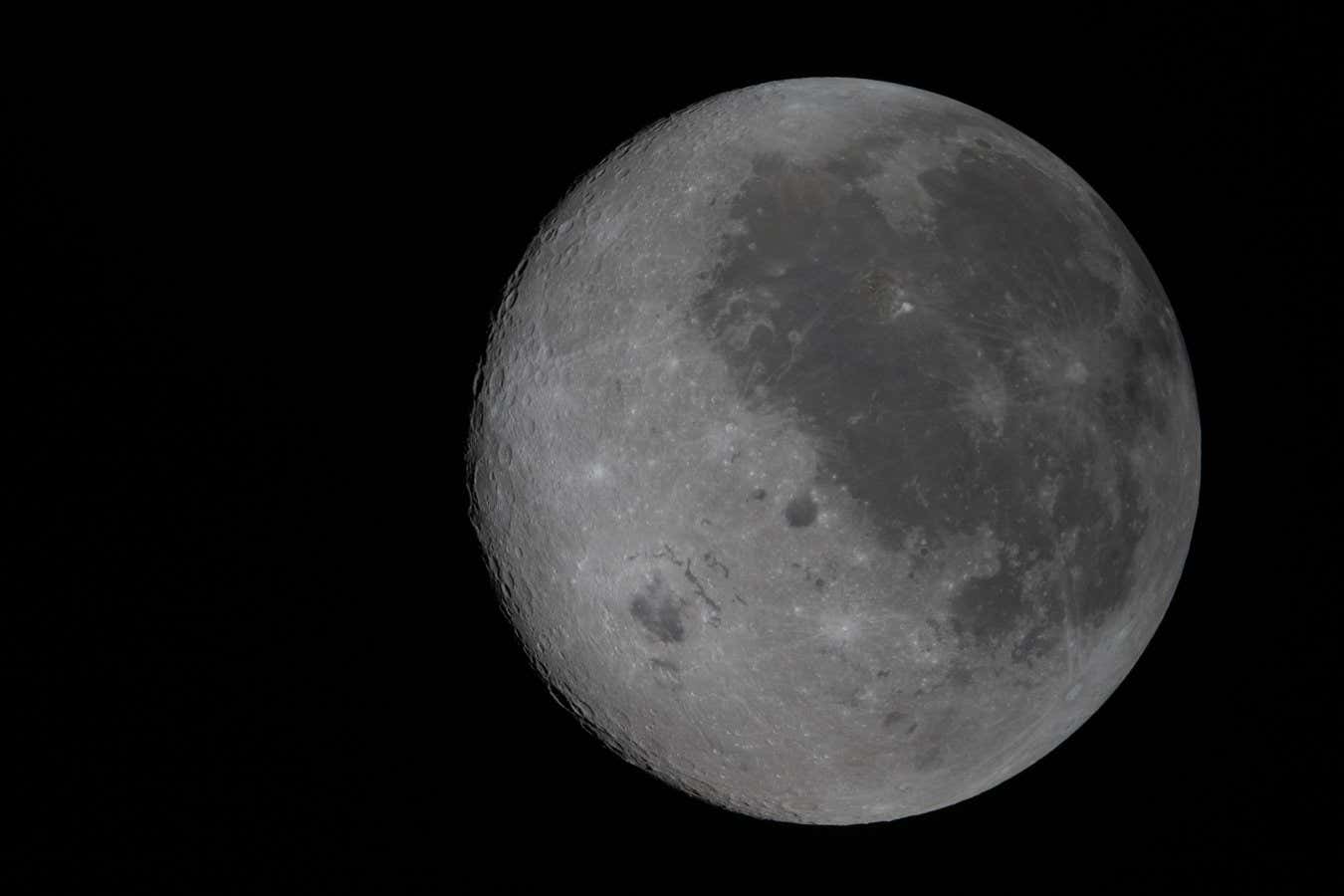
The near side of the moon is visible on the right, identifiable by the dark splotches that cover the surface. Left of this begins the far side that we can’t see from Earth
NASA
For the first time since Apollo 17 in 1972, humans have visited the moon. On 6 April, the four astronauts of NASA’s Artemis II mission flew around the far side of the moon, taking them the furthest humans have ever travelled from Earth.
As they surpassed the distance record of 400,171 kilometres set by the crew of the Apollo 13 mission in 1970, mission commander Reid Wiseman made it clear that this flight is just the beginning. “We most importantly choose this moment to challenge this generation and the next to make sure this record is not long-lived,” he said during the NASA livestream of the flight. The Artemis astronauts also made two proposals of names for newfound craters: Integrity, after the Orion capsule carrying them around the moon, and Carroll, after Wiseman’s late wife.
Over the course of the flyby, the astronauts swapped between staying at the windows to observe and photograph the moon and remaining in the cabin of Orion to stay in communication with mission control in Houston, Texas. The crew members are NASA astronauts Wiseman, Christina Koch and Victor Glover, and Canadian Space Agency astronaut Jeremy Hansen.
As the capsule circled behind the moon, the sun appeared smaller than the moon in the sky, enabling a solar eclipse unlike any that can be seen on Earth. As they would for a typical solar eclipse, the astronauts had to don darkened eclipse glasses to look at the sun, and they made observations of its outermost layer, the corona. Their unique vantage point, unencumbered by the distortion of the atmosphere, could allow them to catch details that would be tough to spot from the ground.

The Artemis astronauts were treated to an amazing eclipse
NASA
Of course, they caught many such details on the surface of the moon itself. Throughout the flight, they emphasised the surprising diversity of colours on the lunar surface: while much of it is grey, as it appears from Earth, there are areas that look green, brown and even orange up close due to chemical variations in the rocks and dust. “It’s amazing how quickly it changes as we speed around the far side of the moon,” said Hansen.
While circling the moon, the crew were able to look at areas that have never been directly seen by human eyes before. They spent much of their time observing the terminator, the line between day and night, where prominent shadows bring the terrain into stark relief. “There is just so much magic in the terminator – the islands of light, the valleys that look like black holes [where] you’d fall straight to the centre of the moon if you stepped in some of those, it’s just so visually captivating,” said Glover.
While looking at the topography up close, the astronauts also expressed that they were struck by imagining what it would be like to walk across the lunar surface. “The truth is, the moon really is its own body in the universe – it’s not just a poster in the sky that goes by, it is a real place,” said Koch.

NASA astronaut Reid Wiseman took this picture of Earth from the Orion spacecraft
NASA/Reid Wiseman
At its closest, the capsule was about 6545 kilometres from the lunar surface. This is the nearest that humans will get to the moon until the Artemis IV mission, planned for 2028, which will include a landing.
Now that Orion has circled the moon, its journey back to Earth begins. The astronauts will arrive home on 10 April, splashing down into the Pacific Ocean off the coast of California. Then, the work of analysing all of their notes, photographs and scientific observations will begin, in preparation for the rest of the Artemis programme to continue apace.
Topics: