
Close Menu
    Trending
    • Negotiations that enable Israel’s land-grabs | Israel-Palestine conflict
    • True-or-false for Round 1 of 2026 NFL Draft: Will Cowboys regret their trade?
    • Opinion | Stewart Brand, Silicon Valley’s Favorite Prophet, on Life’s Most Important Principle
    • Struggling to scale your company? Here are five things that could be holding you back
    • What happens if you’re hit by a primordial black hole?
    • When is London Marathon 2026? Start time and how to watch race for FREE
    • Pentagon Requests $54 Billion For AI War
    • Clavicular Hit With New YouTube Crackdown
    Benjamin Franklin Institute
    Friday, April 24
    • Home
    • Politics
    • Business
    • Science
    • Technology
    • Arts & Entertainment
    • International
    Benjamin Franklin Institute
    Home»Science»The mystery of how volcanic lightning happens has been solved
    Science

    The mystery of how volcanic lightning happens has been solved

    Team_Benjamin Franklin InstituteBy Team_Benjamin Franklin InstituteMarch 18, 2026No Comments3 Mins Read
    Share Facebook Twitter Pinterest Copy Link LinkedIn Tumblr Email VKontakte Telegram
    Share
    Facebook Twitter Pinterest Email Copy Link


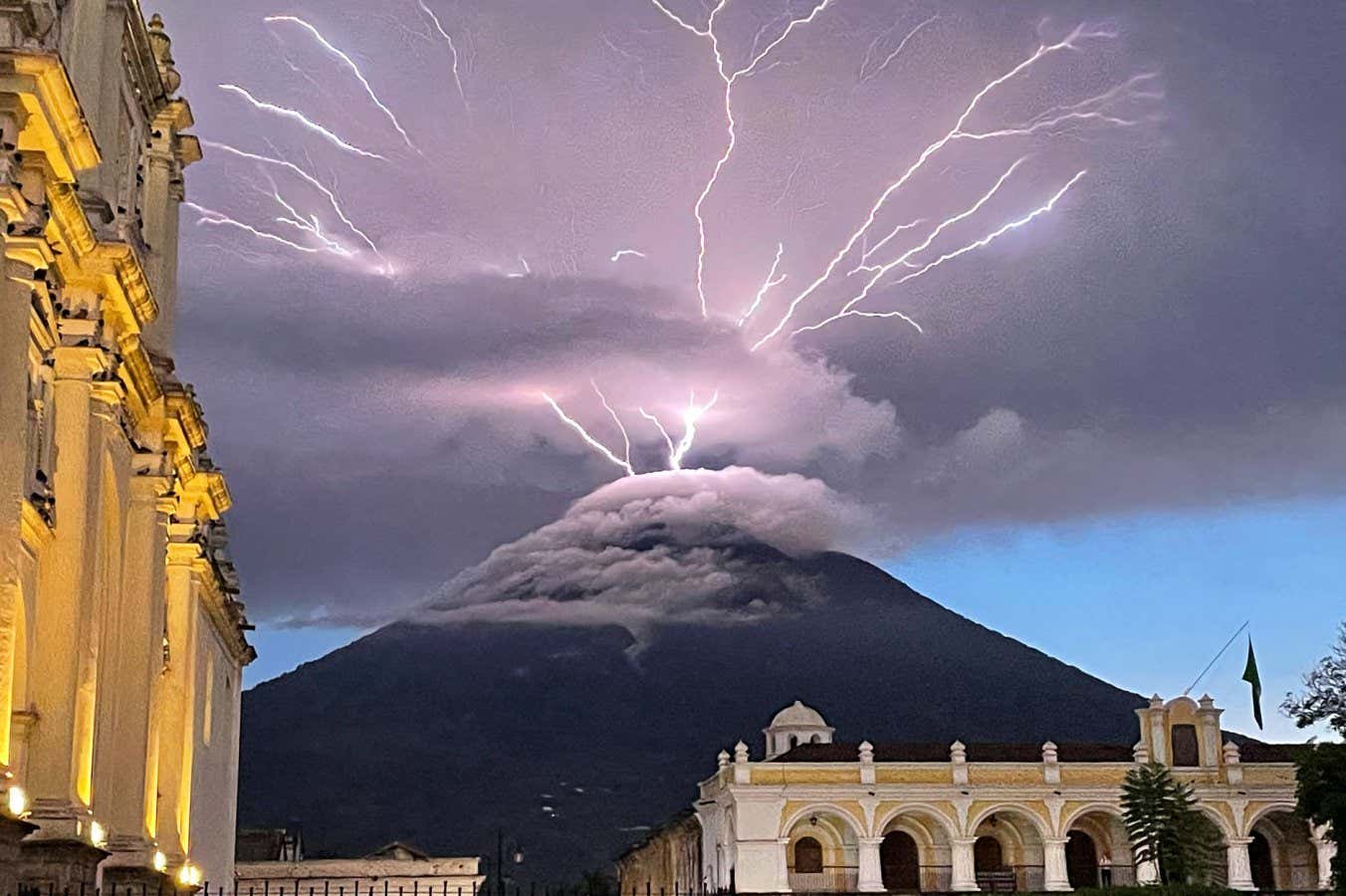
    Lightning strikes over Volcán de Agua in Guatemala

    Mario Dalma Leon/Getty Images

    Physicists have solved a longstanding mystery around the process that creates volcanic lightning: when similar particles rub together, why do some become positively charged while others become negatively charged?

    The exchange of electric charge when two objects touch, called the triboelectric effect, is what causes hair to be attracted towards a balloon after rubbing.

    In a cloud of volcanic ash, swirling particles of silicon dioxide exchange electric charge as they collide. The positively and negatively charged particles separate and lightning occurs when current flows between the two.

    But physicists couldn’t explain what breaks the symmetry between two particles of the same material and causes charge to flow one way or the other.

    “There are a lot of candidates,” says Galien Grosjean, now at the Autonomous University of Barcelona. “People suspect that humidity is important, or roughness, or the crystalline structure.”

    While working at the Institute of Science and Technology Austria in Klosterneuburg, Grosjean wondered if the answer lay in carbon-containing molecules on the surface of the particles. Such molecules are ubiquitous in nature, and materials scientists try to keep these contaminants to a minimum. But Grosjean and his colleagues kept track of what cleaning their samples did to the electrification.

    With ultrasound, they levitated a small particle of silicon dioxide, let it bounce once onto a target plate made of the same material and then measured its charge. “It might charge positive or negative. If positive, we would bake or clean it and redo the experiment – and then it would charge negative,” says Grosjean.

    Analysis of the samples showed that the removal of carbon-containing molecules was indeed the controlling factor.  “We saw that this effect overcomes everything else,” says Grosjean.

    Another giveaway was that a cleaned sample would become positively charged again after about a day, which is also how quickly it would acquire a fresh coat of carbon molecules from the air.

    Daniel Lacks at Case Western Reserve University in Cleveland, Ohio, is impressed by the study. “People know surfaces have a lot of crap on them. But I’ve never seen that come up in triboelectric charging,” he says.

    The discovery could be bad news for physicists, he fears. If carbon contamination determines the charging direction, precisely calculating how particles become charged will be very hard. “Prediction may just be something that will never happen,” says Lacks.

    New Scientist. Science news and long reads from expert journalists, covering developments in science, technology, health and the environment on the website and the magazine.

    Discovery Tours: Geology and volcanology

    From Icelandic volcanoes to Vietnamese caves, unearth the science behind some the most extreme locations on Earth.

    Topics:


    Source link

    Share. Facebook Twitter Pinterest LinkedIn Tumblr Email Telegram Copy Link

    Related Posts

    Science

    What happens if you’re hit by a primordial black hole?

    April 24, 2026
    Science

    How do earthquakes end? A seismic ‘stop sign’ could help predict earthquake risk

    April 24, 2026
    Science

    ‘Kraken’ fossils show enormous, intelligent octopuses were top predators in Cretaceous seas

    April 24, 2026
    Science

    Largest ever octopus was great white shark of invertebrate predators

    April 24, 2026
    Science

    Do you need to worry about Mythos, Anthropic’s computer-hacking AI?

    April 23, 2026
    Science

    How many dachshunds would it take to get to the moon?

    April 23, 2026
    Editors Picks

    South Korea’s former first lady sentenced to jail term in bribery case | Corruption News

    January 28, 2026

    Andrew Bailey warns ‘alarm bells’ ringing over private credit market

    October 21, 2025

    Preseason NASCAR power rankings: Where field stacks up ahead of Daytona

    February 10, 2026

    IEEE Spectrum’s Top Telecom Stories of 2025

    December 27, 2025

    Tokyo protests as China blocks ‘dual-use’ exports to 20 Japanese companies | International Trade News

    February 25, 2026
    About Us
    About Us

    Welcome to Benjamin Franklin Institute, your premier destination for insightful, engaging, and diverse Political News and Opinions.

    The Benjamin Franklin Institute supports free speech, the U.S. Constitution and political candidates and organizations that promote and protect both of these important features of the American Experiment.

    We are passionate about delivering high-quality, accurate, and engaging content that resonates with our readers. Sign up for our text alerts and email newsletter to stay informed.

    Latest Posts

    Negotiations that enable Israel’s land-grabs | Israel-Palestine conflict

    April 24, 2026

    True-or-false for Round 1 of 2026 NFL Draft: Will Cowboys regret their trade?

    April 24, 2026

    Opinion | Stewart Brand, Silicon Valley’s Favorite Prophet, on Life’s Most Important Principle

    April 24, 2026

    Subscribe for Updates

    Stay informed by signing up for our free news alerts.

    Paid for by the Benjamin Franklin Institute. Not authorized by any candidate or candidate’s committee.
    • Privacy Policy
    • About us
    • Contact us

    Type above and press Enter to search. Press Esc to cancel.