

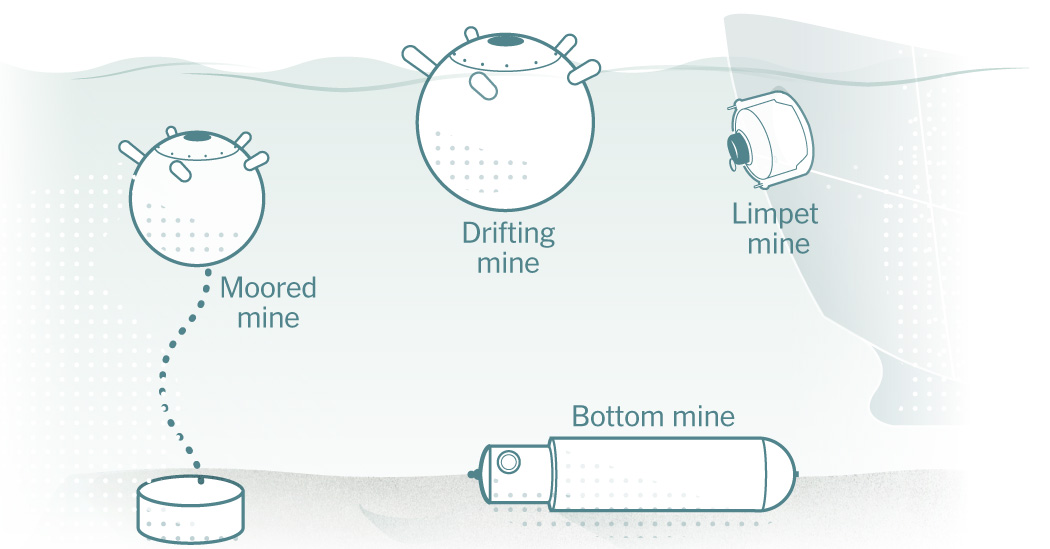
Some float on the surface. Some rest on the seafloor. All could further complicate efforts to restart shipping in the Persian Gulf.
Iran has strangled one of the world’s most critical shipping routes, the Strait of Hormuz, by threatening merchant ships and attacking tankers.
But Iran also has more than 5,000 naval mines in its arsenal, according to estimates by the Defense Intelligence Agency. And Iran is beginning to deploy them, U.S. officials said.
The geography of the strait and the surrounding waters works to Iran’s advantage. A long southern coastline affords ample opportunity for small boats to dart out with mines.
Tight shipping lanes leave little room to navigate. And the water at the strait’s narrowest point is only about 200 feet deep — shallow enough to lay minefields.
It could be hugely expensive, and dangerous, for the U.S. Navy to have to conduct what would most likely be a weekslong mine-clearing operation in the Strait of Hormuz, according to military officials.
Still, mining is a double-edged sword. Laying mines in the strait could prevent Iran’s own oil — and the desperately needed revenues it provides — from making it out of the Gulf.
How naval mines work
Since World War I, militaries have developed a range of naval mines to harass and sink enemy ships.
The most common are moored mines, warheads held just below the surface by a chain connected to a heavy anchor.
In the bottom half of the spherical warhead are explosives, with a pocket of air above to provide buoyancy. Thick horns pointing outward contain devices that cause the mine to explode upon contact with a ship’s hull.
If its anchor chain is severed, the mine is often called a “floater.” It moves with the current.
During the Cold War, “bottom mines” became more widespread. They contain a much larger quantity of explosives than moored mines, and they lie on the seafloor.
These mines use a combination of sensors — magnetic, acoustic, pressure and seismic — to determine when a ship is nearby. Then they detonate with hundreds of pounds of force, sending a large gas bubble upward against the targeted ship.
Trash, shipwrecks and other debris clutter the seafloor, often making the job of finding these mines difficult and time consuming.
Iran also has limpet mines — small explosive charges placed by swimmers or divers to disable a ship, often by targeting the propulsion and steering gear underwater. They typically explode after a preset amount of time, allowing the people who place them time to get away safely.
Most of these mines are designed to create what militaries call “mission-kills,” meaning a ship does not sink but is damaged enough that it cannot continue to perform its assigned tasks.
Modern tankers, which have an inner and outer hull to prevent spillage of oil into the ocean, are especially unlikely to be sunk by naval mines. Even if the outer hull is breached by an explosion, the inner hull may well remain intact. And like all modern warships and cargo vessels, tankers are designed with internal watertight compartments that can be sealed off to prevent flooding.
Clearing mines is dangerous and time consuming
While laying minefields can be done quickly, it’s a painstaking process to clear them — and an almost impossible task while under fire.
To find the mines, clearance teams can deploy a remote vehicle equipped with sonar to survey the water in a back-and-forth pattern. Once mines are found, they can be destroyed by sending explosive devices or divers to disarm them.
Minesweeping, which involves mimicking a ship’s signals to trigger the mines, can be faster than hunting. But the signals don’t always work, leaving a greater chance that unexploded mines will remain in the water.
Reopening the Strait of Hormuz would not require the removal of every last mine. Clearance teams might find paths through a minefield that are wide enough for ships to safely pass through, and mark those channels with buoys.
Once commerce has been restored, the clearance teams can expand their surveys to find and eradicate any remaining minefields.
Iran’s new mining effort in the Strait of Hormuz is not particularly fast or efficient, American officials said, but the Iranians appear to be hoping that they can lay them faster than the United States can clear them and create a further deterrent for ships to move through the strait.
In 1991, after Iraq laid over a thousand naval mines in the Gulf, it took more than a dozen allied ships almost two months to clear the coast of Kuwait, averaging just over one mine a day. The technology has greatly improved since then, allowing for faster underwater surveys with robotic vehicles.
Earlier this week, targeting Iran’s mine-laying capabilities, U.S. Central Command attacked 16 Iranian minelayers, it said. A video posted by Central Command shows U.S. munitions striking nine ships of different types, many of which were moored pierside.
While the U.S. military said it had destroyed larger Iranian naval vessels that could be used to quickly lay mines in the strait, Iran began using smaller boats for its mine-laying operation on Thursday, according to a U.S. official briefed on the intelligence.
Eliminating every mine in storage and every vessel capable of laying mines could mean U.S. forces would have to destroy Iran’s entire civilian maritime infrastructure.
The U.S. military may choose instead to keep armed surveillance drones orbiting overhead, able to immediately fire missiles or drop bombs on any vessels seen laying mines in the strait.