
Close Menu
    Trending
    • Katie Holmes And Joshua Jackson Spark ‘Soul-Level’ Love Chatter
    • Singapore Airlines, Southwest Airlines partner to expand access to nearly 120 US destinations
    • Trump warns Netanyahu: ‘You’ll be on your own’ if attacks on Iran continue | US-Israel war on Iran News
    • Cristiano Ronaldo, ‘The Bosnian Diamond’ headline the World Cup 40-and-over club
    • How housing market inventory is shifting across every state
    • What is a ‘normal’ memory slowdown, and when should I worry?
    • Ariana Grande And Ethan Slater Are ‘Still Friends’ Following Split
    • US says BYD, Baidu, Alibaba and other tech giants are aiding China’s military
    Benjamin Franklin Institute
    Tuesday, June 9
    • Home
    • Politics
    • Business
    • Science
    • Technology
    • Arts & Entertainment
    • International
    Benjamin Franklin Institute
    Home»Science»NASA changed an asteroid’s orbit around the sun for the first time
    Science

    NASA changed an asteroid’s orbit around the sun for the first time

    Team_Benjamin Franklin InstituteBy Team_Benjamin Franklin InstituteMarch 7, 2026No Comments3 Mins Read
    Share Facebook Twitter Pinterest Copy Link LinkedIn Tumblr Email VKontakte Telegram
    Share
    Facebook Twitter Pinterest Email Copy Link


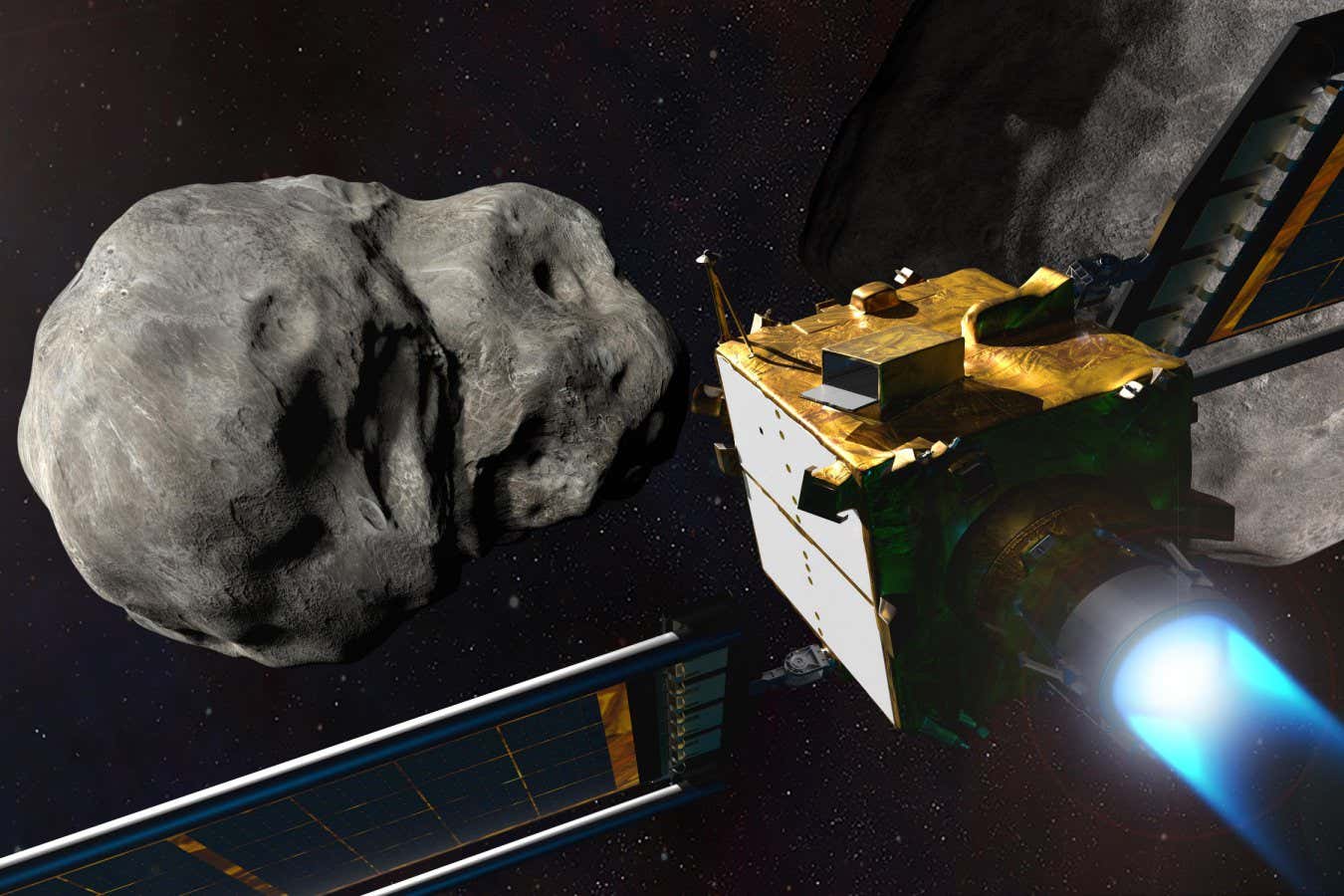
    NASA gave the Didymos system a nudge

    Steve Gribben/Johns Hopkins APL/NASA

    Humanity has shifted an asteroid’s orbit around the sun for the first time. This was achieved by NASA’s Double Asteroid Redirection Test (DART) mission in 2022, but the effect has only now been measured.

    DART’s target was a small asteroid called Dimorphos, which orbits a larger one called Didymos. The spacecraft crashed into the smaller rock in an effort to shift its orbit around the larger one, testing whether this method, called a kinetic impactor, would be an effective way to change an asteroid’s trajectory if it were heading towards Earth and send it careening past safely.

    The mission was a smashing success, shortening the length of Dimorphos’s orbit by 32 minutes. In the years since then, astronomers have continued to watch the system, and with nearly 6000 observations, they have been able to calculate the change in the pair’s overall orbit around the sun: it has slowed down by 11.7 micrometres per second, or around 40 millimetres per hour. That is expected to decrease the radius of its orbit by about 360 metres.

    “It doesn’t sound like a lot, but the whole idea behind these kinetic impacts is that if you do one early enough, a small impact makes a large change in the overall position,” says Rahil Makadia at the University of Illinois Urbana-Champaign, part of the team monitoring the asteroids’ orbits. “It’s a very tiny number, but if you let it accumulate over decades, then it can grow into a big one.”

    The slowdown had two causes: the initial impact by the spacecraft and an additional push from the jet of debris sent up from Dimorphos’s surface in the aftermath. Makadia and his colleagues calculated that the two effects were about equal to one another, which in turn allowed them to calculate the masses and densities of the asteroids. Dimorphos is about half as dense as Didymos, which adds credence to the idea that it is a so-called rubble pile that formed from material flung off of Didymos due to its rotation.

    All of this information will prove useful should we ever need to deflect a hazardous asteroid for real. “We now have one solid anchoring point to predict any future kinetic impact missions,” says Makadia. And the European Space Agency’s Hera spacecraft, which is on its way towards Didymos and is expected to arrive in November, should give us even more precise measurements that will guide any future attempts to protect Earth from incoming asteroids.

    Topics:


    Source link

    Share. Facebook Twitter Pinterest LinkedIn Tumblr Email Telegram Copy Link

    Related Posts

    Science

    What is a ‘normal’ memory slowdown, and when should I worry?

    June 9, 2026
    Science

    Wildlife thrives in solar farm built on restored peatland

    June 8, 2026
    Science

    You don’t need to worry about recursive-self-improving AI – yet

    June 8, 2026
    Science

    Understanding anorexia’s grip on the brain could unlock new therapies

    June 8, 2026
    Science

    Why GLP-1 drugs might reduce cancer risk

    June 8, 2026
    Science

    Landmark pancreatic cancer treatment paves way for targeting other tricky tumors

    June 8, 2026
    Editors Picks

    ‘Refuse to celebrate’: Christians in Gaza mark sombre Easter amid genocide | Israel-Palestine conflict

    April 5, 2026

    Will Mortgage Rates Crash And Spur A Real Estate Boom?

    March 2, 2026

    The Real Reason AI Transformation Fails in Most Companies

    May 22, 2026

    Why human capital is the ultimate moat in AI-first finance

    April 9, 2026

    Fuel supply fears after blaze tears through crucial Australian refinery

    April 16, 2026
    About Us
    About Us

    Welcome to Benjamin Franklin Institute, your premier destination for insightful, engaging, and diverse Political News and Opinions.

    The Benjamin Franklin Institute supports free speech, the U.S. Constitution and political candidates and organizations that promote and protect both of these important features of the American Experiment.

    We are passionate about delivering high-quality, accurate, and engaging content that resonates with our readers. Sign up for our text alerts and email newsletter to stay informed.

    Latest Posts

    Katie Holmes And Joshua Jackson Spark ‘Soul-Level’ Love Chatter

    June 9, 2026

    Singapore Airlines, Southwest Airlines partner to expand access to nearly 120 US destinations

    June 9, 2026

    Trump warns Netanyahu: ‘You’ll be on your own’ if attacks on Iran continue | US-Israel war on Iran News

    June 9, 2026

    Subscribe for Updates

    Stay informed by signing up for our free news alerts.

    Paid for by the Benjamin Franklin Institute. Not authorized by any candidate or candidate’s committee.
    • Privacy Policy
    • About us
    • Contact us

    Type above and press Enter to search. Press Esc to cancel.