

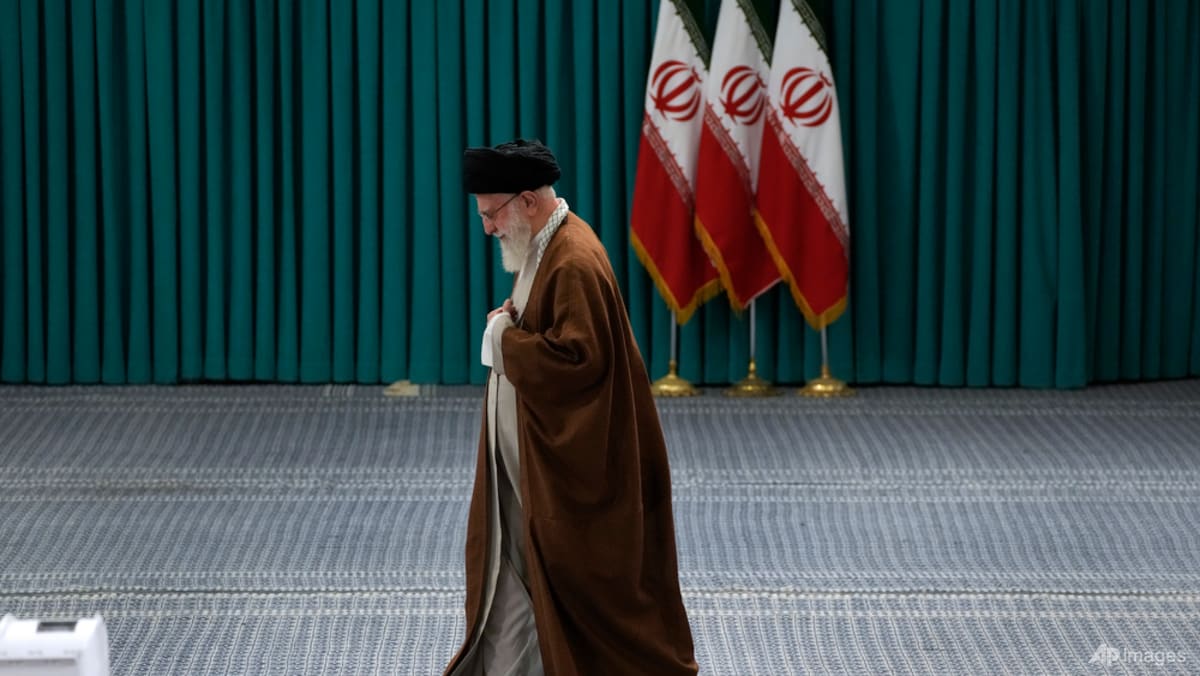
WILL IRAN’S THEOCRACY PERSIST?
Iran’s clerical elite control powerful bodies that extend their influence throughout the political system.
The Assembly of Experts, made up of senior ayatollahs elected every eight years, is the body that appoints the supreme leader. The constitution also gives it power to question and even dismiss a leader, but it has never done so.
In practice, the choice would likely be made by the most senior figures in the Islamic Republic and then approved by the assembly. But with some top Revolutionary Guards leaders confirmed as dead, it is far from clear who would sway the decision.
The Guardian Council – half appointed by the leader and half by the judiciary chief – can veto laws passed by parliament and disqualify election candidates, a mandate that has been used to block potential critics of Khamenei.
Iran follows Shi’ite interpretations of Islamic sharia law and its judges are also clerics under a judiciary chief named by Khamenei. The current head, Gholamhossein Mohseni Ejei, was sanctioned by Western countries for a violent crackdown on protesters in 2009 when he was intelligence minister.
Other influential clerics include former judiciary chief Sadiq Larijani, the brother of Khamenei adviser Ali Larijani; Assembly of Experts member Mohsen Araki; and Tehran Friday prayer leader Ahmad Khatami.
WHAT ROLE COULD THE REVOLUTIONARY GUARDS PLAY?
Unlike the ordinary military, which comes under the defence ministry in the elected government, the Islamic Revolutionary Guards Corps (IRGC) answers directly to the supreme leader.
Its commander Mohammed Pakpour was killed on Saturday.
Formed soon after the revolution, the IRGC’s role defending the Islamic system greatly expanded during the 1980-88 war with Iraq and it is now the strongest and best-equipped section of Iran’s armed forces.
Over the decades, the IRGC have extended their influence through the worlds of politics and business, gaining in power at home and abroad.
The Quds Force, an elite Guards unit, has spearheaded Iran’s regional strategy of supporting affiliated Shi’ite groups across the Middle East, most notably in Lebanon and Iraq. That strategy was hard-hit by the US assassination of Quds Force commander Qassem Soleimani in a 2020 air strike in Iraq, and by Israel’s pummelling of Lebanon’s Hezbollah in a 2024 war.
The Basij militia, a part-time paramilitary force under IRGC control, is often used to quell protests inside Iran.
Since the early 2000s, the IRGC’ economic power has grown as its contracting company Khatam al-Anbiya won projects worth billions of dollars in Iran’s oil and gas sector.
The targeted nature of Israeli strikes on senior IRGC commanders has raised questions over possible Western intelligence penetration in the corps’ upper echelons.
Still, the corps will likely play a major role in what happens to the Islamic Republic next.
WHY DOES IRAN ALSO HAVE ELECTIONS?
Iranians elect a president and a parliament to four-year terms. The president appoints a government that handles daily policy within parameters permitted by the supreme leader.
During the early years of the Islamic Republic the votes drew mass participation. But Guardian Council restrictions on candidates, a much-disputed election outcome in 2009 and the supremacy of unelected parts of the state undermined faith in electoral politics.
President Masoud Pezeshkian, seen as a moderate, was elected in 2024, defeating a noted hardliner. Israel said he too had been targeted in Saturday’s strikes and there was no confirmation later in the day of his status.