

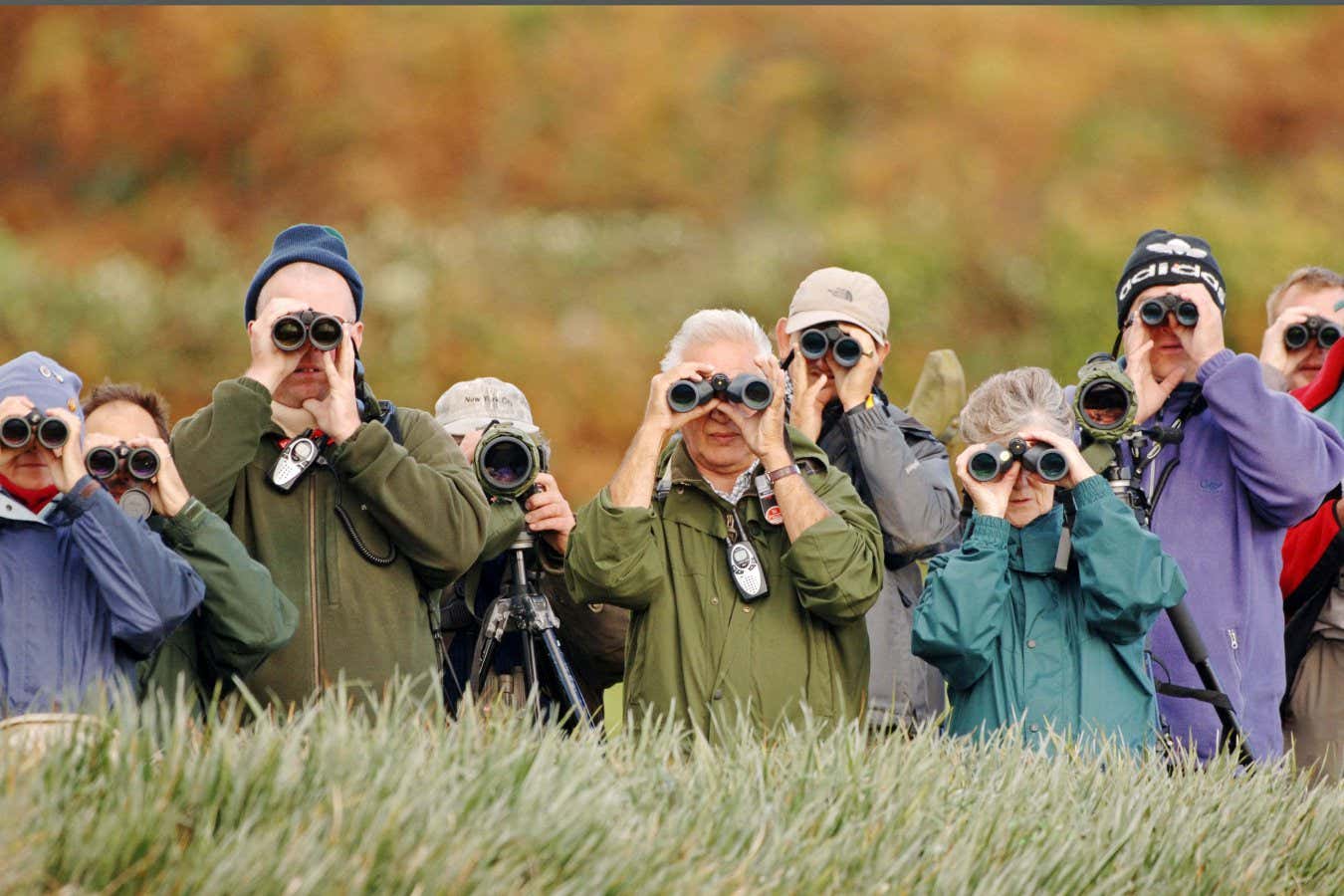
Learning to recognise birds may strengthen your cognitive reserve
steve young/Alamy
Expert birdwatchers have brain differences that may underlie their remarkable ability to identify unfamiliar birds and suggest that birdwatching can reshape the brain in much the same way as learning a language or a musical instrument does. Such activities may bolster cognitive reserve, the brain’s ability to defend itself against ageing and adapt to damage.
When learning or practising a skill, the brain reorganises itself, strengthening and streamlining relevant pathways. This ability, known as neuroplasticity, underpins the development of expertise. It is why professional musicians show structural changes in brain regions involved in hearing, and athletes exhibit similar adaptations in motor areas.
To understand whether birding also shapes the brain, Erik Wing at York University in Canada and his colleagues analysed brain structure and function in 48 hobbyist birders, half experts and half novices, as judged on a screening test. Participants were aged 22 to 79, and both groups were similar in terms of sex, age and education.
While undergoing brain scans, the participants were shown an image of a bird for less than 4 seconds. About 10 seconds later, they tried identifying the same bird in one of four images, each depicting a different species. “All the birds are really similar,” says Wing. “We intentionally picked highly confusable bird species.”
The task was repeated 72 times. In total, the researchers used images of 18 bird species – six of which were local and 12 of which weren’t – as targets.
As expected, expert birders could identify birds better than novices. On average, they accurately identified 83 per cent of local bird species and 61 per cent of the non-local ones. In contrast, novices correctly identified 44 per cent of both groups of birds.
While identifying non-local birds, activity in three brain regions – the bilateral prefrontal cortex, bilateral intraparietal sulcus and right occipitotemporal cortex – increased in expert birders, but not in novices. These regions are involved in object identification, visual processing, attention and working memory. “It speaks to the wide range of cognitive processes that are involved in birding,” says Wing.
These regions, along with others involved in these functions, also appeared more structurally complex and organised in expert birders than in novices, suggesting that building expertise in birding reshapes the brain.
As we get older, structural complexity and organisation tend to diminish in the brain – a trend observed in both novices and expert birdwatchers. But the decline was less pronounced in expert birders, suggesting birding may help build cognitive reserve, the brain’s ability to defend itself against ageing and adapt to damage.
“It suggests that maintaining brain activity with some specialised abilities is also linked to reduced effects of ageing,” says Robert Zatorre at McGill University in Canada. “That is an idea that has been out there for quite a long time, but it’s sort of disputed,” he says. “This paper adds another bit of evidence in favour of the concept.”
Engaging extensively in other hobbies that rely on similar skills, such as attention, memory and sensory integration, could result in similar brain changes, says Wing. “Birding engages a lot of these different cognitive domains, which potentially make it beneficial to a lot of different types of cognition,” he says. “But there is nothing inherent to the bird aspect. If you had another domain that recruited all of the same types of processes, we would expect to see sort of comparable changes there.”
However, this study is only a snapshot in time. It could be that people who become interested in birding already have structural changes in their brain, or that other lifestyle factors that cause brain changes happen to be more common among birders. To really know whether the brain changes are due to birding, researchers would have to scan the brain multiple times over months to years, says Wing.
Topics: