
Close Menu
    Trending
    • Beijing’s new supply chain rules deepen concerns for US firms in China
    • India denounces ‘hellhole’ remark shared by Trump | Donald Trump News
    • New photos of Mike Vrabel and Dianna Russini emerge
    • AI search demands a new audience playbook
    • How do earthquakes end? A seismic ‘stop sign’ could help predict earthquake risk
    • Trump Announces Cease-Fire Between Israel and Lebanon
    • Google Is Tracking Your Life – Photo Cloud Feeding AI System
    • Rachel Zoe Confronts Amanda Frances In ‘RHOBH’ Reunion Clip
    Benjamin Franklin Institute
    Friday, April 24
    • Home
    • Politics
    • Business
    • Science
    • Technology
    • Arts & Entertainment
    • International
    Benjamin Franklin Institute
    Home»Science»NASA’s Artemis II mission to the moon is inching toward the launch pad
    Science

    NASA’s Artemis II mission to the moon is inching toward the launch pad

    Team_Benjamin Franklin InstituteBy Team_Benjamin Franklin InstituteJanuary 18, 2026No Comments4 Mins Read
    Share Facebook Twitter Pinterest Copy Link LinkedIn Tumblr Email VKontakte Telegram
    Share
    Facebook Twitter Pinterest Email Copy Link


    January 17, 2026

    2 min read

    Add Us On GoogleAdd SciAm

    NASA’s Artemis II mission to the moon is inching toward launch

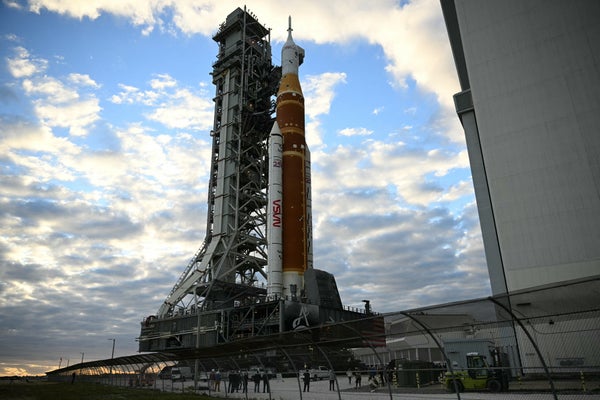
    NASA rolled out the fully stacked Artemis II rocket and Orion capsule on Saturday, embarking on a four-mile journey to the launch pad
    By Claire Cameron edited by Clara Moskowitz

    Fully stacked Artemis rocket rolling out to the launch pad

    Photo by Jim WATSON / AFP via Getty Images

    NASA’s Artemis II began its final journey on Earth Saturday. The fully stacked Space Launch System (SLS) rocket and Orion capsule rolled out of the Vehicle Assembly Building at NASA’s Kennedy Space Center in Cape Canaveral, Fla., a milestone for the first crewed mission to the moon in more than 50 years.

    “This is the start of a very long journey,” NASA administrator Jared Isaacman said at a press conference on Sunday.

    From the gigantic shed it has called home, Artemis II will take a leisurely pace of one mile an hour to make the four-mile trip to Launch Pad 39B, a journey that will take approximately eight to 10 days.


    On supporting science journalism

    If you’re enjoying this article, consider supporting our award-winning journalism by subscribing. By purchasing a subscription you are helping to ensure the future of impactful stories about the discoveries and ideas shaping our world today.


    Once the rocket makes it to the pad, the real fun begins. On Friday, NASA officials laid out the series of tests and checks Artemis II will need to complete before it is cleared for takeoff, including the critical “wet dress rehearsal.” That involves pumping the rocket full of cryogenic propellant and practicing the countdown sequence as if it were about to launch—testing the rocket’s limits without humans onboard.

    If all goes to plan, NASA is targeting a launch no earlier than February 6.

    Artemis II is a test of the space agency’s readiness to send humans back to the lunar surface—but the mission won’t actually be landing on the moon. Instead four astronauts—NASA’s Reid Wiseman, Victor Glover, and Christina Koch and Canadian Space Agency astronaut Jeremy Hansen—will take a loop around the moon, going farther into space than any human has gone before.

    On the 10-day journey, the astronauts will conduct a series of experiments and tests that will inform NASA’s next planned moon mission, Artemis III. Eventually, the space agency wants to set up a permanently staffed base on the lunar surface, a goal Isaacman emphasized at the press conference on Saturday.

    But before any of that can happen, Artemis II must first complete its mission. “We really are ready to go,” Wiseman said at the same press conference.

    It’s Time to Stand Up for Science

    If you enjoyed this article, I’d like to ask for your support. Scientific American has served as an advocate for science and industry for 180 years, and right now may be the most critical moment in that two-century history.

    I’ve been a Scientific American subscriber since I was 12 years old, and it helped shape the way I look at the world. SciAm always educates and delights me, and inspires a sense of awe for our vast, beautiful universe. I hope it does that for you, too.

    If you subscribe to Scientific American, you help ensure that our coverage is centered on meaningful research and discovery; that we have the resources to report on the decisions that threaten labs across the U.S.; and that we support both budding and working scientists at a time when the value of science itself too often goes unrecognized.

    In return, you get essential news, captivating podcasts, brilliant infographics, can’t-miss newsletters, must-watch videos, challenging games, and the science world’s best writing and reporting. You can even gift someone a subscription.

    There has never been a more important time for us to stand up and show why science matters. I hope you’ll support us in that mission.


    Source link

    Share. Facebook Twitter Pinterest LinkedIn Tumblr Email Telegram Copy Link

    Related Posts

    Science

    How do earthquakes end? A seismic ‘stop sign’ could help predict earthquake risk

    April 24, 2026
    Science

    ‘Kraken’ fossils show enormous, intelligent octopuses were top predators in Cretaceous seas

    April 24, 2026
    Science

    Largest ever octopus was great white shark of invertebrate predators

    April 24, 2026
    Science

    Do you need to worry about Mythos, Anthropic’s computer-hacking AI?

    April 23, 2026
    Science

    How many dachshunds would it take to get to the moon?

    April 23, 2026
    Science

    The Age Code review: Can you slow ageing with your diet? A new book gives it a go

    April 23, 2026
    Editors Picks

    The neuroscientist who wants us to be nicer to psychopaths

    March 20, 2026

    Lily Collins’ Beau Charlie McDowell Responds to Surrogacy Critics

    February 2, 2025

    PayPal replaces CEO Alex Chriss with HP’s Enrique Lores

    February 3, 2026

    New antibiotic could stave off drug-resistant gonorrhoea

    December 12, 2025

    Commentary: As US wades into Iran, its pivot to Asia lies in tatters

    March 5, 2026
    About Us
    About Us

    Welcome to Benjamin Franklin Institute, your premier destination for insightful, engaging, and diverse Political News and Opinions.

    The Benjamin Franklin Institute supports free speech, the U.S. Constitution and political candidates and organizations that promote and protect both of these important features of the American Experiment.

    We are passionate about delivering high-quality, accurate, and engaging content that resonates with our readers. Sign up for our text alerts and email newsletter to stay informed.

    Latest Posts

    Beijing’s new supply chain rules deepen concerns for US firms in China

    April 24, 2026

    India denounces ‘hellhole’ remark shared by Trump | Donald Trump News

    April 24, 2026

    New photos of Mike Vrabel and Dianna Russini emerge

    April 24, 2026

    Subscribe for Updates

    Stay informed by signing up for our free news alerts.

    Paid for by the Benjamin Franklin Institute. Not authorized by any candidate or candidate’s committee.
    • Privacy Policy
    • About us
    • Contact us

    Type above and press Enter to search. Press Esc to cancel.