
Close Menu
    Trending
    • $25bn or $1 trillion: How much has Iran war really cost the US? | US-Israel war on Iran News
    • More information emerges on concerning Bo Nix update
    • Opinion | Why Are We Still Driving?
    • The fake magazine in ‘The Devil Wears Prada 2’ is having a better year than most real magazines
    • Is an AI version of Mark Zuckerberg – or any boss – a good plan?
    • Portugal’s Defense Sector Rising | Armstrong Economics
    • Timothée Chalamet’s Love Life Sparks Shock Fan Exit
    • UK boosts security for Jews after London stabbings
    Benjamin Franklin Institute
    Thursday, April 30
    • Home
    • Politics
    • Business
    • Science
    • Technology
    • Arts & Entertainment
    • International
    Benjamin Franklin Institute
    Home»Science»The world’s first fully 3D-printed microscope blew up in 2025
    Science

    The world’s first fully 3D-printed microscope blew up in 2025

    Team_Benjamin Franklin InstituteBy Team_Benjamin Franklin InstituteDecember 25, 2025No Comments3 Mins Read
    Share Facebook Twitter Pinterest Copy Link LinkedIn Tumblr Email VKontakte Telegram
    Share
    Facebook Twitter Pinterest Email Copy Link


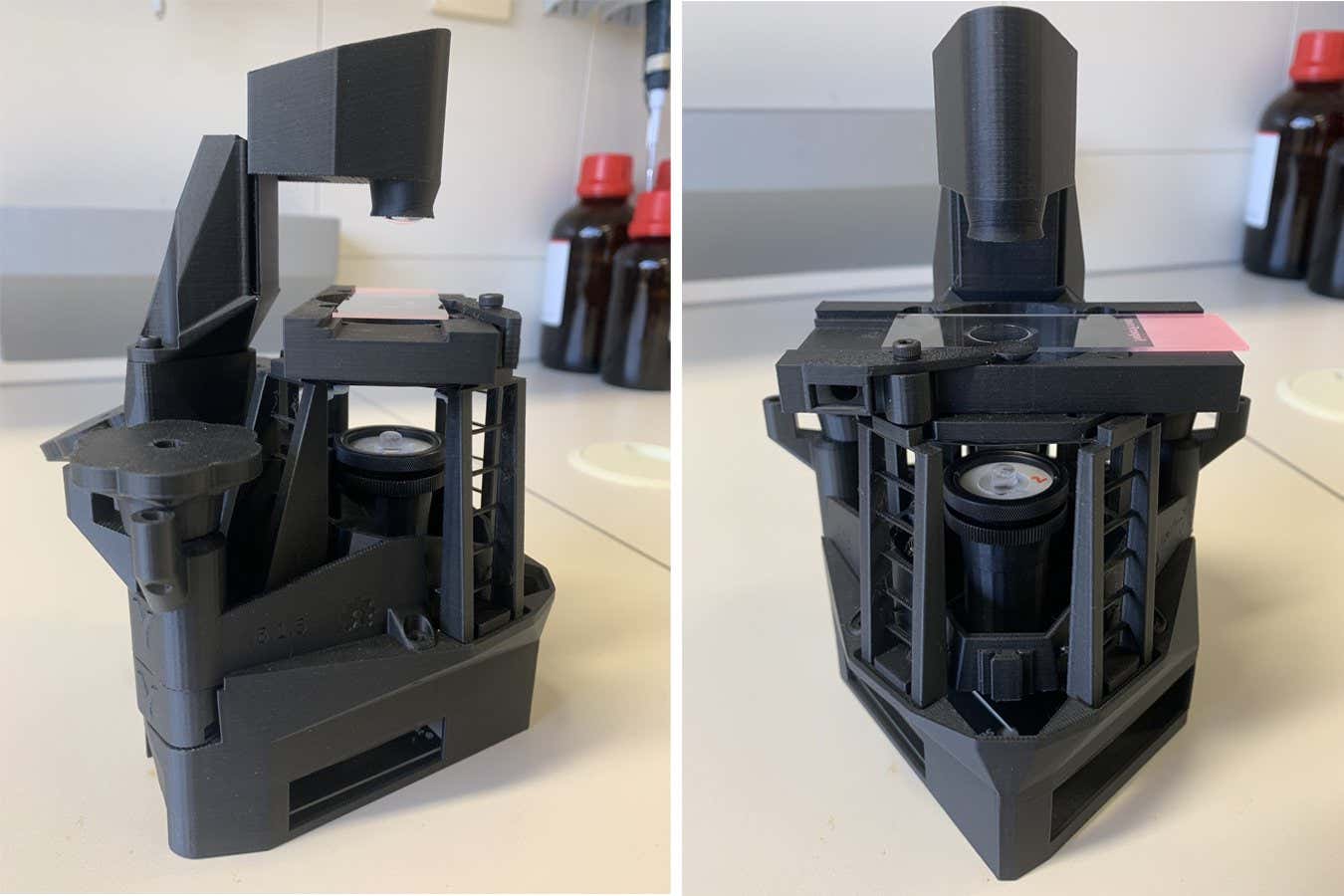
    The 3D-printed microscope

    Dr Liam M. Rooney/University of Strathclyde

    At the beginning of 2025, a preprint of a paper about a new microscope caused an awful lot of excitement among researchers. It was the world’s first fully 3D-printed microscope, made in only a few hours and for a fraction of the typical cost.

    Liam Rooney at the University of Glasgow in the UK, who worked on the project, says that after New Scientist reported on the microscope, people reached out from all over the world, from biomedical researchers to community groups and even film-makers. “Community reception was incredible,” he says. The work has now also been published in the Journal of Microscopy.

    For the body of the microscope, his team used a design from OpenFlexure, which is a resource for 3D-printing scientific instruments that anyone can access. They also used a store-bought camera and a light source, while the control for all the microscope’s parts came from a Raspberry Pi computer.

    The real breakthrough, however, was that the team 3D-printed the microscope’s lens out of clear plastic – this is what made their microscope both more affordable and more accessible than more conventional devices. While such microscopes can cost thousands, creating the new one cost less than £50.

    “We must have printed about a thousand more lenses of different shapes since January,” says team member Gail McConnell at the University of Strathclyde in the UK.

    She says several companies that make commercial products that require lenses reached out about the team’s work, as cheap and lightweight 3D-printed lenses are not at all common in large-scale manufacturing. She and her colleagues tested the microscope by examining a blood sample and a thin section of a mouse kidney, which established that it could be useful in medicine and biology studies.

    But the team says their goal with the work was to democratise access to microscopes, and those dreams are coming true. They are now collaborating with a laboratory at the Kwame Nkrumah University of Science and Technology in Ghana to make microscopy more available to researchers and students in West Africa, and they have received grants from the UK Institute for Technical Skills and Strategy, says Rooney. They are also participating in programmes that upskill and empower students who face barriers to accessing education.

    Additionally, the researchers have incorporated the new microscope into the Strathclyde Optical Microscopy Course, which is designed for researchers at all levels of experience and, according to Rooney, a unique educational opportunity within the UK. “This is really changing how we teach,” he says.

    And there is scope for the 3D-printed microscope to become even better. The researchers have been working on improving its resolution without making it more costly, and they have already worked out how to increase its contrast by up to 67 per cent.

    McConnell says that because the microscope was designed to be created with consumer electronics and accessible 3D printers, the limitations on how much it could do in the future, and how well, really lie with the limitations of current 3D-printing technology.

    “As these printers get better, we will get better too: this is the bottleneck. The bottleneck is not imagination,” she says. “We are getting emails constantly from people asking us to print something new.”

    Topics:

    • 3D printing/
    • 2025 news review


    Source link

    Share. Facebook Twitter Pinterest LinkedIn Tumblr Email Telegram Copy Link

    Related Posts

    Science

    Is an AI version of Mark Zuckerberg – or any boss – a good plan?

    April 30, 2026
    Science

    What happened after the fall of Rome? Ancient genomes offer new clues

    April 30, 2026
    Science

    A giant hailstorm just killed an emu at a Missouri zoo

    April 30, 2026
    Science

    Measles outbreaks can end, but the danger of the disease doesn’t

    April 30, 2026
    Science

    Simple treatment tweak drastically reduces blood loss from severe cuts

    April 29, 2026
    Science

    The chips in your phone are probably broken – and that’s a good thing

    April 29, 2026
    Editors Picks

    Tesla loses title as world’s biggest electric carmaker

    January 4, 2026

    Trump posts image of himself with Jesus as administration’s pope criticism continues

    April 16, 2026

    McDonald’s, ‘Burgergate,’ pile-ons, and what it all means for brands moving forward

    March 7, 2026

    Michael B. Jordan ‘Repulsed’ By BAFTAs Racial Slur As It Left His Parents In Tears

    February 24, 2026

    Schitt’s Creek star Catherine O’Hara dead at 71

    January 30, 2026
    About Us
    About Us

    Welcome to Benjamin Franklin Institute, your premier destination for insightful, engaging, and diverse Political News and Opinions.

    The Benjamin Franklin Institute supports free speech, the U.S. Constitution and political candidates and organizations that promote and protect both of these important features of the American Experiment.

    We are passionate about delivering high-quality, accurate, and engaging content that resonates with our readers. Sign up for our text alerts and email newsletter to stay informed.

    Latest Posts

    $25bn or $1 trillion: How much has Iran war really cost the US? | US-Israel war on Iran News

    April 30, 2026

    More information emerges on concerning Bo Nix update

    April 30, 2026

    Opinion | Why Are We Still Driving?

    April 30, 2026

    Subscribe for Updates

    Stay informed by signing up for our free news alerts.

    Paid for by the Benjamin Franklin Institute. Not authorized by any candidate or candidate’s committee.
    • Privacy Policy
    • About us
    • Contact us

    Type above and press Enter to search. Press Esc to cancel.