


70 Percent of Cancer Patients Now Survive at Least Five Years, Study Finds
Cancer survival rates climbed significantly in recent decades. But federal funding cuts could threaten that progress, physicians warn
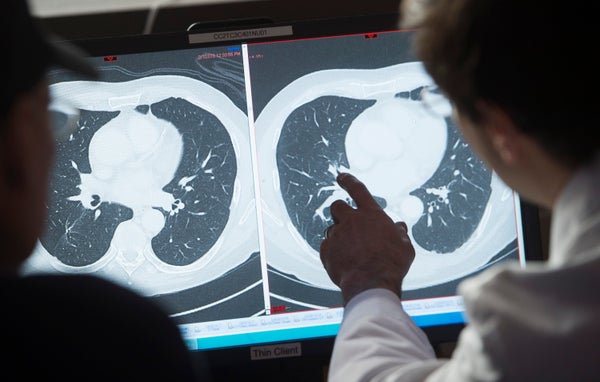
A CT scan showing cancerous tumors (right) and a clean scan after treatment (left). Survival rates across cancer types have increased in recent decades.
SAUL LOEB/AFP via Getty Images
On Tuesday the American Cancer Society (ACS) released its annual report on cancer statistics in the U.S., and it offered a rare bit of good news: the proportion of people who were alive at least five years after a cancer diagnosis hit a record high.
The report found that, among all cancer patients diagnosed between 2015 and 2021 in the U.S., the survival rate at the five-year mark relative to those who didn’t have cancer was 70 percent. This is the highest rate ever recorded by ACS. The researchers attributed the gains to better detection and treatment, as well as cutbacks in smoking.
“Seven in 10 people now survive their cancer five years or more, up from only half in the mid-70s,” said Rebecca Siegel, ACS’s senior scientific director for surveillance research, in a statement. “This stunning victory is largely the result of decades of cancer research that provided clinicians with the tools to treat the disease more effectively, turning many cancers from a death sentence into a chronic disease.”
On supporting science journalism
If you’re enjoying this article, consider supporting our award-winning journalism by subscribing. By purchasing a subscription you are helping to ensure the future of impactful stories about the discoveries and ideas shaping our world today.
Some of the most fatal cancers saw the greatest improvement in survival. The five-year relative survival rate for myeloma (a type of cancer that affects bone marrow), for instance, nearly doubled between the 1990s and now, jumping from 32 to 62 percent, while liver cancer survival more than tripled from 7 to 22 percent.
In part, that’s because of greater understanding of the cancer genome and the development of targeted therapies against cancer mutations, added William Dahut, ACS’s chief scientific officer, on a press call with reporters on Monday, ahead of the report’s release. “People are living with metastatic cancer for years and years now,” he said. “This has really been driven by research.”
But the full picture isn’t entirely rosy. The report projects that, in 2026, more than two million people in the U.S. will be diagnosed with new cancer cases, and more than 625,000 people will die of their disease. Lung cancer is expected to cause the most deaths—more than twice as many as any other cancer, the report’s authors write. (That’s particularly tragic because, as Scientific American has reported, many of those who are most at risk of lung cancer never get screened.)
Cuts to federal funding for cancer-related research threaten the country’s progress, the authors warn. In just the first three months of 2025, a Senate minority report estimated, National Cancer Institute grant funding was down 31 percent from the previous year.
“Although decades of scientific investment have translated into longer lives for most people diagnosed with cancer,” the authors of the new ACS report concluded, “pending federal cuts to health insurance and cancer research will inevitably reduce access to life‐saving drugs and halt progress at a time when incidence is rising for many common cancers.”
It’s Time to Stand Up for Science
If you enjoyed this article, I’d like to ask for your support. Scientific American has served as an advocate for science and industry for 180 years, and right now may be the most critical moment in that two-century history.
I’ve been a Scientific American subscriber since I was 12 years old, and it helped shape the way I look at the world. SciAm always educates and delights me, and inspires a sense of awe for our vast, beautiful universe. I hope it does that for you, too.
If you subscribe to Scientific American, you help ensure that our coverage is centered on meaningful research and discovery; that we have the resources to report on the decisions that threaten labs across the U.S.; and that we support both budding and working scientists at a time when the value of science itself too often goes unrecognized.
In return, you get essential news, captivating podcasts, brilliant infographics, can’t-miss newsletters, must-watch videos, challenging games, and the science world’s best writing and reporting. You can even gift someone a subscription.
There has never been a more important time for us to stand up and show why science matters. I hope you’ll support us in that mission.