
Close Menu
    Trending
    • 5 big ideas shaping journalism’s next chapter
    • What is the AI compute crunch, and why are AI tools hitting usage limits?
    • How Israel Is Using the Same Tactics in Lebanon That It Did in Gaza
    • Broadway Star Credits Craigslist For Andy Cohen Affair
    • Rubio to visit Vatican, Rome after Trump row
    • Israel issues new forced displacement orders in southern Lebanon | News
    • Chiefs provide major Patrick Mahomes injury update
    • Looking to find meaning and purpose in your life? Try these simple steps
    Benjamin Franklin Institute
    Sunday, May 3
    • Home
    • Politics
    • Business
    • Science
    • Technology
    • Arts & Entertainment
    • International
    Benjamin Franklin Institute
    Home»Science»NASA Telescopes Capture Colliding Spiral Galaxies in Sparkling Detail
    Science

    NASA Telescopes Capture Colliding Spiral Galaxies in Sparkling Detail

    Team_Benjamin Franklin InstituteBy Team_Benjamin Franklin InstituteJanuary 4, 2026No Comments3 Mins Read
    Share Facebook Twitter Pinterest Copy Link LinkedIn Tumblr Email VKontakte Telegram
    Share
    Facebook Twitter Pinterest Email Copy Link


    December 31, 2025

    1 min read

    Add Us On GoogleAdd SciAm

    Colliding Spiral Galaxies Captured in Sparkling Detail

    Astronomers combined data from NASA’s JWST and Chandra X-ray Observatory to create a stunning new image of two merging spiral galaxies
    By Claire Cameron edited by Sarah Lewin Frasier

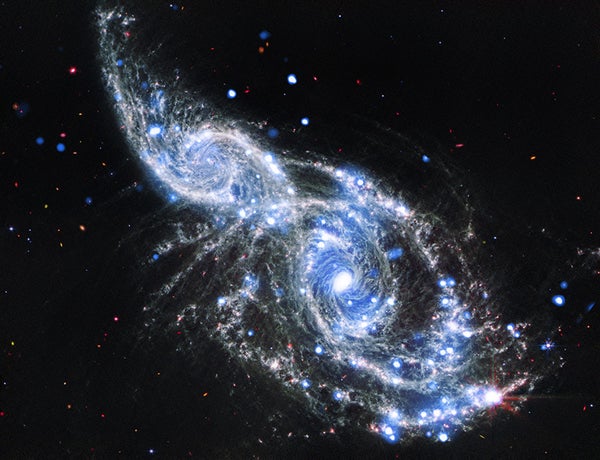
    Mid-infrared data from NASA’s James Webb Space Telescope (in white, gray, and red) and X-ray data from NASA’s Chandra X-ray Observatory (in blue) come together in this photo of colliding spiral galaxies released on Dec. 1, 2025. The pair grazed one another millions of years ago; billions of years in the future, they will merge into a single galaxy.

    X-ray: NASA/CXC/SAO; Infrared: NASA/ESA/CSA/STScI/Webb; Image Processing: NASA/CXC/SAO/L. Frattare

    Two space telescopes really are better than one. This month NASA released a new image that combines observations from the James Webb Space Telescope (JWST) and the Chandra X-ray Observatory of two spiral galaxies on a cosmic collision course.

    The two space telescopes have very different trajectories—giving them each a heady vantage point on the universe. JWST orbits the sun and observes the cosmos in infrared light, whereas Chandra, which orbits Earth, is sensitive to the x-ray spectrum. The newly released image combines their observations into one, revealing the galaxies IC 2163 (the left-hand galaxy) and NGC 2207 (on the right) in a new light.

    The pair are located some 120 million light-years from Earth. The larger galaxy, NGC 2207, is slowly stretching and stripping the smaller of the pair. Together they are joined in a slow, gravitational dance that will, billions of years from now, end in their merger into a single galaxy. In the image, mid-infrared data from JWST shows dust and other cooler matter in white, gray and red, while x-ray data from Chandra shows high-energy areas, including regions of intense star formation, in blue.


    On supporting science journalism

    If you’re enjoying this article, consider supporting our award-winning journalism by subscribing. By purchasing a subscription you are helping to ensure the future of impactful stories about the discoveries and ideas shaping our world today.


    When galaxies merge, they can trigger explosive bursts of star formation, and astronomers are keen to observe these collisions to understand how galaxies evolve over time.

    It’s Time to Stand Up for Science

    If you enjoyed this article, I’d like to ask for your support. Scientific American has served as an advocate for science and industry for 180 years, and right now may be the most critical moment in that two-century history.

    I’ve been a Scientific American subscriber since I was 12 years old, and it helped shape the way I look at the world. SciAm always educates and delights me, and inspires a sense of awe for our vast, beautiful universe. I hope it does that for you, too.

    If you subscribe to Scientific American, you help ensure that our coverage is centered on meaningful research and discovery; that we have the resources to report on the decisions that threaten labs across the U.S.; and that we support both budding and working scientists at a time when the value of science itself too often goes unrecognized.

    In return, you get essential news, captivating podcasts, brilliant infographics, can’t-miss newsletters, must-watch videos, challenging games, and the science world’s best writing and reporting. You can even gift someone a subscription.

    There has never been a more important time for us to stand up and show why science matters. I hope you’ll support us in that mission.


    Source link

    Share. Facebook Twitter Pinterest LinkedIn Tumblr Email Telegram Copy Link

    Related Posts

    Science

    What is the AI compute crunch, and why are AI tools hitting usage limits?

    May 3, 2026
    Science

    What is the Kardashev scale, and can we climb it?

    May 3, 2026
    Science

    The spring migration of birds is peaking. Here’s how to watch

    May 3, 2026
    Science

    US lawmakers vote to cut science spending—but reject Trump’s sweeping reductions

    May 3, 2026
    Science

    A third of U.S. adults don’t get enough sleep, new CDC report warns

    May 2, 2026
    Science

    Why the FDA rejected a ‘breakthrough’ melanoma drug

    May 2, 2026
    Editors Picks

    Ashton Kutcher’s Hollywood Comeback Slammed As ‘Desperate’

    December 28, 2025

    NASA’s Artemis II moon mission is gearing up for its lunar flyby

    April 5, 2026

    Chance of a devastating asteroid impact briefly spiked in 2025

    December 27, 2025

    Inside The Silent Rift Beyoncé And Rihanna Never Explained

    December 14, 2025

    Who is Martin Lewis? What’s his net worth and cost of living advice

    February 26, 2026
    About Us
    About Us

    Welcome to Benjamin Franklin Institute, your premier destination for insightful, engaging, and diverse Political News and Opinions.

    The Benjamin Franklin Institute supports free speech, the U.S. Constitution and political candidates and organizations that promote and protect both of these important features of the American Experiment.

    We are passionate about delivering high-quality, accurate, and engaging content that resonates with our readers. Sign up for our text alerts and email newsletter to stay informed.

    Latest Posts

    5 big ideas shaping journalism’s next chapter

    May 3, 2026

    What is the AI compute crunch, and why are AI tools hitting usage limits?

    May 3, 2026

    How Israel Is Using the Same Tactics in Lebanon That It Did in Gaza

    May 3, 2026

    Subscribe for Updates

    Stay informed by signing up for our free news alerts.

    Paid for by the Benjamin Franklin Institute. Not authorized by any candidate or candidate’s committee.
    • Privacy Policy
    • About us
    • Contact us

    Type above and press Enter to search. Press Esc to cancel.