

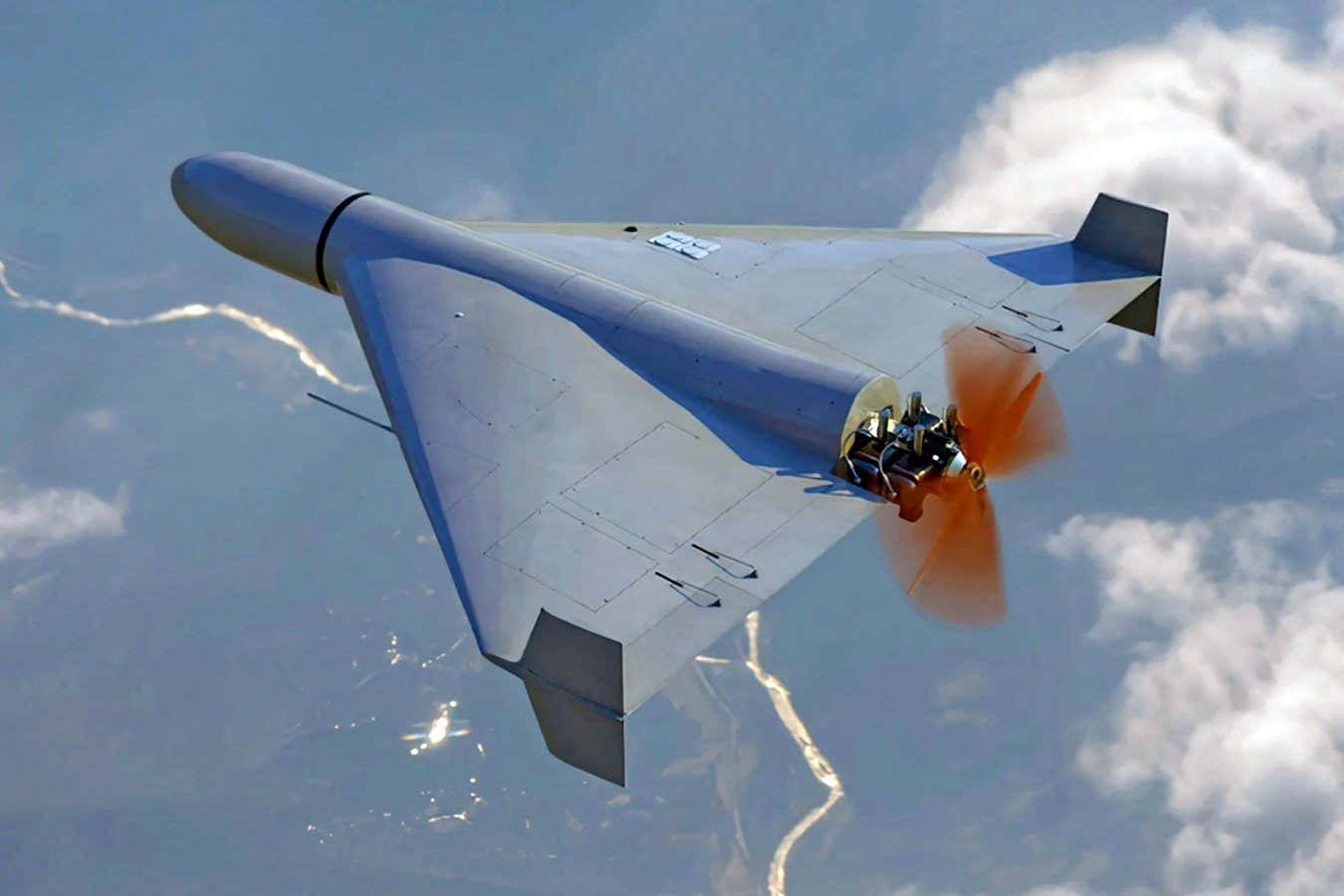
The Shahed 136 drone was invented by Iran and then copied by the US
Pictorial Press/Alamy
Iran invented the relatively simple Shahed 136 attack drone, but is now fending off US copies launched against it in combat. Why, when the US military has expensive, cutting-edge and hi-tech weapons, is it making flimsy drones powered by a motorbike engine?
Iranian company Shahed Aviation Industries originally designed the 136. It is 2.6 metres long and can carry 15-kilogram payloads over distances of about 2500 kilometres. It travels at a relatively modest speed of around 185 kilometres per hour – far slower than cruise missiles or bomb-carrying aircraft. But it has the advantage of extremely low cost – perhaps as low as $50,000 per unit.
Shaheds are now used in their hundreds in daily strikes on Ukraine by Russia, requiring layers of air defence – including fighter jets, machine guns, missiles and interceptor drones – to try to bring them down before they hit civilian or military targets. They are even in use by Houthi forces in Yemen.
Iran has been using Shahed drones as well as a range of other hardware in attacks around the Gulf this week in retaliation for US and Israeli strikes. In return, the US military has used its Low-cost Uncrewed Combat Attack System (LUCAS), produced by Arizona-based Spektreworks, in combat for the first time against Iran, which is a reverse-engineered copy of the Shahed 136. This means that Iran’s own design is now being used against it.
LUCAS is modular, allowing reconnaissance or communications equipment to be fitted or a warhead for ground strikes. Spektreworks calls it the FLM 136, seemingly a nod to the Shahed 136, whose design it was cloned from.
The US reportedly reverse-engineered the drone after capturing units from Iranian-backed militias in Iraq and Syria, and it was successfully test launched from a US Navy ship last year.
Anthony King at the University of Exeter, UK, says that cheap, relatively simple attack drones like the Shahed are essentially modern versions of the “doodlebug” – the V-1 flying jets that Nazi Germany used to bombard the UK in the second world war.
Such ordnance is cheap and easy to produce at scale, and can be used in numbers that overwhelm an adversary, soaking up even highly sophisticated air defences until they fail, or so that they consume vast resources and make a fight unsustainable. This leaves an adversary vulnerable to further attacks.
“You’re knocking them out of the sky with ordnance that’s way more expensive not just than the Shahed, but sometimes it’s more expensive than the thing that the Shahed is actually hitting,” says King. “There have been loads of cases where the target the Shahed is hitting is cheaper than the Patriot missile [used to take it down]. The appearance of these kind of crude, but effective, remote systems changes the economic calculus of war in an interesting way.”
Interestingly, there is reason to believe that Iran copied the original design for the Shahed 136 from a cold war device. A 1980s project between Germany and the US for a similar device that could strike Soviet radar stations or soak up air defences to protect other aircraft led to the Dornier design called Die Drohne Antiradar – quite literally “the anti-radar drone”.
Ian Muirhead at the University of Manchester, UK, who previously spent 23 years in the military, says that Shahed drones will never replace crewed aircraft or highly advanced missiles, but that they are increasingly finding a place in combat and that western militaries are learning lessons from the war in Ukraine and adopting similar weapons.
“A lot of modern weapons are extremely complex and expensive, and if you’re having large-scale conflicts like this, having lots of cheap, expendable weapons – particularly if you don’t have big armies any more – is more effective,” says Muirhead. “If you can send a thousand of them, you can overwhelm defences with cheap munitions.”
“It’s just economics: if it costs you 10 times more for your defence than it is for your attackers, you’re never going to be able to outpace the other side,” says Muirhead.
Article amended on 3 March 2026
We’ve corrected our description of the V-1.
Topics: