

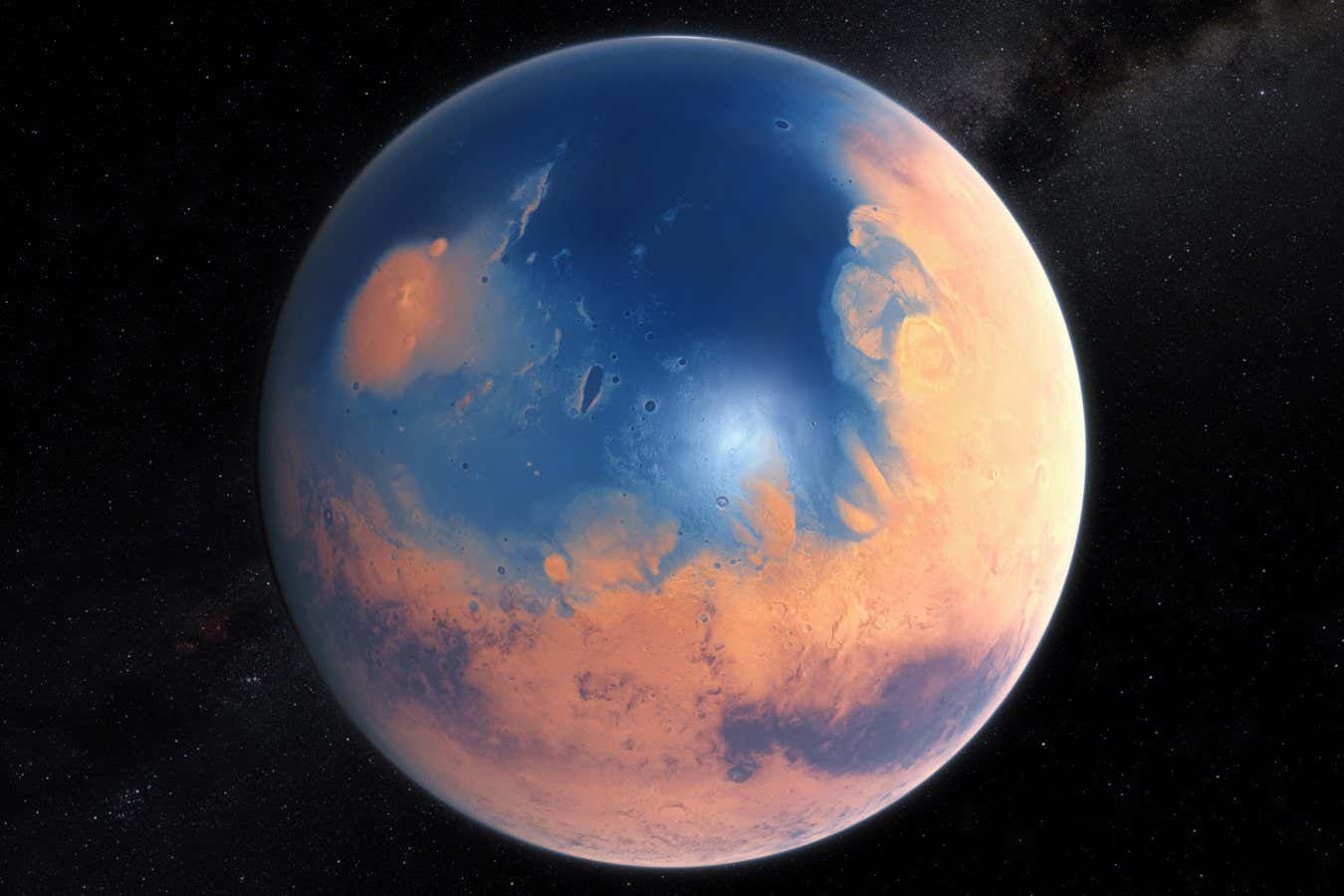
An artist’s impression of Mars millions of years ago, when it had more water on its surface
ESO/M. Kornmesser/N. Risinger
Planetary scientists agree that Mars used to have liquid water on its surface and a water-rich atmosphere, far different from its current arid state. But an accounting of all the sources of water to the Martian surface and all the ways it could have been taken away has found a major discrepancy – we simply don’t know where all that water went.
The period when Mars is thought to have had liquid water, between about 4.5 billion and 3.7 billion years ago, is known as the Noachian Period. Based on our best estimates of how water could have arrived at the Martian surface, there should have been enough surface water at the end of the Noachian Period to cover the entire planet in an ocean between 150 and 250 metres deep.
But when Bruce Jakosky at the University of Colorado Boulder and his colleagues totted up all of the ways water could have been removed from the surface since then, they found that it added up to just a few tens of metres at most. Jakosky presented this work at the Lunar and Planetary Science Conference (LPSC) in Texas on 20 March.
The total water near the Martian surface now, mostly in the form of ice and hydrated minerals, is about the equivalent of a global ocean only 30 metres deep. “How do you go from 150 metres, take away a couple of tens [of metres] and get to 30 metres? You can’t do that. Clearly there’s something missing from our understanding,” said Jakosky. Even if you take the lower reasonable limit of every process that could have added water to the surface and the upper reasonable limit of every process that removed it, the discrepancy still isn’t completely alleviated, he said.
There are some ideas for where the water might have gone: it could be that much more of it evaporated away into space since the end of the Noachian than we thought, it could be frozen in yet-undiscovered ice deposits, we could be misunderstanding the interactions between the ice caps and the atmosphere, or perhaps some of the sources of water actually interact with one another in unexpected ways and we are overcounting. Most likely it is some combination of these, and possibly other mechanisms as well, Jakosky said.
While such a large discrepancy may be surprising, it is uncontroversial to say that we do not fully understand the history of water on Mars. In other talks at LPSC, researchers put forward the idea that rather than having one long period of water on the surface, there may have been brief periods of rain followed by drought.
“This suggests that the hydrologic cycle on Mars was completely different from Earth, and probably distinct from terrestrial analogues,” said Eric Hiatt at Washington University in St. Louis during his talk. His research suggests that the groundwater on Mars may not interact with the surface and atmosphere in the ways that we have previously thought, which could shift our view of how much water was actually added to the surface.
In another talk, Bethany Ehlmann at the University of Colorado Boulder suggested that there may be more water still on Mars now than we have traditionally assumed. All of this highlights that while we know a great deal about Mars, we do not know enough to build a full picture of its hydrological history.
Sorting out the mystery of Mars’s water – and therefore, its potential habitability at various times in its history – will be a monumental task. “How do we move forward on this? We’re not going to do it with more models,” said Jakosky. “If you ask me, I think this really requires boots on the ground.”
With NASA and SpaceX both prioritising exploration of the moon, it could be decades before a human sets foot on Mars, so any progress for now will be incremental, with data from rovers and orbiters.
Spend a weekend with some of the brightest minds in science, as you explore the mysteries of the universe in an exciting programme that includes an excursion to see the iconic Lovell Telescope. Topics:
Mysteries of the universe: Cheshire, England