

High-speed rail systems are found all over the globe. Japan’s bullet train began operating in 1964. China will have 31,000 miles (50,000 kilometers) of high-speed track by the end of 2025. The fastest train in Europe goes almost 200 mph (320 kph). Yet high-speed rail remains absent from most of the U.S.
Stephen Mattingly, a civil engineering professor at the University of Texas at Arlington, explains why high-speed rail projects in much of the country so often go off track.
Dr. Stephen Mattingly discusses the problems that come with implementing high-speed rail in the U.S.
The Conversation has collaborated with SciLine to bring you highlights from the discussion, edited for brevity and clarity.
How is high-speed rail different from conventional trains?
Stephen Mattingly: With conventional rail, we’re usually looking at speeds of less than 80 mph (129 kph). Higher-speed rail is somewhere between 90, maybe up to 125 mph (144 to 201 kph). And high-speed rail is 150 mph (241 kph) or faster. There’s also a difference in the infrastructure for these different rail lines.
Is there anything in the U.S. that’s considered high-speed rail?
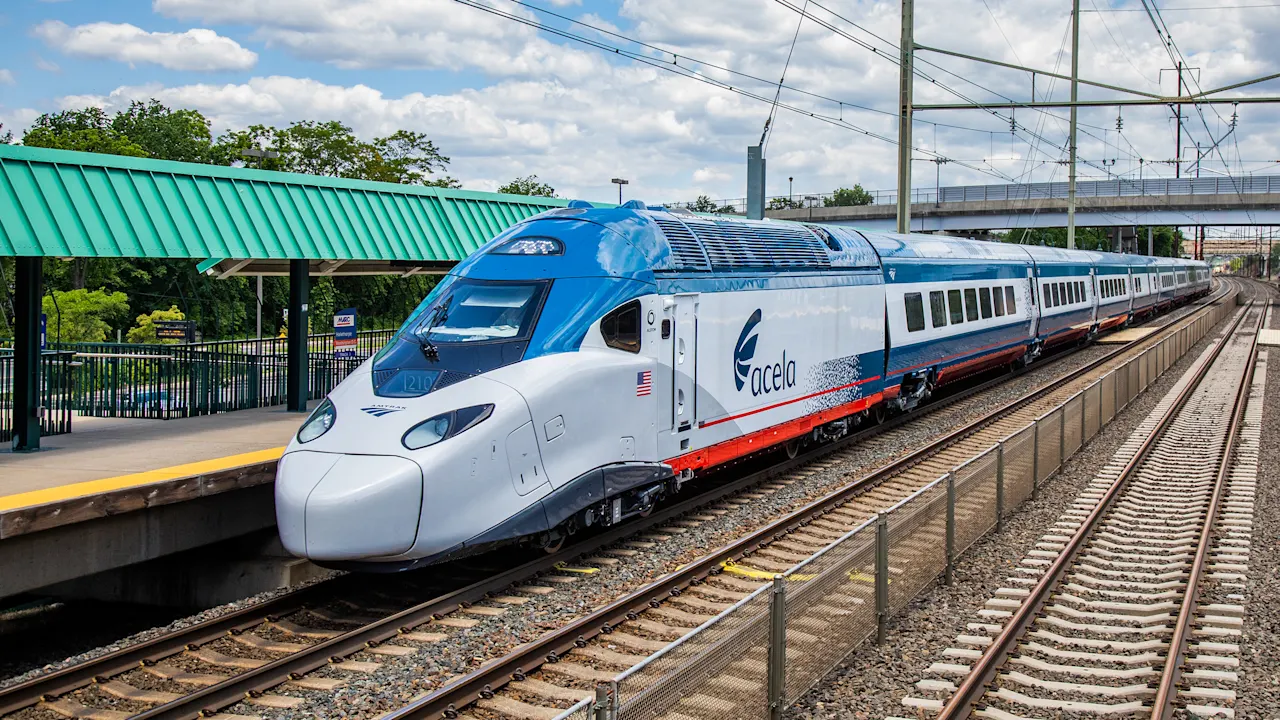
Mattingly: The Acela train operates in the Northeast Corridor and serves Boston, New York City, Philadelphia, Baltimore, and Washington, D.C. In some parts of the corridor, the Acela runs on infrastructure that accommodates the train’s maximum 150 mph (241 kph) speed.
Why has the U.S. been slow to adopt this?
Mattingly: Except for some in the northeastern U.S., not many cities have enough travel between them and are at the correct distance to support an investment in high-speed rail, because it’s not necessarily going to take a huge number of cars off the road. Trains are not a replacement for auto travel; they compete more directly with air.
High-speed rail competes best with air when the trip is between one-and-a-half to three hours. Within that range, a train’s door-to-door travel time is typically faster than air. That’s because of the additional security time required for air travel: sitting around in the airport, the time it takes to load and unload and all of that.
For longer distances—more than three hours—the train’s travel time starts to get noncompetitive with air. That’s because for every three or four hours of high-speed rail travel, air travel only takes one hour.
Go lower than that—a trip of less than an hour-and-a-half—and cars become the more attractive choice.
That said, what are the advantages of high-speed rail?
Mattingly: First, the environmental benefit is an advantage. High-speed rail has lower carbon emissions than air travel, especially on a per passenger basis. You can load more people onto a train than most planes.
Then, of course, its speed makes it a viable way to commute when compared with conventional rail. Our current Amtrak system, outside the Northeast Corridor, is really a leisure travel mode, as opposed to business travel mode.
What large-scale projects are in the works here in the U.S.?
Mattingly: Some higher-speed rail is in Florida, and Brightline, a private train company, is proposing to improve the existing line with more of a high-speed capability. There’s also a proposed line in Texas to run between Dallas and Houston.
The Texas project has a lot of challenges with eminent domain, which is the right of government to take private property for public use after providing compensation. A federal grant to help fund the line was recently terminated, and a strategic partner pulled out of the project. With delays, costs inevitably begin to increase.
California’s high-speed rail project for its Central Valley actually has about 120 miles (193 kilometers) of track laid down. And it’s working on slowly building that out. There are some other proposals in the Pacific Northwest, but those are more ideas than projects at this point.
When these systems are proposed, they’re often positioned as a replacement for auto travel. But I’m incredibly skeptical that auto travel will significantly decrease with a new public transit mode that deposits you within a larger metropolitan destination, which may not even have the public transportation to take you to your final destination.
Regional networks of high-speed rail could connect more exurban or rural areas to hub airports and enhance economic development in these regions. In this case, a public high-speed rail system could receive public money, just like the federal government has done with the interstate highway system and all the other road investments that we’ve made over the past century and longer.
But I’m not sure that high-speed rail will be a solution for congested freeways between cities for any place outside of the Northeast Corridor.
What is your central message about high-speed rail?
Mattingly: I love high-speed rail as a technology. For specific applications, it’s beneficial, especially from an environmental perspective. But the country has to be very careful in its choices on where those public investments in high-speed rail would actually make sense and be worthwhile investments. So I’m hesitant to make large investments without really understanding what the outcomes are.
SciLine is a free service based at the American Association for the Advancement of Science, a nonprofit that helps journalists include scientific evidence and experts in their news stories.
Stephen Mattingly is a professor of civil engineering at the University of Texas at Arlington.
This article is republished from The Conversation under a Creative Commons license. Read the original article.