

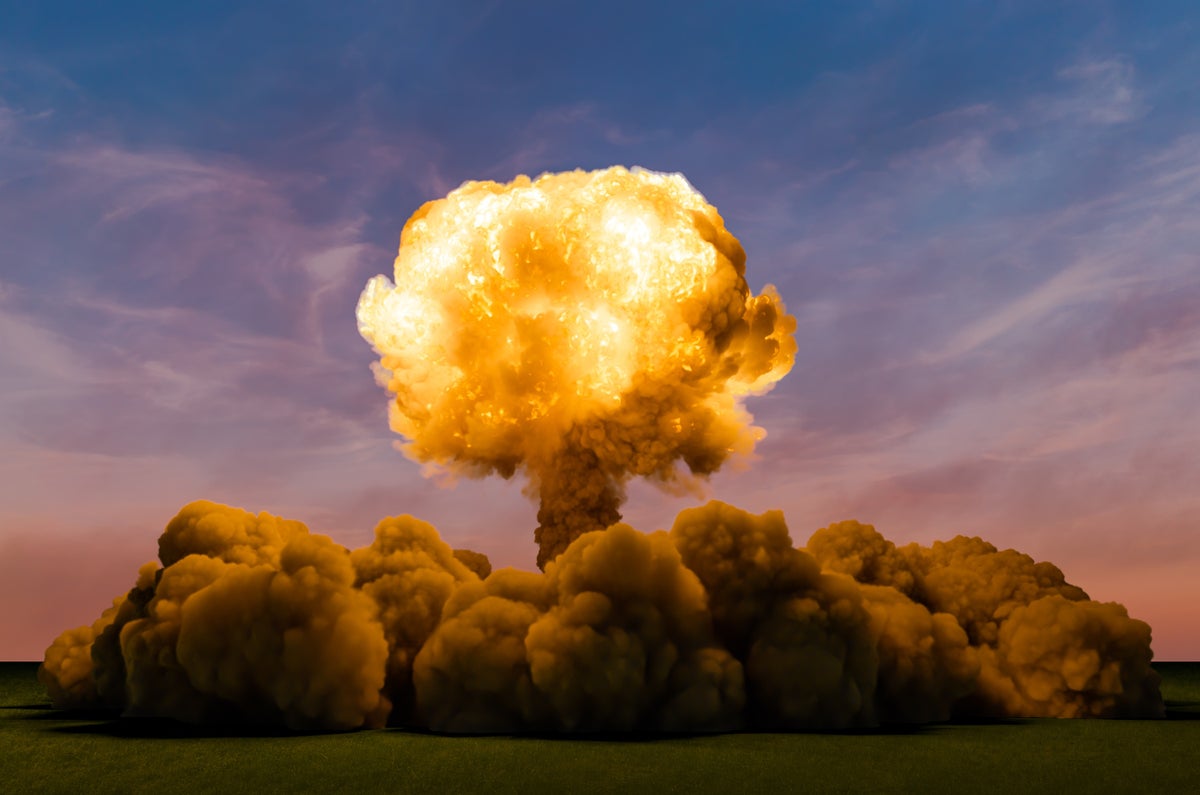
“The half-life of humanity is currently around 35 years,” said Nobel laureate in physics David Gross as he concluded an evening lecture at the German Physical Society’s conference in Erlangen in March. Put another way, the physicist believes that in a little more than three decades, there is a 50 percent chance that our species will be extinct.
The alarming statement followed Gross’s estimation that the risk of a nuclear war was increasing from 1 percent per year to about 2 percent annually. After the lecture, the audience was visibly pensive. The current world situation and the award-winning speaker’s warnings hung over attendees like a dark cloud.
“I’m still hoping game theory will come to the rescue,” another physicist later told me at the conference. The rules of logic—provided everyone follows them—would prohibit a nuclear first strike, this reasoning goes.
On supporting science journalism
If you’re enjoying this article, consider supporting our award-winning journalism by subscribing. By purchasing a subscription you are helping to ensure the future of impactful stories about the discoveries and ideas shaping our world today.
But looking at history, I’m not quite so optimistic. Unfortunately, people rarely act rationally. Furthermore, the founder of game theory, the brilliant Hungarian-American mathematician and physicist John von Neumann, not only helped develop the first atomic bomb but also worked with the U.S. government to plan the nuclear attacks on Japan. He even recommended a preemptive strike against the Soviet Union. The 20th century reveals that game theory offers a remarkable tool for problem-solving, but it does not, in itself, guarantee peace.
Game Theory Basics
Von Neumann profoundly shaped numerous scientific fields in the 20th century, including information theory, quantum mechanics and computer science. He was also—contrary to stereotypes about introverted scientists—notorious for his wild late-night parties.
Thinking about strategy in various games would eventually lead to von Neumann’s 1928 book Zur Theorie der Gesellschaftsspiele (“On the Theory of Board Games”), which caught the attention of economist Oskar Morgenstern. The two researchers began compiling and publishing their joint reflections on game strategies, and this culminated in the nearly 700-page book Theory of Games and Economic Behavior.
In game theory, various scenarios are considered, and each is assigned a numerical value, for example, between –10 and 10. A high value symbolizes a particularly advantageous situation for a particular player. The exact numerical values chosen for each situation are subjective. Based on this subjective weighting, however, an optimal strategy can then be developed from an objective perspective.
For the purposes of illustrating how game theory can be applied, let’s consider a scenario where two players are, say, playing chess. Just to keep things simple, imagine that player A is weighing two moves: target a pawn on square 1 or a different pawn on square 2. The opponent, player B, is also thinking defensively about how to respond. Game theorists would assign different scenarios numeric outcomes. For example, if player A succeeds in taking square 1 with no negative consequences, they will receive +10 points, and player B would receive –10 points. If player A takes square 1 but immediately thereafter loses a valuable piece, then the outcome is –4 for player A and +4 for player B.
If you spend enough time thinking about these scenarios, you may notice that there’s a danger of getting trapped in a decision-making loop. For instance, player A knows that player B is likely to follow a particular course of action, but player B knows that player A knows that, too, and so might do the opposite. This little thought experiment turns into an unending spiral.
So one of the additional steps that game theorists take is leaning into the idea that chance will be part of the process. In cases where there is no optimal decision, to avoid the loop of “I know what you’re thinking but you know what I’m thinking,” game theorists propose imagining that a particular scenario will be repeated many times over. Then they ask which course of action is the best for a particular player on average. You could represent the opponent’s response using a coin flip, for example, to game out what’s likely to pay off. And you can stack the odds with a “biased coin” to explore the best strategy, assuming the odds are not 50–50 for a particular response but instead tilted more in your opponent’s favor than your own.
When Theorists Enter the War Room
But game theory is not just about board games. It’s about making scientifically sound decisions and weighing the associated risks.
For example, in 1945 the U.S. wanted to force Japan to surrender as quickly as possible, before Stalin could intervene in World War II. The U.S.’s new atomic bomb, whose development von Neumann had significantly influenced, seemed suitable for this purpose. Yet the U.S. needed a strategy for this weapon. On the one hand, the targets had to be important from a military perspective; on the other hand, they should not be too obvious, so as not to prevent Japan from preparing for the attack. Japan and the U.S. were each trying to stay one step ahead of the other. At the same time, both nations had finite resources and had to decide between attacking and defending individual cities. American strategists considered five different target cities: Kokura, Hiroshima, Yokohama, Niigata and Kyoto.
We don’t know precisely how these wartime decisions were made—but we do know that von Neumann was included on the target selection committee that ultimately determined that Hiroshima and Nagasaki would be bombed. Game theory would have been a logical approach to invoke because it helps people weigh varied options.
In the end, the committee chose Hiroshima and Nagasaki. The destruction of these two cities went down in history as a horrific event. An estimated 200,000 people lost their lives. Ultimately the U.S. achieved its goal: Japan surrendered.
With the end of World War II, the cold war began. The nuclear arms race between the U.S. and the Soviet Union started. And von Neumann did not believe in a peaceful solution. He was certain that an open nuclear war would break out between the two powers. Therefore, he advocated for a nuclear first strike. “If you say, why not bomb [the Russians] tomorrow, I say: Why not bomb them today? If you say today at 5 o’clock, I say why not 1 o’clock?” he reportedly said in 1950.
Today we know that it was a good decision to ignore von Neumann’s advice regarding bombing the Soviet Union. The cold war thankfully ended without a catastrophic nuclear war.
But now, some 35 years after the end of the cold war, the world finds itself once again in a time of open conflict involving countries that possess nuclear weapons. This makes the 2024 Mainau Declaration on nuclear weapons, initiated by Gross and others in reference to the original 1955 Mainau Declaration and signed by more than 100 Nobel laureates, all the more important.
The declaration urgently warns of the danger “that, either by accident or by deliberate act, these horrible weapons may be used—with the likelihood of the end of human civilization as we know it.” And last year the first-ever Nobel Laureate Assembly for the Prevention of Nuclear War issued a separate declaration that suggests concrete proposals to reduce nuclear war risk. For example, it states that at least two people should be required to order a nuclear attack; this is not the case in many countries (such as the U.S. or North Korea).
Let’s hope the scholars are heard in this case, even though things currently look bleak.
This article originally appeared in Spektrum der Wissenschaft and was reproduced with permission. It was translated from the original German version with the assistance of artificial intelligence and reviewed by our editors.