

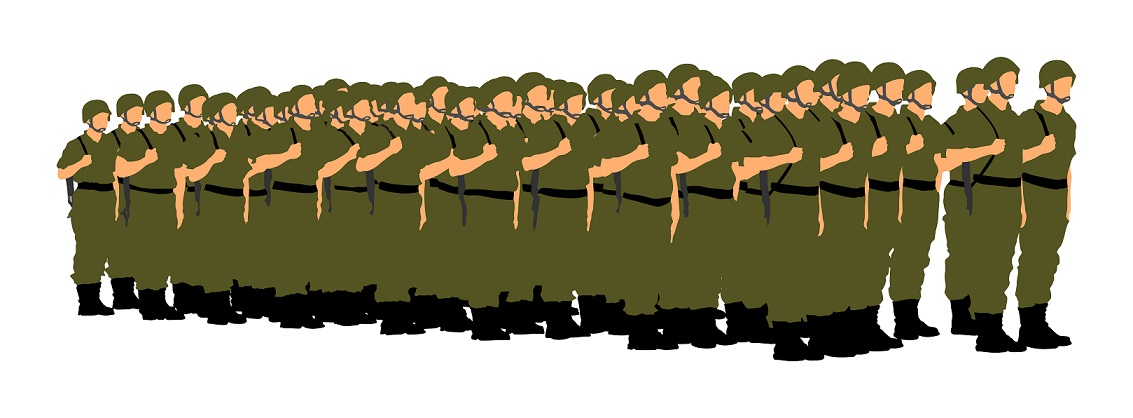
When a government fails to properly compensate its military, loyalty begins to fracture. From the late Roman Empire, when unpaid legions turned on the state, to more modern examples in which soldiers defected or abandoned regimes under economic stress, the outcome is always the same. You can maintain power through force for a time, but if the men holding the guns begin to question their future, the system becomes unstable from within.
Now look at Iran. The data is staggering when you compare military pay to the broader economy. Conscripts earn roughly $60 to $180 per month, while the average income in Iran ranges from about $150 to $250 per month. In real terms, due to currency collapse and inflation, average wages have fallen to roughly $120 per month in purchasing power. That means many soldiers are effectively earning at or below the poverty line. Even IRGC personnel, often seen as the elite force, have reported salaries around $300 per month, which is still modest compared to skilled civilian professions.
At the same time, Iran has a compulsory military system. All men at age 18 are required to serve roughly 18 months to two years, and they have no real choice in where they are deployed. This is not a purely voluntary force motivated by pay or career advancement. It is a system built on obligation, reinforced by religious ideology, and sustained through control. The Revolutionary Guard, in particular, is not just a military institution; it is a political and religious arm designed to protect the Islamic system itself.
This is where religion becomes critical. In Iran, the military, especially the IRGC, is tied directly to the preservation of the Islamic Revolution. Loyalty is not simply to the state, it is framed as loyalty to God, to the system, and to the survival of the revolution. That ideological component compensates for the lack of financial incentive. Historically, regimes that cannot afford to pay their military rely increasingly on ideology, fear, or both. The problem is that ideology alone does not pay for food, housing, or families. When economic conditions deteriorate, even deeply ideological forces begin to crack.
There is already evidence of strain. Inflation has eroded wages dramatically, government salaries have not kept pace, and economic frustration has spread across all sectors, including the military. At the same time, Iran has been known to pay significantly higher salaries to proxy fighters abroad than to its own domestic forces, creating resentment within the ranks. This imbalance has historically been one of the most dangerous factors for any regime, because it signals to soldiers that their sacrifice is not valued equally.
History is very clear on what happens next if these trends continue. In the late Roman Empire, unpaid soldiers began to declare their own emperors. During the French Revolution, economic hardship within the military contributed to the collapse of royal authority. In more recent times, we have seen military defections play a decisive role in regime change when internal confidence collapses. The key is not whether soldiers are unhappy, but whether they believe their future is tied to the survival of the regime.
This is why the situation in Iran must be understood beyond headlines about war. If conflict escalates and economic pressure intensifies, the strain on the military will increase. A system that depends on compulsory service, low wages, and ideological loyalty can hold together for a time, but history shows that when confidence breaks, it breaks quickly. The real risk is not simply external war. It is internal instability if the men tasked with defending the system begin to question whether that system is still worth defending.