

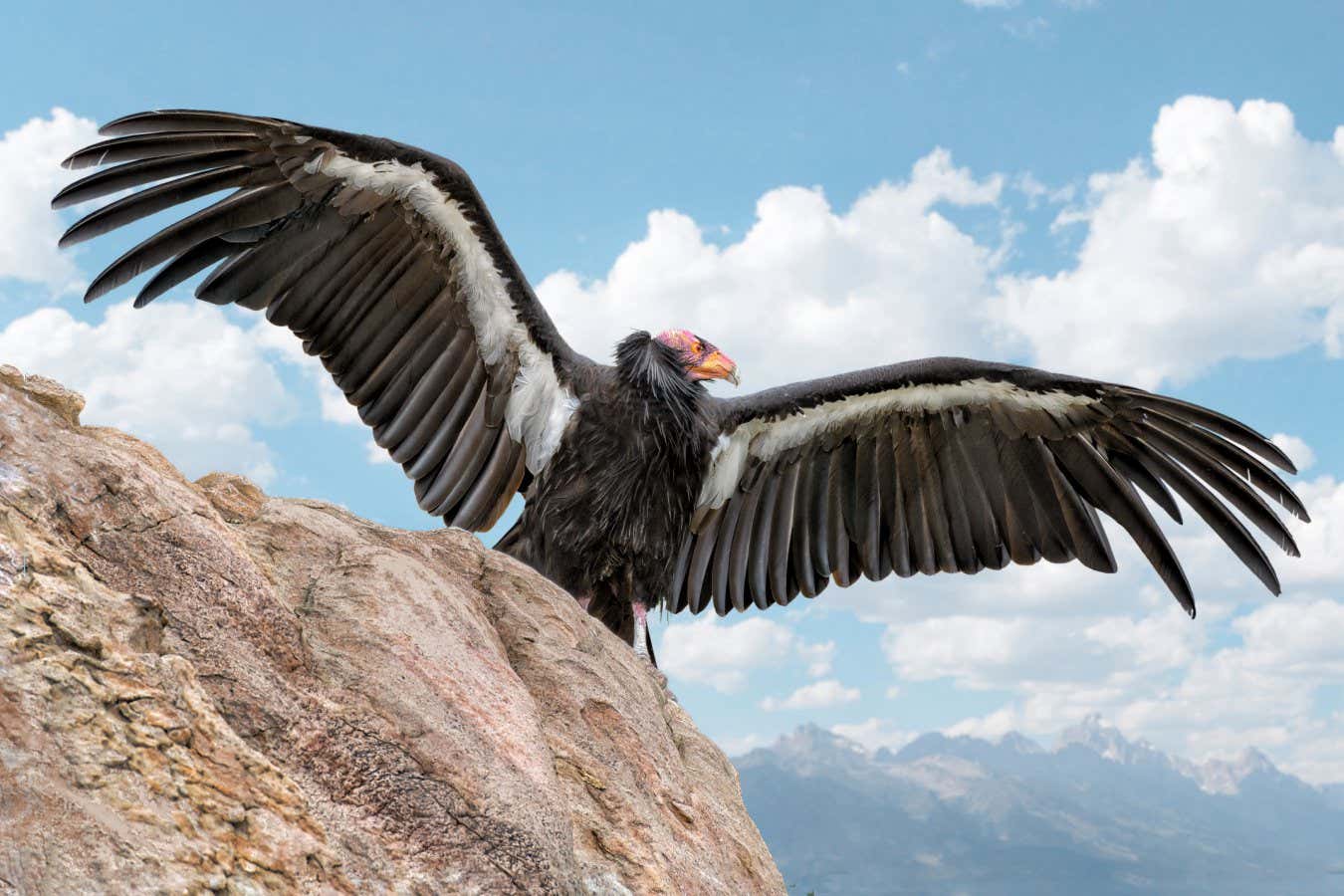
California condor embryos can develop without fertilisation
Shutterstock/Barbara Ash
On the Origin of Sex
Lixing Sun, Profile Books
As children, many of us learn the facts of life with examples from the natural world. The thinking is that it is more straightforward (and certainly less uncomfortable) to illustrate “the talk” with images of birds laying eggs and bees pollinating flowers than it is to focus on humans or, heaven forbid, your parents.
But this is a comforting fiction, as evolutionary and behavioural biologist Lixing Sun sets out in his engaging and frequently mind-boggling book, On the Origin of Sex: The weird and wonderful science of how our planet is populated. The “birds and the bees” analogy just doesn’t capture the diversity, drama and strangeness of animal reproduction.
Even animals that might strike us as dull have surprising and frequently cut-throat approaches to reproduction: barnyard hens can eject most of the sperm after mating with a low-ranking male; male ducks have evolved a corkscrew-shaped penis; and female ducks have evolved vaginas that spiral in the opposite direction, giving them greater control over paternity.
On the Origin of Sex is stuffed with such examples, enlivening the biological nuts and bolts. The range of reproduction makes the most adventurous of human activities seem tame, but, as the title suggests, Sun’s scope is far more ambitious. Instead, he grapples with the big questions puzzling us about reproduction, starting with why there is such a thing as sex at all.
“
The strict male-female binary starts to feel not just limited, but downright outdated
“
For readers who aren’t well-versed in evolutionary biology, this might seem an odd line of enquiry, but from an evolutionary perspective, sexual reproduction is more difficult and costly than asexual reproduction. This is because it requires two partners, one producing male gametes and the other female gametes. On the face of it, asexual reproduction is far more efficient and is still used by many species, such as bacteria and fungi. Parthenogenesis, a form of asexual reproduction in which the embryo develops without need for fertilisation, has been found in more than 80 species of vertebrates, including California condors, bonnethead sharks and Komodo dragons.
So why did a “two-sex system” take off? Sun devotes the book’s first section to that question with a brisk tour through key ideas, such as Muller’s ratchet, proposed in 1964 by geneticist Hermann Muller. This explains that the lack of genetic mixing in asexual reproduction leads to the gradual accumulation of irreversible “bad” mutations.
Then there is the “Red Queen hypothesis”, which sees evolution as a perpetual arms race in which species “have to hustle at full throttle just to keep up with their adversaries and stay in the game”, writes Sun. This effectively reinforces the stakes of sex as quite literally a matter of life and death.
A distinguished research professor at Central Washington University, Sun is well-connected to many of the scientists whose work he cites. On The Origin of Sex is his fourth book for a lay audience, following works on cheating and fairness in the natural world – and a natural history of the beaver.
By Sun’s own admission, On the Origin of Sex is a “fast, selective ride”, but his imagined reader isn’t always obvious. He can assume considerable knowledge of evolutionary biology. At other times, his asides and flourishes point to a more accessible title. But the book remains interesting because the many examples of kooky animal sex make it a pacy read, even if you struggle with some of the more technical scientific discussion.
Sun’s enthusiasm for his subject, and his wonder at the adaptive strategies of the animal kingdom, is also infectious. His chapters on gender adaptations and sex variations are especially refreshing. Sun argues that we need to take a more expansive view of gender, writing that our current definition is “hopelessly homocentric, cut off from our evolutionary connections”. He uses the term to describe an animal’s roles and functions beyond gamete production, and his patient, step-by-step explanation of the science underpinning both sex and gender not only clarifies, but highlights how much humans have invested in the subject.
He writes that in “popular discourse, gender is often treated as a social construct. What’s missing, though, is a more basic understanding of gender as a biological construct – something evolutionary biology can help uncover. That’s where I come in.”
He is careful not to wade into culture wars, stressing his concern is evolutionary biology and, mostly, non-human animals. But it becomes clear that nature isn’t binary. “Biological sex isn’t just a matter of splitting the world into sperm-producers and egg-makers,” Sun writes. For example, swamp eels, clownfish, wrasses and other fish change sex as a matter of course. Even in birds and mammals (including humans), there is broad variation, including intersex individuals.
Gender, too – taking in not just reproductive roles but behaviour and social dynamics – is far more fluid among animals than we thought, and is also related to sex. For example, hyenas don’t just live in matriarchal packs; females also possess a “pseudo-penis” (and a “pseudo-scrotal sac”), evolved to give them an edge in the competition to get at food after a kill, but complicating pregnancy.
Sun points to this kaleidoscopic range to argue for fresh thinking on sex and gender, to be inclusive of differences as “natural, adaptive parts of life’s diversity”. As he concludes, the “strict male-female binary starts to feel not just limited, but downright outdated”.
Elsewhere, Sun has said his early ambition with On the Origin of Sex was to inject science into discussions of diversity and social justice. By sticking to science and giving examples from nature, he succeeds. Indeed, the dizzying diversity among non-human life and the many questions about sex and reproduction still awaiting answers should challenge us to embrace complexity and keep an open mind, he suggests.
We might think we know about the facts of life, but even Sun concludes his book feeling awed by “how little we truly understand”.
Elle Hunt is a writer based in Norwich, UK

Three more great reads on sex and evolution

The Red Queen: Sex and the evolution of human nature by Matt Ridley
Check out this 1993 pop-sci classic by author Matt Ridley. Lixing Sun namechecks it for shaping our understanding of sex and gender – and for its “razor-sharp wit and punchy prose”.

The Sexual Evolution: How 500 million years of sex, gender and mating shape modern relationships by Nathan H. Lents
Packed with examples of animal sexual diversity, this entertaining and witty book by Nathan H. Lents makes light work of his rigorous research and contains important points about sexual diversity in humans, too.

The Intimate Animal: The science of love, fidelity and connection by Justin Garcia
This 2026 book sheds light on the science of human attraction and connection. Justin Garcia is superqualified as an evolutionary biologist, executive director of the Kinsey Institute and scientific advisor to dating site Match.com.
Topics: