

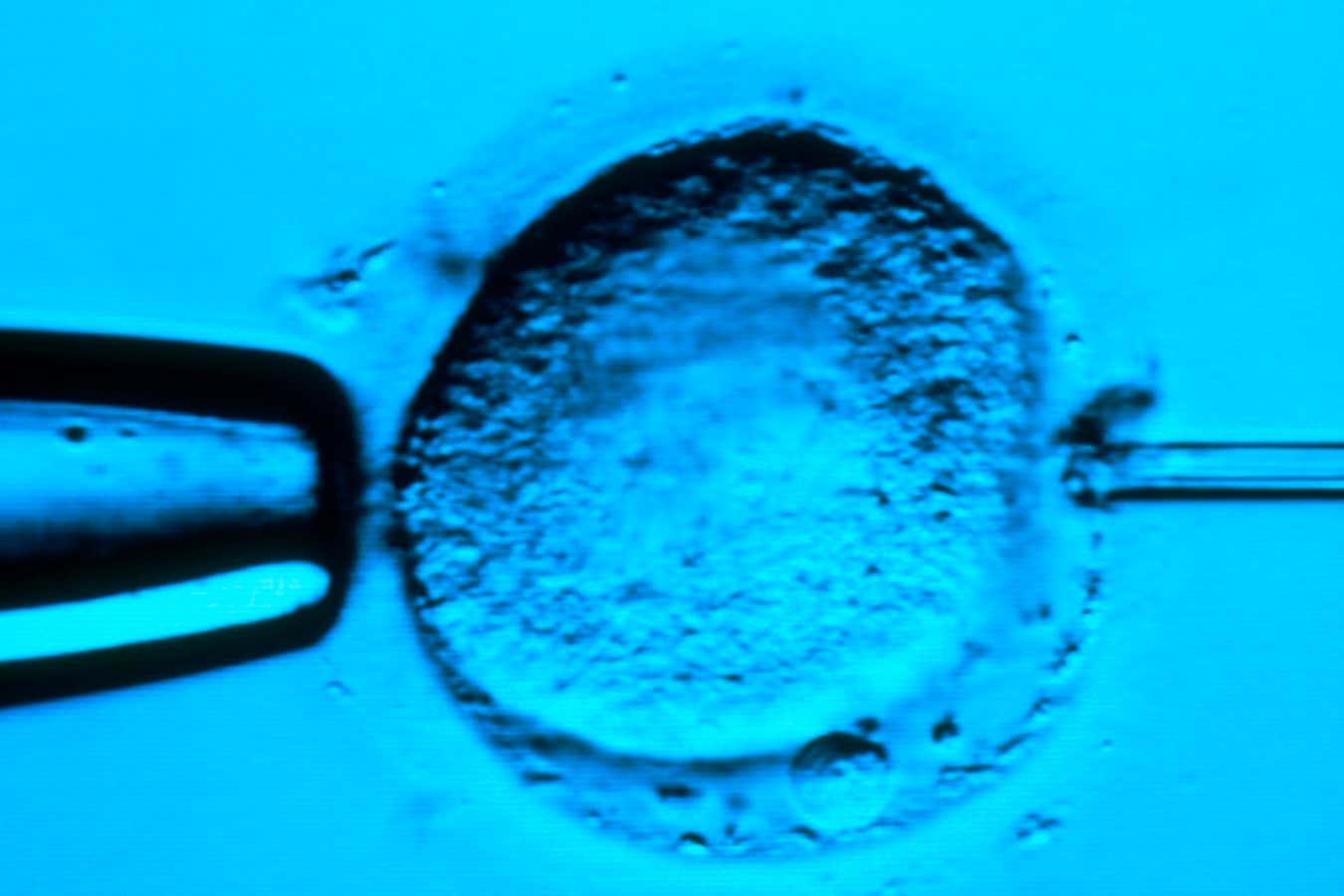
Understanding embryonic development could improve IVF success
PHILIPPE PLAILLY/SCIENCE PHOTO LIBRARY
We now know the master gene that controls embryonic development in people. Called NANOG, its role has been identified by making precise changes to the DNA of fertilised eggs using a technique called CRISPR base editing.
The discovery might lead to ways to boost the success rate of IVF, among other conditions. “The other reason we study these early stages of human development is that it has really profound importance for stem cell biology,” says Kathy Niakan at the University of Cambridge. “A better understanding will help stem cell research and regenerative medicine, and that could have a transformative impact that can affect all of our lives.”
It’s long been known from animal studies that NANOG plays a role in embryonic development. The gene was named after the Celtic world of the ever-young, Tír na nÓg, because its activation is what makes stem cells immortal. Crucially, though, the team’s work shows that NANOG has a different role in people than in other animals, such as mice.
When a fertilised egg starts developing, the cells take on one of three different roles – forming the placenta, the yolk sac, which is also in mammalian embryos, or the embryo itself. When the team used base editing to disable NANOG in fertilised mouse eggs, none of the resulting cells developed into yolk sac progenitors. Base editing is a modified form of CRISPR that changes a single DNA letter at a time. By contrast, the original form of CRISPR slices through DNA strands, resulting in various kinds of mutations. “The precision of the technique reduces the likelihood of unintended chromosomal abnormalities, which can occur with the original version,” says Niakan.
But when the team disabled NANOG in human eggs donated by women undergoing IVF treatments, none of the cells developed into those that form the embryo. In other words, the activation of NANOG is what initiates the developmental programme that results in cells forming a human body.
These embryos still appeared normal under a microscope, however, and the selection of IVF for implantation is based largely on shape, Niakan says. “One out of two times, even though from the shape it looks like the embryo is developing well, it doesn’t have the potential to implant,” she says. “So perhaps by identifying key markers or genes like NANOG, that knowledge could help improve on these rates.”
Niakan’s team isn’t the first to base-edit human embryos. It was first done in 2017, but using embryos discarded because of abnormalities, so the results might not reflect what happens in healthy embryos. Then last month, Dieter Egli at Columbia University in New York released a pre-print describing base editing of two-cell embryos.
“What we were trying to achieve was fundamentally different. Our study is about understanding key genes – this is the first time that the technique has been used to study gene function in human embryos,” says Niakan. “Dieter’s study was evaluating the use of the technology in disease-associated mutation correction.”
Egli says Niakan’s study shows that NANOG has an important role in human development that is different to its role in mice.
All three studies suggest that CRISPR base editing of human embryos is much safer than editing them with the original form of CRISPR, as was done with three children. However, Mary Herbert at Monash University in Melbourne, Australia, who was part of Niakan’s team, stresses that we are still far from the point where CRISPR base editing could be used to create gene-edited children, for example, to prevent inherited conditions. “The technology is not ready for that,” says Herbert. “I think there is unanimous agreement on that.”
A major obstacle to this is that, often, only some of the cells in an embryo are successfully gene-edited, known as mosaicism. This means if gene editing was used to correct disease-causing mutations in an embryo, the resulting child might still develop that condition.
For instance, with one edit that Egli’s team tried to make, 80 per cent of embryos were mosaics. Niakan’s team did its editing at a much earlier stage, injecting the gene-editing machinery into eggs along with the sperm used to fertilise them. This reduced mosaicism, but not by much: half of the eggs were still mosaics. “[This] would still be too high a rate of mosaicism in many circumstances if the methods were being used to correct a DNA variant that causes a genetic disorder,” says Robin Lovell-Badge at the Francis Crick Institute in London.
Niakan says it would be really unethical to try to base-edit children at the moment, but she’s not ruling it out in the future: “I would also hugely advocate for much more basic research that’s publicly available and publicly discussed.”
Article amended on 26 June 2026
We have corrected how we described Dieter Egli’s views on the new study.
Topics: