
Close Menu
    Trending
    • Beijing’s new supply chain rules deepen concerns for US firms in China
    • India denounces ‘hellhole’ remark shared by Trump | Donald Trump News
    • New photos of Mike Vrabel and Dianna Russini emerge
    • AI search demands a new audience playbook
    • How do earthquakes end? A seismic ‘stop sign’ could help predict earthquake risk
    • Trump Announces Cease-Fire Between Israel and Lebanon
    • Google Is Tracking Your Life – Photo Cloud Feeding AI System
    • Rachel Zoe Confronts Amanda Frances In ‘RHOBH’ Reunion Clip
    Benjamin Franklin Institute
    Friday, April 24
    • Home
    • Politics
    • Business
    • Science
    • Technology
    • Arts & Entertainment
    • International
    Benjamin Franklin Institute
    Home»Science»Weird inside-out planet system may have formed one world at a time
    Science

    Weird inside-out planet system may have formed one world at a time

    Team_Benjamin Franklin InstituteBy Team_Benjamin Franklin InstituteFebruary 13, 2026No Comments3 Mins Read
    Share Facebook Twitter Pinterest Copy Link LinkedIn Tumblr Email VKontakte Telegram
    Share
    Facebook Twitter Pinterest Email Copy Link


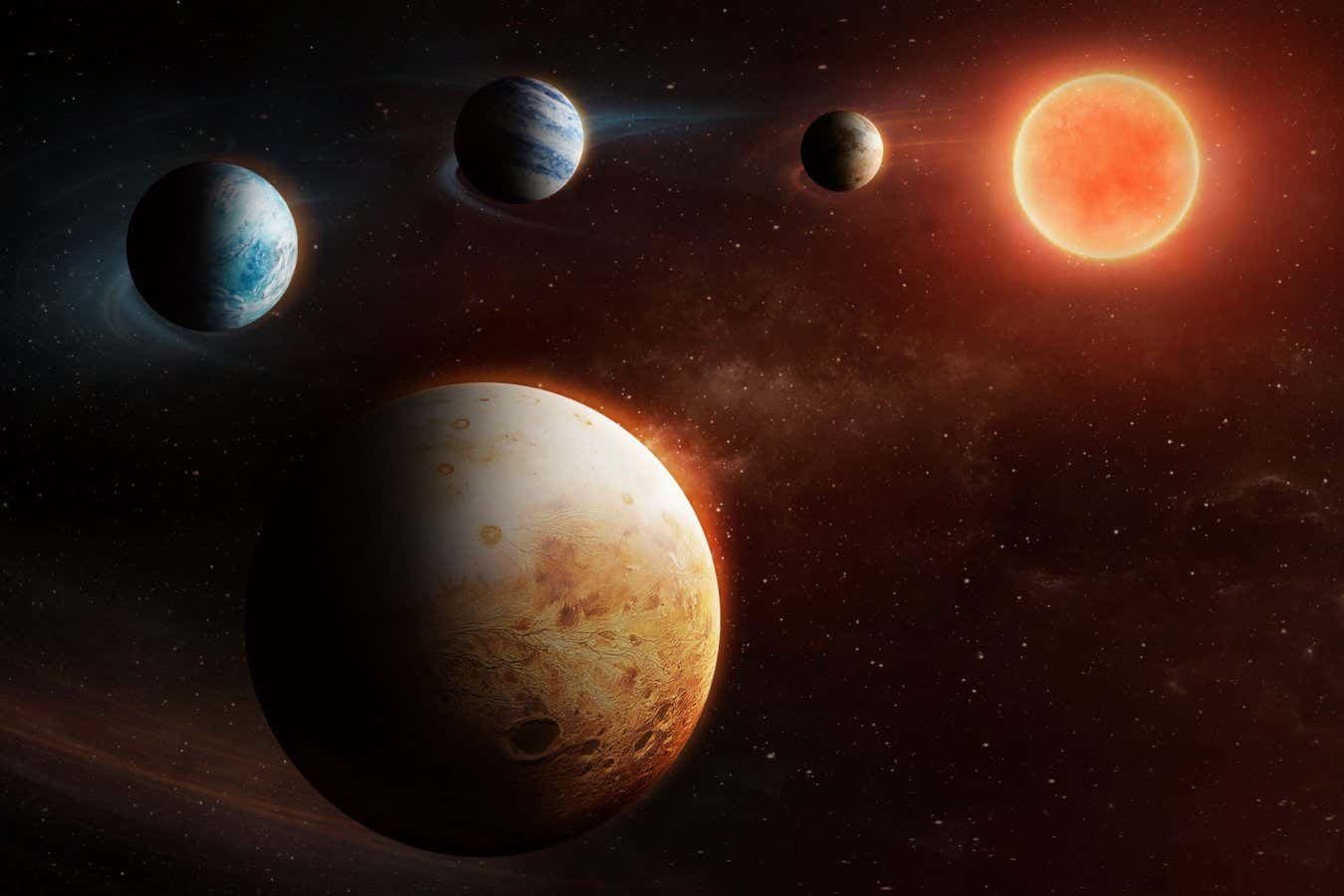
    Artist impression of the planetary system around the star LHS 1903

    ESA

    Astronomers have found a planetary system that seems to have formed inside-out. While most systems, like our own, have rocky planets closest to their star and gaseous ones further out, the LHS 1903 system has a rocky world at its edge, challenging established models of planet formation.

    The outermost of the system’s four planets wasn’t immediately apparent in initial observations from the Transiting Exoplanet Survey Satellite – those first measurements allowed researchers to identify one rocky planet a little bigger than Earth close to the star, plus two gaseous ones slightly smaller than Neptune beyond that. But when Ryan Cloutier at McMaster University in Hamilton, Canada, and his colleagues followed up on the system using eight other observatories, they spotted the telltale signatures of a fourth world that is marginally bigger than the other rocky planet in the system.

    This rocky world, which is further from the star than its gaseous siblings, was unexpected. “These systems are not unheard-of, but they’re rare – and the systems that have this unique architecture, and for which we can characterise them in detail, are extraordinarily rare,” says Cloutier.

    Those details, including the sizes of the planets and the fact that they all orbit their star in periods of less than 30 Earth days, made it possible for the researchers to test models of how these planets may have formed. “Producing one planet can be done with several mechanisms, but once you need to produce four different ones, you can start to discriminate between different models,” says Solène Ulmer-Moll at Leiden University in the Netherlands. “You have find a model that can explain all of them.”

    Most systems are thought to form all of their planets at about the same time from the same disc of dust and gas. The sizes and compositions of the planets are dependent on where they formed within that disc and what events, such as collisions with other worlds, happened to them afterwards. For the LHS 1903 system, though, that model doesn’t work.

    If the planets of LHS 1903 were born in the traditional way, the outermost one should have formed with a thick gaseous envelope like the middle two. That atmosphere could have been lost through a collision or bombardment with radiation, but the researchers’ simulations show that such a process would have also stripped away the gas from one or both of the inner planets.

    “It’s really difficult for you to sculpt the outermost planet without affecting those gaseous planets that are closer to the star,” says Cloutier. But the orbital dynamics of the system make it extraordinarily unlikely that any of the planets wasn’t born from the same disc.

    Cloutier and his team found that the most likely way for this system to be created is through a process called “inside-out” planet formation. Here, a single planet forms and then migrates inwards towards the star, making room for the next planet, and so on. This takes time, so the planets are born in different environments as the protoplanetary disc evolves. “That final planet, if it’s taken long enough, it has formed in an environment where there’s no gas available,” says Cloutier. This system goes to show how diverse the planetary formation processes in the universe might be, he says.

    Topics:


    Source link

    Share. Facebook Twitter Pinterest LinkedIn Tumblr Email Telegram Copy Link

    Related Posts

    Science

    How do earthquakes end? A seismic ‘stop sign’ could help predict earthquake risk

    April 24, 2026
    Science

    ‘Kraken’ fossils show enormous, intelligent octopuses were top predators in Cretaceous seas

    April 24, 2026
    Science

    Largest ever octopus was great white shark of invertebrate predators

    April 24, 2026
    Science

    Do you need to worry about Mythos, Anthropic’s computer-hacking AI?

    April 23, 2026
    Science

    How many dachshunds would it take to get to the moon?

    April 23, 2026
    Science

    The Age Code review: Can you slow ageing with your diet? A new book gives it a go

    April 23, 2026
    Editors Picks

    Trump administration proposes massive budget cuts to science

    April 5, 2026

    China’s EV sales zoom past western rivals

    December 27, 2024

    If a bird flu pandemic starts, we may have an mRNA vaccine ready

    April 22, 2026

    Nvidia just unexpectedly tanked these stocks, and here’s why

    January 7, 2026

    How the US left Ukraine exposed to Russia’s winter war | News

    February 5, 2026
    About Us
    About Us

    Welcome to Benjamin Franklin Institute, your premier destination for insightful, engaging, and diverse Political News and Opinions.

    The Benjamin Franklin Institute supports free speech, the U.S. Constitution and political candidates and organizations that promote and protect both of these important features of the American Experiment.

    We are passionate about delivering high-quality, accurate, and engaging content that resonates with our readers. Sign up for our text alerts and email newsletter to stay informed.

    Latest Posts

    Beijing’s new supply chain rules deepen concerns for US firms in China

    April 24, 2026

    India denounces ‘hellhole’ remark shared by Trump | Donald Trump News

    April 24, 2026

    New photos of Mike Vrabel and Dianna Russini emerge

    April 24, 2026

    Subscribe for Updates

    Stay informed by signing up for our free news alerts.

    Paid for by the Benjamin Franklin Institute. Not authorized by any candidate or candidate’s committee.
    • Privacy Policy
    • About us
    • Contact us

    Type above and press Enter to search. Press Esc to cancel.