

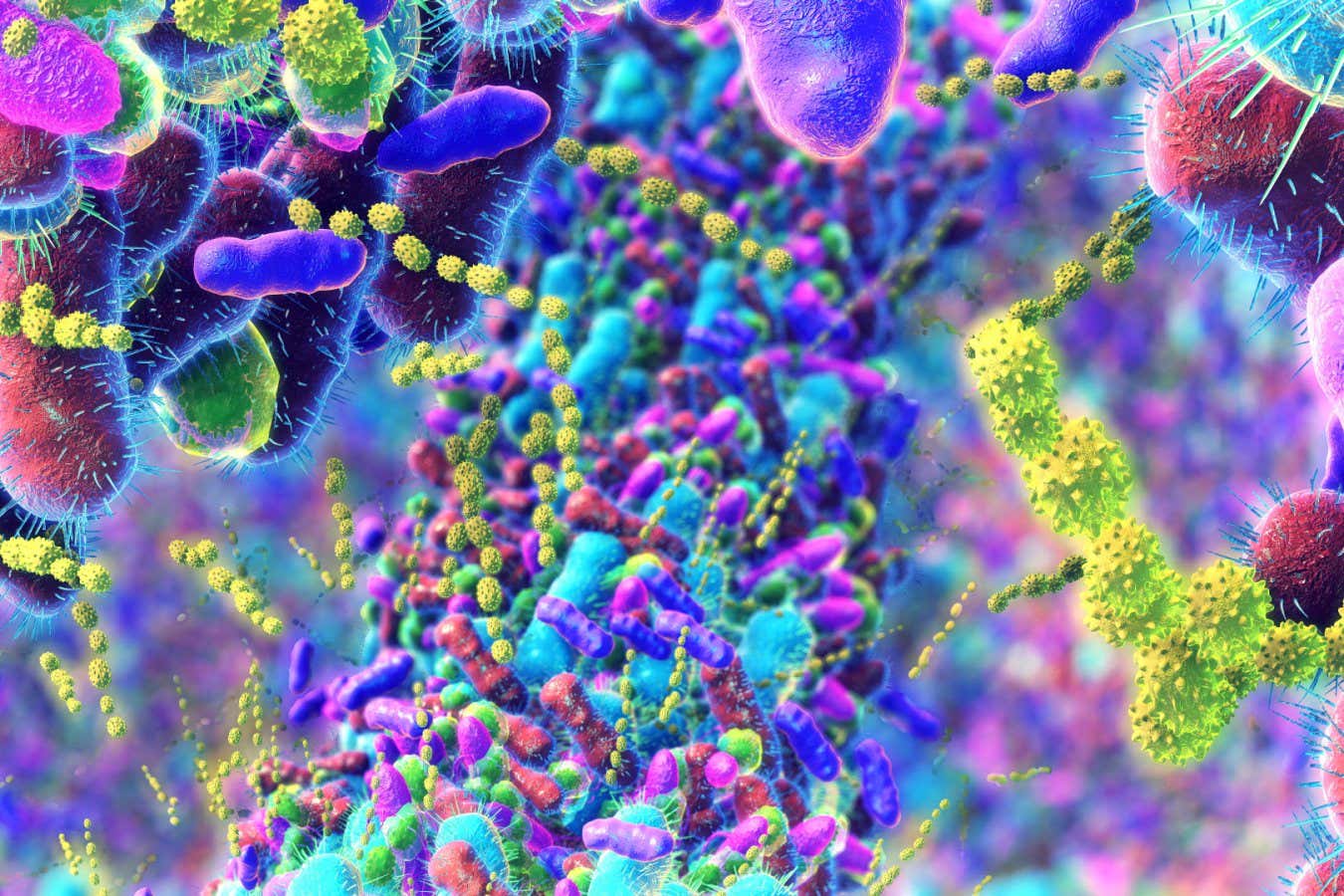
Our gut microbiome has a significant impact on our hormones
nopparit/Getty Images
Discarded sex hormones can be returned to the bloodstream by bacteria in the gut – and now, a study has found that there are far more of these sex-hormone-recycling bacteria in the guts of people in industrialised societies than in those of hunter-gatherers and non-industrial farmers. This might mean that, as a result of urban living, some people have higher blood levels of certain sex hormones, which would have profound health effects.
“We don’t how the body would respond to this increased input,” says Rebecca Brittain at Jagiellonian University Medical College in Poland. “But the implications could be quite large.”
Sex hormones, such as oestrogens, circulate in the blood. When levels are too high, cells in the liver add a chemical tag that results in a hormone being excreted, often via the gut. But that tag happens to be a sugar molecule that certain bacteria feed on. So, some bacteria in the gut cut off the tags, using enzymes called beta-glucuronidases.
Once a tag is removed, a hormone can be reabsorbed by the body and end up back in the bloodstream. Studies suggest that substantial proportions of excreted sex hormones are recycled by gut bacteria in this way.
In 2011, the concept of the “oestrobolome” was first used to describe all the gut bacteria that can alter oestrogens, and thus potentially affect blood levels in both sexes. Earlier this year, it was proposed that “testobolome” be used to describe the gut bacteria that can affect testosterone levels.
The latest study from Brittain’s team has compared the oestrobolomes of hundreds of people from 24 populations around the world, using data from previous studies in which their gut microbiomes were sequenced. These populations included, for example, hunter-gatherers in Botswana and Nepal, rural farmers in Venezuela and Nepal, and city dwellers in Philadelphia and Colorado.
Specifically, Brittain’s team looked for genetic sequences coding for beta-glucuronidase enzymes, measuring the overall proportion of these sequences and their diversity. The results suggest that the oestrogen-recycling capacity of gut microbes in industrialised populations is up to seven times greater than in the hunter-gathering and rural farming populations, with twice the diversity too.
The team also found that there is up to three times the recycling capacity in babies who are fed formula than in those who are breastfed, with up to 11 times the diversity. People’s age, sex and BMI, however, made no difference to their oestrobolomes.
Brittain’s team and others are now trying to establish if the higher recycling capacity suggested by the gene sequences really does correspond with higher levels of oestrogen recycling and, most crucially, if this results in higher blood levels of the hormones. It could be, for instance, that people’s bodies can adjust hormone levels to partially or completely compensate for higher recycling.
But if some individuals do have higher blood levels of oestrogens throughout their lives because of their microbiomes, it could have a big impact on their fertility and health, increasing the risk of certain cancers, for instance. But in some cases, these effects could be beneficial. “The assumption is usually that higher oestrogen recycling is harmful,” says Brittain. “I don’t think that’s a fair assumption. For some people with really low oestrogen levels this could be a good thing.”
“It is an interesting study that adds to the growing evidence of the importance of the gut microbiome function in human health and development,” says Katherine Cook at Wake Forest University School of Medicine in North Carolina, who is investigating the possible links between the microbiome and the risk of breast cancer.
But it does have limitations, she says, including the fact that all the industrialised populations were in the US. “Additional cohorts, perhaps from Europe, could have strengthened the industrial associations,” says Cook.
Brittain says that she and her colleagues will try to identify the lifestyle factors responsible for the differences they found. “We would love to know so much more about these individuals, but the data didn’t exist, so we’ll do our own study,” she says.
Topics: