
Close Menu
    Trending
    • Beijing’s new supply chain rules deepen concerns for US firms in China
    • India denounces ‘hellhole’ remark shared by Trump | Donald Trump News
    • New photos of Mike Vrabel and Dianna Russini emerge
    • AI search demands a new audience playbook
    • How do earthquakes end? A seismic ‘stop sign’ could help predict earthquake risk
    • Trump Announces Cease-Fire Between Israel and Lebanon
    • Google Is Tracking Your Life – Photo Cloud Feeding AI System
    • Rachel Zoe Confronts Amanda Frances In ‘RHOBH’ Reunion Clip
    Benjamin Franklin Institute
    Friday, April 24
    • Home
    • Politics
    • Business
    • Science
    • Technology
    • Arts & Entertainment
    • International
    Benjamin Franklin Institute
    Home»Business»The Trump administration just gave the food pyramid a Sweetgreen makeover
    Business

    The Trump administration just gave the food pyramid a Sweetgreen makeover

    Team_Benjamin Franklin InstituteBy Team_Benjamin Franklin InstituteJanuary 7, 2026No Comments3 Mins Read
    Share Facebook Twitter Pinterest Copy Link LinkedIn Tumblr Email VKontakte Telegram
    Share
    Facebook Twitter Pinterest Email Copy Link


    President Donald Trump’s administration has introduced a new, inverted food pyramid with fewer food groups.

    The new three-section food pyramid is part of the administration’s new nutrition policy announced Wednesday, which encourages Americans to eat whole or minimally processed foods, which it calls “real food,” and has been a long time interest of Health and Human Services Secretary Robert F. Kennedy.

    His policy interests also shine through on the initiative’s new website, realfood.gov, which features copy that reads like a MAHA manifesto. The National Design Studio gave the website a minimalist design that takes cues from consumer companies like Chobani and Sweetgreen, with clean, sans-serif typefaces and playful illustrations.

    The new pyramid

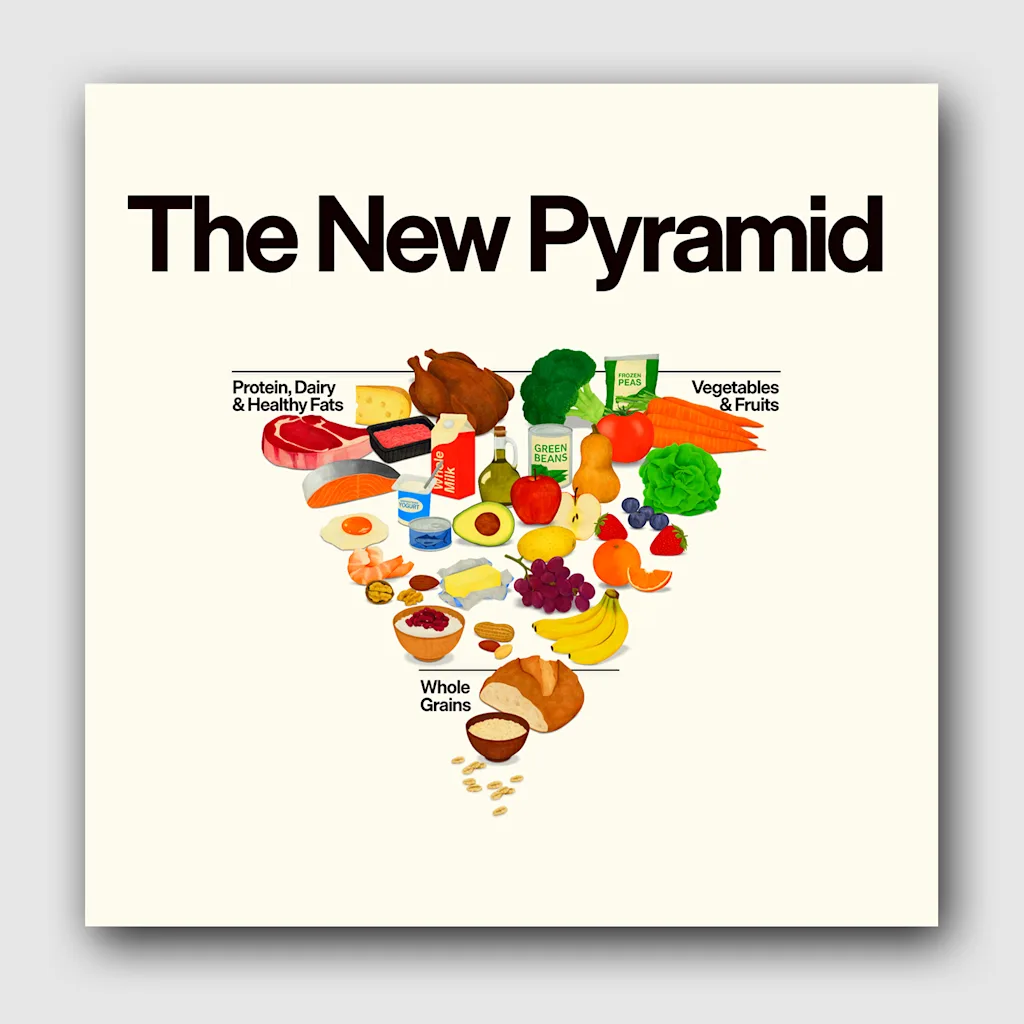
    The original pyramid, released by the U.S. Department of Agriculture (USDA) in 1992, featured six sections. The new version is flipped and has three: protein, dairy, and healthy fats; vegetables and fruits; and whole grains. Sweets have been removed.

    [Image: USDA]

    “It’s upside-down, a lot of people would say,” Health Secretary Robert F. Kennedy, Jr., said at a White House press conference. “But it was actually upside-down before and we just righted it.”

    The new pyramid graphic makes do with fewer groups by combining categories from the original food pyramid. Whole grains, once included in the base of the original pyramid, now make up the smallest portion of the new version, while old categories—fruits and vegetables, and meat and dairy—are combined.
    [Image: USDA]

    The graphic is colorful, with eye-catching, painterly illustrations of example foods that might appear in a ’70s health food magazine. But the infographic is less successful as a piece of communication design. It’s not clear how literally the placement of foods within the graphic is meant to be. And although supporting documents about the new pyramid offer specific guidelines, like suggesting saturated fat consumption shouldn’t exceed 10% of total daily calories, the new pyramid doesn’t communicate specifics itself.

    Users can hover over each section of the pyramid for additional information, but it doesn’t provide much. The pyramid doesn’t indicate how many servings dairy or healthy fats should you have. And to determine your protein target, realfood.gov asks Americans to take on the additional step of first calculating their weight in kilograms. (Quite frankly, we don’t know what that is.)

    The federal government’s new guidance, which gets updated every five years, also removes specific recommendations about daily alcohol consumption and only suggests to drink less. It also calls for more protein and full-fat dairy.

    Government designers have worked to improve upon the food pyramid before. In 2005, an updated graphic made the food segments slice upwards instead of dividing the shape horizontally. In 2011, it ditched the pyramid altogether for MyPlate, a skeuomorphic representation of dietary guidelines that used a circular graphic to represent portions as they’d appear on a plate.

    The new 2026 pyramid represents the Trump administration’s “Make America Healthy Again” priorities under Kennedy’s Health Department and comes two days after the agency cut its number of recommended vaccines for children, worrying medical groups.

    The new recommendations are not meant to be a strict diet, according to its website, but “a flexible framework meant to guide better choices.” It’s minimalist, for sure, but whether Americans find it a useful guide to healthy living remains to be seen.


    Source link

    Share. Facebook Twitter Pinterest LinkedIn Tumblr Email Telegram Copy Link

    Related Posts

    Business

    AI search demands a new audience playbook

    April 24, 2026
    Business

    AI is replacing creativity with ‘average’

    April 24, 2026
    Business

    Palantir is dropping merch and stirring pots

    April 24, 2026
    Business

    NASA’s awe-inducing iPhone moon video is a free ad for Apple, but there’s a catch

    April 23, 2026
    Business

    The U.S. just changed marijuana law for the first time in decades

    April 23, 2026
    Business

    Want to live a longer, happier life? Science says work to be more successful (but not in the way you might think)

    April 23, 2026
    Editors Picks

    Ingestible Electronics Are Turning Pills Into Devices

    February 18, 2026

    WATCH: Mother Of Maryland Woman Murdered By MS-13 Gang Member Details Gruesome Attack

    April 18, 2025

    Machine Gun Kelly Unveils New Ink Dedicated To Daughter Saga

    March 2, 2026

    TerraUSD creator sentenced to 15 years in prison over $40bn crash

    December 12, 2025

    Opinion | A Real Plan for A.I. Job Losses

    April 22, 2026
    About Us
    About Us

    Welcome to Benjamin Franklin Institute, your premier destination for insightful, engaging, and diverse Political News and Opinions.

    The Benjamin Franklin Institute supports free speech, the U.S. Constitution and political candidates and organizations that promote and protect both of these important features of the American Experiment.

    We are passionate about delivering high-quality, accurate, and engaging content that resonates with our readers. Sign up for our text alerts and email newsletter to stay informed.

    Latest Posts

    Beijing’s new supply chain rules deepen concerns for US firms in China

    April 24, 2026

    India denounces ‘hellhole’ remark shared by Trump | Donald Trump News

    April 24, 2026

    New photos of Mike Vrabel and Dianna Russini emerge

    April 24, 2026

    Subscribe for Updates

    Stay informed by signing up for our free news alerts.

    Paid for by the Benjamin Franklin Institute. Not authorized by any candidate or candidate’s committee.
    • Privacy Policy
    • About us
    • Contact us

    Type above and press Enter to search. Press Esc to cancel.