

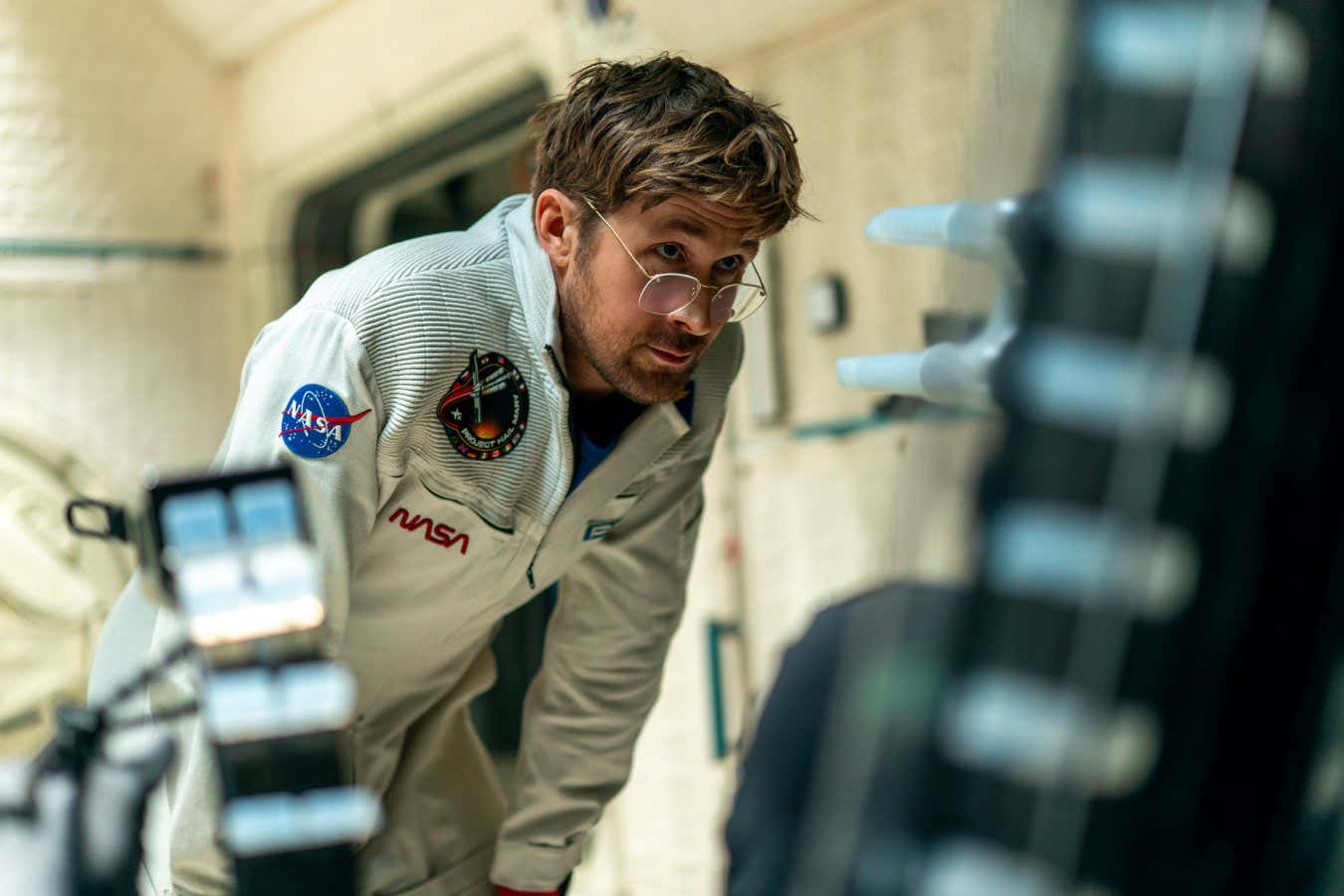
Ryan Gosling stars as Ryland Grace in Project Hail Mary
Jonathan Olley / Amazon Content Services LLC
Part-way through watching Project Hail Mary in a full IMAX theatre, I let out a solitary gasp. Wondering why nobody else was shocked about what I had just seen, I realised it was because I am a physicist.
Let me explain, with an extremely mild spoiler: there’s a scene in the middle of the film where the Hail Mary spaceship suddenly lurches forward. Ryan Gosling’s character, Ryland Grace, is not strapped into his seat and his head smacks sideways into the screens in front of him. If this had been real, he would have certainly died. Of course, I see films all the time where people get thrown around and punched in the face and dropped from heights that would shatter their bodies, but they survive. Usually, I am able to suspend disbelief.
What made this viewing experience different was the careful attention to getting the science of motion in outer space right. Instead of asking their science advisors to help them make invented science look real, directors Phil Lord and Christopher Miller evidently asked a team at NASA to help them make their science-fiction film look true to life.
What matters here is momentum. If you’ve ever been peddling your bike very fast and had to stop suddenly, you have a sense of momentum. It’s harder to stop with a heavier bike; it’s also harder to stop when you’re going fast than when you’re going slow. One way to think of momentum is that it’s how much force you and the bike are carrying together. It is proportional to your speed and your mass. For related reasons, this is why trucks should follow cars at a bigger distance than smaller vehicles; they are more massive and have a longer stop time.
One of the wonders about physics as a body of knowledge is that momentum applies everywhere in the universe. Isaac Newton’s second law codified this notion of momentum and the idea that it was a literally universal phenomenon. When an astronaut leaves Earth, they still have to contend with it in new and unexpected ways. When you put the fact of Newton’s second law into conversation with Newton’s first law, life in space quickly gets interesting.
The first law says that an object in motion will stay in motion, while an object at rest will stay at rest. This never quite seems to be the case in daily life, as other forces are at play here on Earth. In a cricket match, when a batter makes contact with the ball, even if it flies for a while, it eventually hits the ground. Earth’s gravity counteracts the force of the contact between bat and ball. The ball does not stay in motion. In space, far from a massive source of gravity, there is no impediment; the ball would keep going.
This is exactly what happens to Grace in the film when his spaceship lurches forward. With no seat belt to hold him down, he goes flying. When his head and the spaceship panel collide, they do so with a high level of momentum because there is no force to impede the force of the contact – which is why I was expecting a bone-crunching death. (The fact that this doesn’t happen shows that physics can’t always overrule a movie’s plot).

The character Ryland Grace experiences Newton’s laws of motion on his journey through space
Alamy Stock Photo / LANDMARK MEDIA
In the movie there are a variety of little moments like this that had me stressed. Honestly, at times I felt like I was in hell, not because the movie was bad, but to the contrary – because much of the physics (if not physiology) was rendered so well. It was also sometimes beautiful. There’s a scene where Grace is throwing an object from his spaceship, and I loved the simplicity of watching it continue in a perfectly straight line, without slowing down, something that would never happen on Earth.
Four years ago, I wouldn’t have had the same experience watching a film like Project Hail Mary. I’ve spent my entire career trying to keep a distance between myself and Newtonian physics, preferring the realm of relativistic and quantum sciences. As a first-year university student, I found these thought experiments involving cars speeding and sports balls flying through the air to be a bit stale. I wanted the big, cosmic science. As a professor, I’ve since accepted that this is the best way to introduce students to ideas that will follow them into places like the quantum realm, where the concept of momentum takes on importance in a rather spectacular way. But initially, this was a grudging acceptance.
Everything changed when I was doing research for my new book, The Edge of Space-Time. I wanted to write about how we try to understand and conceptualise space, and in the process realised that Newton’s first law especially is, of course, part of that story. Imagine my surprise when I learned that over a millennium before Isaac Newton was born, the Zhou Kingdom philosopher Mozi and his followers had already written down something like that law in the Mo Ching.
I spent three weeks down a rabbit hole, studying the only three known English translations of the Mo Ching, emerging with a new sense of why the fundamentals of motion matter. Reading those Mo Ching passages convinced me to read Newton’s original words in the Principia in both Latin and English. Suddenly, I was fascinated. Decades after earning my first degree in physics, I am still having my world tilted by new lessons about it. And importantly, it wouldn’t have been possible without the translation work of my colleagues in the humanities who spend their time with ancient languages.
My time watching Project Hail Mary was a real moment of synergy: scientists advised some artists who made art that depended on the translation work of humanists. I gripped my chair with anxiety and emerged with some criticisms of the story (and its author, Andy Weir). But I also walked out of the theater satisfied at all the ways I had taught my mind to see the universe in action, and grateful to all the people who made it possible for me to witness it.
Topics: