

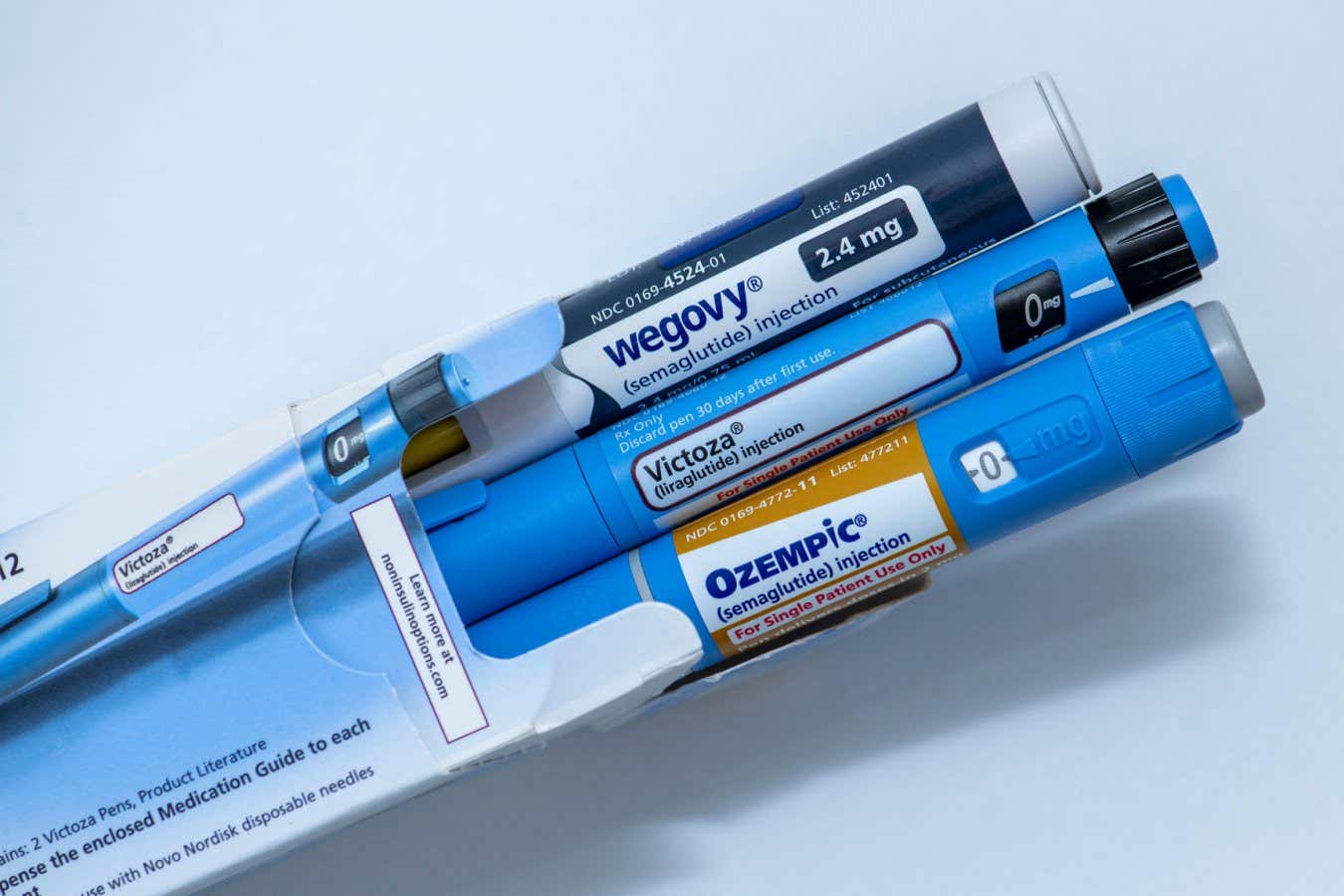
A drastic surge in demand has put drugs like Wegovy, Victoza and Ozempic in short supply
Michael Siluk/Alamy
The blockbuster weight-loss drug semaglutide and its rivals promise to help reverse the global obesity epidemic – if only more of the people who would benefit from these treatments could afford them. But this year could see welcome steps in that direction.
For years, weight-loss drugs were in short supply, but by the end of 2024, manufacturers had caught up with the huge demand. But medicines such as semaglutide (sold as Wegovy or Ozempic) remain very expensive, typically costing several thousand dollars for a year’s supply.
That price tag puts them beyond the reach of most of the more than 1 billion people around the world who have obesity; only 3 per cent of eligible people in the US are on weight-loss drugs, and less than 1 per cent elsewhere, according to the financial company Morgan Stanley.
But two key developments are expected in 2026. One is the approval of a drug called orforglipron in various countries. This works in the same way as semaglutide, by mimicking the action of a hormone called GLP-1, which reduces appetite. But it’s a small molecule, meaning that unlike semaglutide, it can be absorbed through the gut and thus can be taken in pill form.
“Tablets are cheaper to produce, easier to store and simpler to distribute,” says Lora Heisler at the University of Aberdeen in the UK. “In short, pills can provide treatment to more people who need it.”
Semaglutide, by contrast, is a large molecule, a kind of protein. Large-molecule drugs are generally much more difficult and expensive to manufacture. They also usually have to be injected, and supplying them in injector pens adds to the costs and complications. These are the reasons why manufacturers long struggled to meet the demand for GLP-1 drugs after they became popular for weight loss.
Confusingly, there is a pill form of semaglutide called Rybelsus, which is approved for type 2 diabetes, and the maker of semaglutide – Novo Nordisk – has applied for approval for a pill form for weight loss.
However, Rybelsus is not an ordinary pill. It contains semaglutide in combination with a substance called salcaprozate sodium, which neutralises stomach acid and “fluidises” cell membranes, allowing semaglutide to pass through the cells lining the gut and enter the bloodstream. You don’t want this happening with partially digested food, so Rybelsus has to be taken at least 8 hours after eating, and people cannot eat or drink for half an hour after taking it.
All this is why orforglipron should be cheaper to produce than semaglutide, and why it can be taken without the special requirements for Rybelsus.
The approval of another GLP-1 drug will also increase competition between pharmaceutical companies. The maker of orforglipron, Lilly, has yet to announce pricing but has indicated it will be cheaper than other GLP-1 drugs.
The only downside is that it seems to be less effective, with people on the highest dose losing around 10 per cent of their weight after 72 weeks, compared with around 14 per cent for semaglutide, though a head-to-head trial will be needed to confirm this.
The second big development is the expiry of semaglutide patents in countries including China, India, Brazil, Canada and Turkey – that is, for a big chunk of the global population. This means drug manufacturers can start selling generic versions.
Generics have to be approved and meet the same standards as patented versions, but can be much cheaper. “When a medicine loses patent protection, typically generic competition reduces prices by as much as 90 per cent,” says Jeremy Durrant at Medicines UK, an association of generic medicine manufacturers.
So soon a lot more people could have access to these drugs. But in guidelines released in December, the World Health Organization (WHO) recommended that people should get counselling on behavioural and lifestyle changes in addition to the drugs, to maximise the benefits and ensure they persist. “Medication alone cannot solve the global obesity burden,” wrote Francesca Celletti at the WHO.
Topics: