
Close Menu
    Trending
    • NHTSA considers new car door safety rules after fatal Tesla crashes
    • PlayStation Network outage resolved after thousands of gamers unable to play
    • Market Talk – July 24, 2026
    • Joe Biden Gives Up, Declines to Seek Further Review of Appeals Court Ruling on Release of Audiotapes with Ghostwriter
    • Meghan McCain Claps Back At Being Called ‘Old And Ugly’
    • Mixed day for global equities as oil prices retreat
    • Venezuela to exit International Criminal Court, accusing it of ‘bias’ | ICC News
    • Andy Reid shares massive Patrick Mahomes recovery update
    Benjamin Franklin Institute
    Friday, July 24
    • Home
    • Politics
    • Business
    • Science
    • Technology
    • Arts & Entertainment
    • International
    Benjamin Franklin Institute
    Home»Science»Temperature gets a new definition using a quantum device
    Science

    Temperature gets a new definition using a quantum device

    Team_Benjamin Franklin InstituteBy Team_Benjamin Franklin InstituteMarch 27, 2026No Comments3 Mins Read
    Share Facebook Twitter Pinterest Copy Link LinkedIn Tumblr Email VKontakte Telegram
    Share
    Facebook Twitter Pinterest Email Copy Link


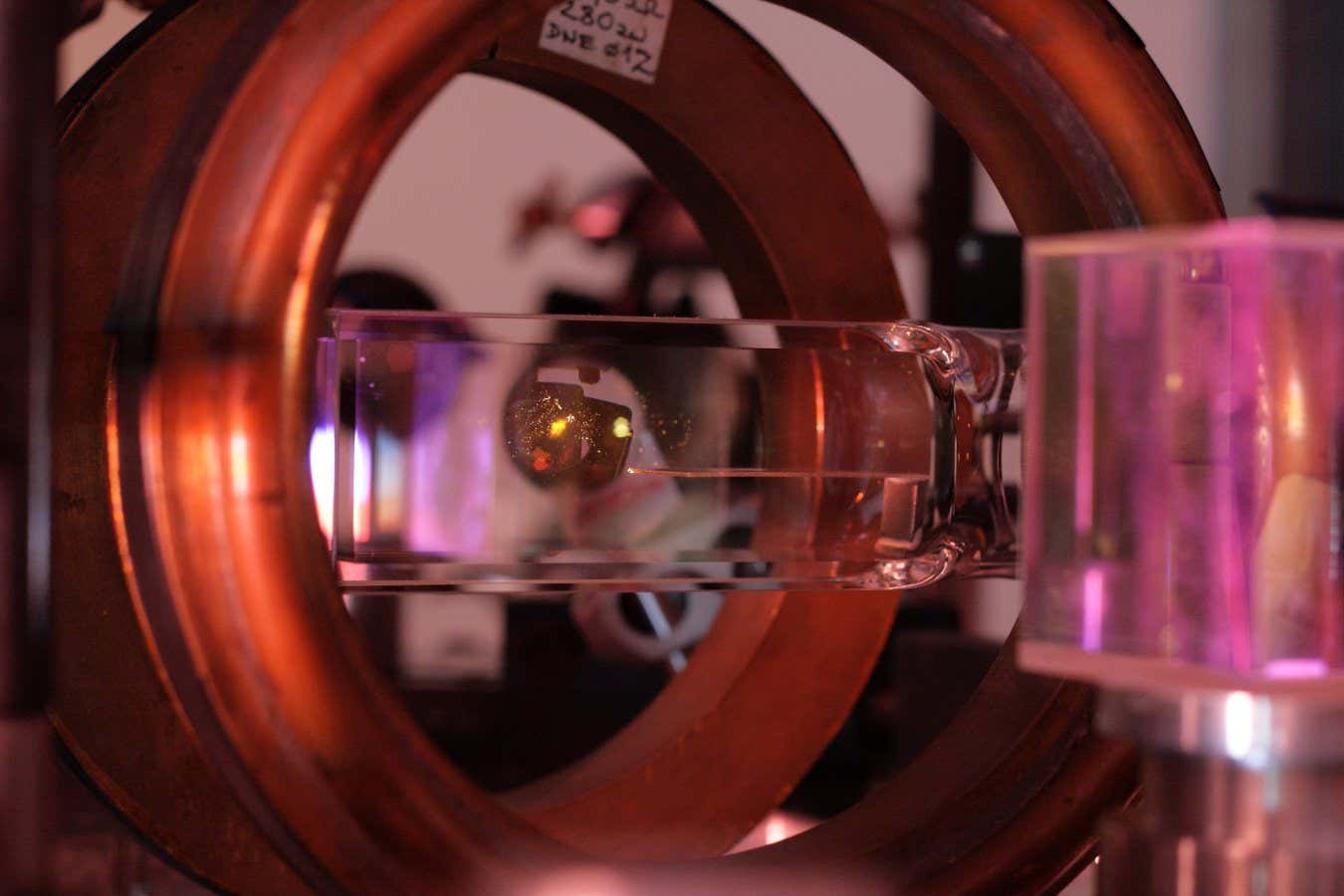
    The main part of the new set-up for cooling and trapping rubidium atoms

    Tomasz Kawalec CC BY-SA 4.0

    A better, more reliable definition of temperature could come from a quantum device full of giant atoms.

    While some countries measure temperatures in Celsius and others use Fahrenheit, physicists everywhere use a unit called kelvin. Zero kelvin denotes the absolute coldest temperature allowed by the known laws of physics, so kelvin is said to measure “absolute temperature”. In practice, however, making sure that when you measure a single kelvin, it really is a single kelvin is a laborious process.

    “If you want to make an absolute temperature measurement, you buy a commercial temperature sensor, which was calibrated by another commercial temperature sensor, which was calibrated by another commercial temperature sensor, and so on. And one of those sensors was, at some point, sent to the National Institute of Standards [and Technology],” says Noah Schlossberger at NIST in Colorado.

    He and his colleagues have now built a device that uses quantum effects to measure kelvin, which researchers could use instead of having to get someone else to calibrate their sensors.

    The device is a small box made from metal and glass containing trapped rubidium atoms. The researchers push these atoms to an extreme size, using lasers to move the outermost electrons unusually far from the nucleus, and to an extreme temperature by using both lasers and electromagnetic fields to grab onto and chill the atoms to about half a millikelvin, a temperature roughly a 600,00th that of room temperature.

    As a result, the outermost electrons in the rubidium atoms become extremely sensitive to even a small increase in temperature and “jump” into a different quantum state when exposed to one. These jumps are what makes the device a great temperature sensor, because there are well-established mathematical models that can determine the temperature differences needed to make them – effectively allowing for a redefinition of kelvin in these terms.

    The International Bureau of Weights and Measures defines the kelvin in a similar way – as a product of several quantum constants – but, in practice, even institutions like NIST use non-quantum devices for calibration. The hope is that the new device gives a quantum definition of kelvin where calibration wouldn’t be needed.

    “Every rubidium atom in the world is exactly the same, and they will behave in exactly the same way in the same environment. I can rebuild the device on the other side of the world, and it will be exactly the same,” says Schlossberger. He says this is especially important for keeping high-precision devices functioning correctly, such as atomic clocks, which can only work at very low-kelvin temperatures.

    But the new device is still a prototype and so it still has imperfections in how quantum states are detected, for example. It is also too bulky to leave the lab and took more than six months to build. The researchers are now working on optimising its design to make it more practical and to increase its accuracy.

    Schlossberger presented the work on 16 March at the American Physical Society Global Physics Summit in Colorado.

    Topics:


    Source link

    Share. Facebook Twitter Pinterest LinkedIn Tumblr Email Telegram Copy Link

    Related Posts

    Science

    NHTSA considers new car door safety rules after fatal Tesla crashes

    July 24, 2026
    Science

    Fungus made fashion—researchers turn living organisms into textiles

    July 24, 2026
    Science

    How a 99-year-old mathematician unraveled a century-old braid mystery

    July 24, 2026
    Science

    Is it possible to regain a sense of smell? These scientists are working on it

    July 24, 2026
    Science

    Why don’t insects live in the ocean?

    July 24, 2026
    Science

    Why environmental groups are suing over SpaceX’s land swap deal

    July 24, 2026
    Editors Picks

    Kama muta: The emotion you never knew you had, and how to feel more of it

    December 31, 2025

    Trump’s Tariffs & The New Risk Ahead

    February 21, 2026

    Opinion | Ossoff: A Cross-Ideological 2028 Dark Horse

    June 16, 2026

    4 tips to help you maintain a healthy credit rating

    November 30, 2025

    Federal Appeals Court Maintains Trump’s Federalization Of CA National Guard

    June 14, 2025
    About Us
    About Us

    Welcome to Benjamin Franklin Institute, your premier destination for insightful, engaging, and diverse Political News and Opinions.

    The Benjamin Franklin Institute supports free speech, the U.S. Constitution and political candidates and organizations that promote and protect both of these important features of the American Experiment.

    We are passionate about delivering high-quality, accurate, and engaging content that resonates with our readers. Sign up for our text alerts and email newsletter to stay informed.

    Latest Posts

    NHTSA considers new car door safety rules after fatal Tesla crashes

    July 24, 2026

    PlayStation Network outage resolved after thousands of gamers unable to play

    July 24, 2026

    Market Talk – July 24, 2026

    July 24, 2026

    Subscribe for Updates

    Stay informed by signing up for our free news alerts.

    Paid for by the Benjamin Franklin Institute. Not authorized by any candidate or candidate’s committee.
    • Privacy Policy
    • About us
    • Contact us

    Type above and press Enter to search. Press Esc to cancel.