

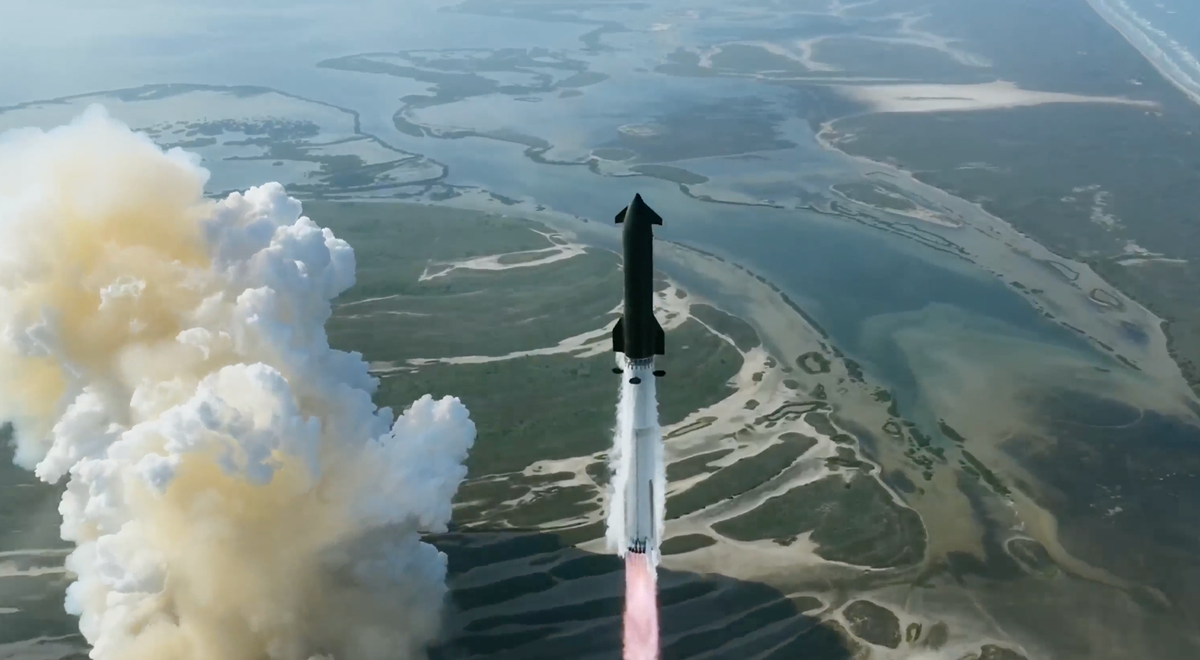
SpaceX launches Starship V3—the world’s most powerful and tallest rocket ever
Friday’s test flight marks a major milestone for SpaceX as the company gears up to go public and to participate in NASA’s Artemis III mission in 2027
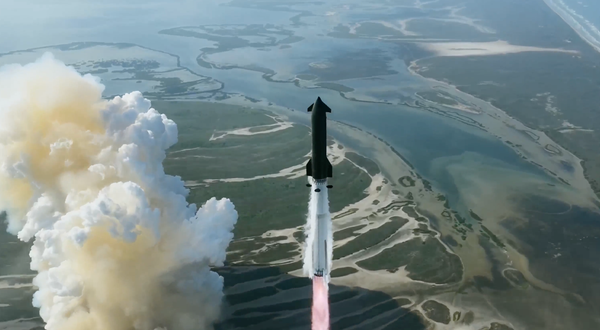
SpaceX on Friday launched the latest and largest version of Starship. Lifting off at around 6:30 P.M. EDT, the flight is the first test of Starship Version 3 (V3). This is the twelfth Starship test and the first demonstration of the rocket in seven months.
Fully stacked with its booster, the rocket is 408 feet (124 meters) tall and packing 18 million pounds of thrust, it is the tallest and most powerful rocket ever built. The entire vehicle is designed to be reusable, but SpaceX is not attempting to recover the booster or the rocket after this test.
In the initial stage of the flight, one of the 33 engines did not light as expected, but it continued on its ascent. After a couple of minutes, the booster separated with Starship, falling back to Earth to splash down in the Gulf of Mexico as planned a few minutes later. Starship continued on, with one of its six engines also out—an issue that SpaceX said could change the scope of the mission. Still, as it ascended, whoops and cheers could be heard from SpaceX’s ground team.
On supporting science journalism
If you’re enjoying this article, consider supporting our award-winning journalism by subscribing. By purchasing a subscription you are helping to ensure the future of impactful stories about the discoveries and ideas shaping our world today.
The test flight aimed to show that Starship V3 can successfully launch, separate from its booster and then splash down in the Indian Ocean. Once separated from its booster, the spacecraft deployed 20 dummy Starlink Internet satellites at an altitude of around 195 kilometers, as well as two operational satellites that are designed to scan Starship’s heat shield and beam images back to Earth for further analysis.
This image shows a view of Starship in space, as seen by one of those satellites.

Reentry began around 47 minutes after lift off. During this period, the spacecraft performed a series of landing maneuvers, including a flip. The landing was on target.
NASA administrator Jared Isaacman praised SpaceX before the test flight, nodding to Starship’s anticipated role in future Artemis missions to return astronauts to the moon as soon as 2028. “We’re looking forward to meeting up with you all in low Earth orbit,” said Isaacman, referring to the agency’s 2027 mission Artemis III, which will see NASA’s crew capsule Orion attempt to dock with either (or both) a modified version of Starship and a Blue Moon spacecraft.
Certainly, NASA has a lot riding on SpaceX’s Starship. The 2027 Artemis III mission is a stepping stone to NASA potentially using Starship to ferry its astronauts from lunar orbit to the moon’s surface, with a landing planned for as soon as 2028. But the rocket is running behind: Initial tests ended in explosions, and NASA watchdog, the Office of the Inspector General, has warned that SpaceX may be unable to deliver Starship in time for the agency’s upcoming Artemis missions.
This largely successful demonstration of SpaceX’s rocket is a feather in the company’s cap as it moves to go public as soon as next month. Elon Musk’s company touts the spacecraft as a workhorse that will drastically increase how much it can loft into orbit in a single flight—up to 100 metric tons of cargo in its reusable configuration. The company hopes to use that capability to grow its Starlink satellite Internet service, and eventually, build artificial intelligence data centers in space.
Editor’s note: This is a developing story and will be updated.
It’s Time to Stand Up for Science
If you enjoyed this article, I’d like to ask for your support. Scientific American has served as an advocate for science and industry for 180 years, and right now may be the most critical moment in that two-century history.
I’ve been a Scientific American subscriber since I was 12 years old, and it helped shape the way I look at the world. SciAm always educates and delights me, and inspires a sense of awe for our vast, beautiful universe. I hope it does that for you, too.
If you subscribe to Scientific American, you help ensure that our coverage is centered on meaningful research and discovery; that we have the resources to report on the decisions that threaten labs across the U.S.; and that we support both budding and working scientists at a time when the value of science itself too often goes unrecognized.
In return, you get essential news, captivating podcasts, brilliant infographics, can’t-miss newsletters, must-watch videos, challenging games, and the science world’s best writing and reporting. You can even gift someone a subscription.
There has never been a more important time for us to stand up and show why science matters. I hope you’ll support us in that mission.