

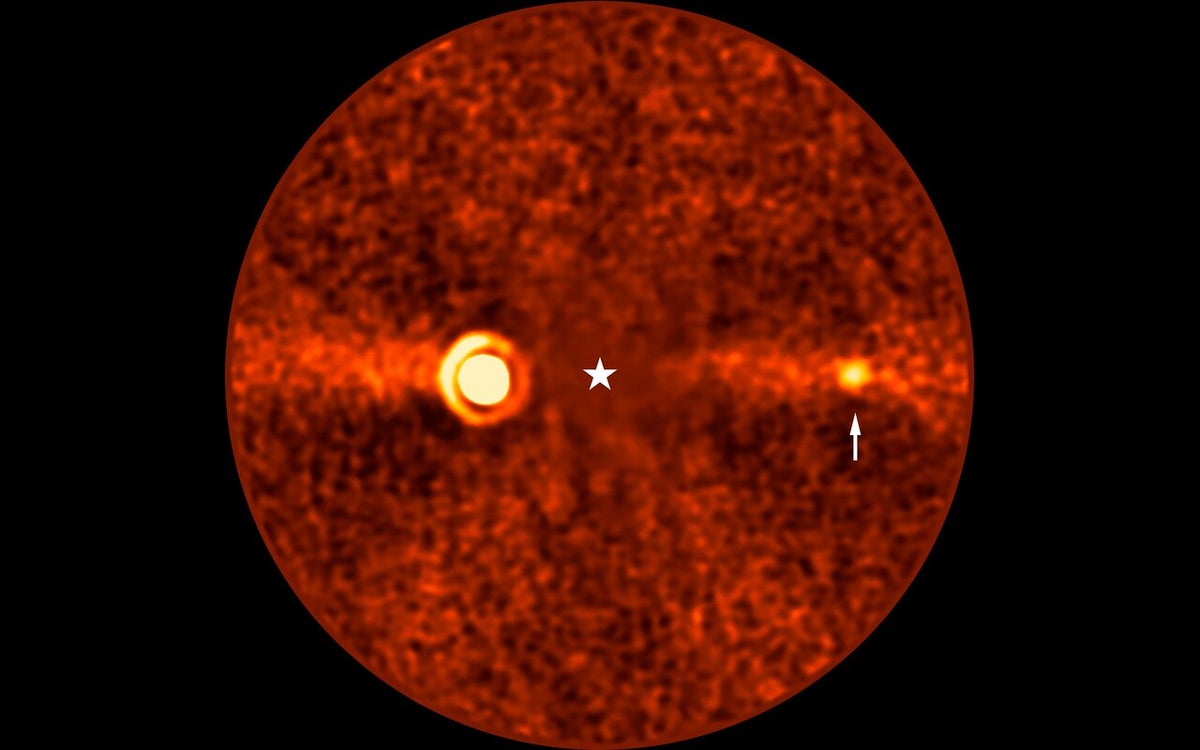
Ben Sutlieff wasn’t looking for a new planet. He’d set out to study the atmosphere of one of the two known planets orbiting a well-documented star system, Beta Pictoris. Instead, he revealed the presence of a third world—an exoplanet so small, it is the faintest planet ever imaged using a terrestrial telescope.
In December 2025, Sutlieff, a postdoctoral research associate at the University of Edinburgh, was using scanners on Chile’s Very Large Telescope (VLT) to look at light from the system in the mid-infrared range, hoping to gather data on the planet, Beta Pictoris b’s, atmosphere. But as he looked at the data he had collected, he noticed a tiny speck.
“If you look at the location where Beta Pictoris b is, you can see the new planet even then, but it’s very, very faint and you can barely tell it’s there,” says Sutlieff. “Normally, when you see things like that, you work on the data some more, and these little scrappy signals go away because they’re not real; they’re noise and they vanish.”
On supporting science journalism
If you’re enjoying this article, consider supporting our award-winning journalism by subscribing. By purchasing a subscription you are helping to ensure the future of impactful stories about the discoveries and ideas shaping our world today.
Sutlieff turned the observations over to Markus Bonse, an astronomer at the European Southern Observatory. After Bonse applied machine learning algorithms to clean the image up, the speck remained.
The mote appeared in an ideal spot to be a planet: it was located in a disk of dust orbiting the star, which astronomers believed to be debris from the planet formation process. But the researchers couldn’t rule out that it may have been just a background star until they could confirm that it was orbiting Beta Pictoris.
“If you look at the host star in multiple observations, if the planet is still there, then you know it’s a real planet,” says Sutlieff. “Whereas, if it was a background star, then it would appear to be moving away.”
Rather than waiting several years to look at the object through the VLT once more, Sutlieff, Bonse and their colleagues dove into older, archival imagery of the star system, looking for signs of their speck. Past images taken by the VLT and the James Webb Space Telescope’s near-infrared camera offered more evidence: the speck had been hiding in plain sight, but there it was, detectable by the residual heat left over from its formation, an estimated 20 million years ago.
The planet was so elusive that Sutlieff and Bonse nodded to it in the title of their co-authored article in The Astrophysical Journal Letters: Seeking it out was akin, they wrote, to a “decade-long game of hide-and-seek.”
Called Beta Pictoris d, the exoplanet is a gas giant—made up mostly of carbon dioxide, with some water and methane tossed in—with around 2.4 times the mass of Jupiter, circling its star in a wide, 91-year-long orbit. It may sound large by our solar system’s standards, but this world is fairly tiny for the Beta Pictoris system. The star is almost double the mass of the sun, and the two other known planets are both around 10 times as massive as Jupiter.
The hunt for exoplanets has turned up thousands of worlds, but given there are likely trillions of planets in the Milky Way, many more await discovery. Powerful tools like the JWST can help hasten the search, but it’s expensive—roughly 30 times as costly as using terrestrial telescopes, says Bonse.
That means astronomers using terrestrial telescopes “can be a bit more greedy in searching for new planets from the ground,” he says. “And there’s many upcoming opportunities that many different research institutes are also targeting.”
That search will be aided further by improving technology, including the Extremely Large Telescope, which comes online in 2029. The identification of Beta Pictoris d coming at a moment when astronomers are gearing up for that impressive piece of equipment makes it “really exciting,” says John Monnier, an astronomy professor at the University of Michigan.
“Basically, this is just a little bit of an appetizer,” he says. “We think the ELTs are going find just a huge number more of these objects.”
It’s Time to Stand Up for Science
If you enjoyed this article, I’d like to ask for your support. Scientific American has served as an advocate for science and industry for 180 years, and right now may be the most critical moment in that two-century history.
I’ve been a Scientific American subscriber since I was 12 years old, and it helped shape the way I look at the world. SciAm always educates and delights me, and inspires a sense of awe for our vast, beautiful universe. I hope it does that for you, too.
If you subscribe to Scientific American, you help ensure that our coverage is centered on meaningful research and discovery; that we have the resources to report on the decisions that threaten labs across the U.S.; and that we support both budding and working scientists at a time when the value of science itself too often goes unrecognized.
In return, you get essential news, captivating podcasts, brilliant infographics, can’t-miss newsletters, must-watch videos, challenging games, and the science world’s best writing and reporting. You can even gift someone a subscription.
There has never been a more important time for us to stand up and show why science matters. I hope you’ll support us in that mission.