

For decades, atomic clocks have provided the most stable means of timekeeping. They measure time by oscillating in step with the resonant frequency of atoms, a method so accurate that it serves as the basis for the definition of a second.
Now, a new challenger has emerged in the timekeeping arena. Researchers recently developed a tiny, MEMS-based clock that makes use of silicon doping to gain record stability. After running for 8 hours, the clock deviated only by 102 nanoseconds, approaching the standard of atomic clocks while both requiring less physical space and less power to run. Doing so has been a challenge in the past because of the chaos that even slight temperature variations can introduce into timekeeping.
The group presented their new clock at the 71st Annual IEEE International Electron Devices Meeting last week.
Saving Space and Power
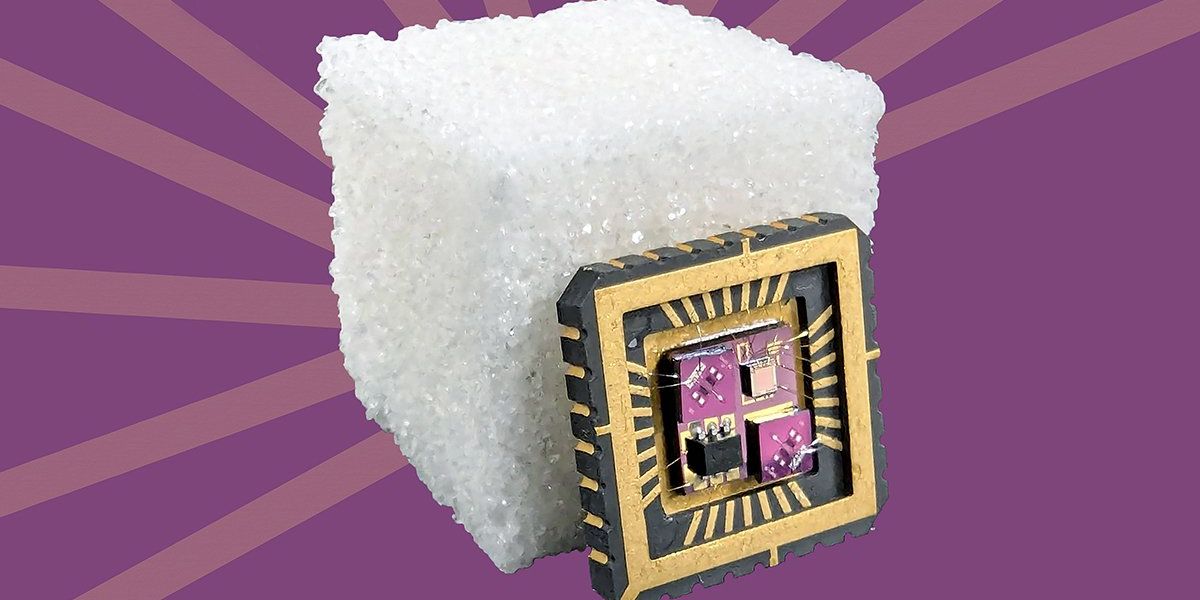
The MEMS clock is built from a few tightly connected parts, all integrated on a chip smaller than the face of a sugar cube. At its center, a silicon plate topped with a piezoelectric film vibrates at its natural frequencies, while nearby electronic circuitry measures those vibrations. A tiny, built-in heater gently keeps the whole structure at an optimal temperature. Because the resonator, electronics, and heater are all close together, they can work as a coordinated system: The resonator creates the timing signal, the electronics monitor and adjust it, and the heater prevents temperature swings from causing drift.
This clock is unique in a few ways, explains project advisor and University of Michigan MEMS engineer Roozbeh Tabrizian. For one, the resonator is “extremely stable amid variations in environment,” he says. “You could actually change the temperature from -40 °C all the way to 85 °C and you essentially don’t see any change in the frequency.”
The resonator is so stable because the silicon from which it’s crafted has been doped with phosphorus, Tabrizian says. When a material is doped, impurities are added into it, typically to change its conductive properties. Here, though, the group used doping specifically to stabilize mechanical properties. “We’re controlling the mechanics in a very tight way so that the elasticity of the material does not change upon temperature variations,” he says.
Some other materials, like the commonly used timing-crystal quartz, can also be doped for robustness. But “you cannot miniaturize [quartz] and you have a lot of limitations in terms of packaging,” Tabrizian explains. “Semiconductor manufacturing benefits from size miniaturization,” so it is an obvious choice for next-generation clocks.
The doping also allows the electronics to actively tune out any small drifts in frequency over long periods. This attribute is “the most distinctive aspect of our device’s physics compared to previous MEMS clocks,” Tabrizian says. By making the silicon conductive, the doping lets the electronics subtly adjust how strongly the device is mechanically driven, which counteracts slow shifts in frequency.
This system is also unique in its integration of autonomous temperature sensing and adjustment, says Banafsheh Jabbari, a graduate student at the University of Michigan who led the project. “This clock resonator is operating in two modes [or resonant frequencies], essentially. The main mode of the clock is very stable and we use it as the [time] reference. The other one is the temperature sensor.” The latter acts like an internal thermometer, helping the electronics automatically detect temperature shifts and adjust both the heater and the main timing mode itself. This built-in self-correction helps the clock maintain steady time even as the surrounding environment changes.
These features mean that it’s the first MEMS clock to run for 8 hours and only deviate by 102-billionths of a second. Linearly scaled up to a week of operation, that equates to just over 2 microseconds of drift. That’s worse than the top-of-the-line laboratory atomic clocks by a few orders of magnitude, but it rivals the stability of miniaturized atomic clocks.
What’s more, the MEMS clock has a significant space and power savings advantage over its atomic competition. The more isolated from their environments and the more power they use, the more precisely atomic clocks can probe the oscillations of atoms, Tabrizian explains, so they’re typically the size of a cabinet and draw a lot of power. Even chip-scale atomic clocks are 10 to 100 times as large as the MEMS clock, he says. And, “more importantly,” this new clock requires 1/10th to 1/20th the power of the mini atomic clocks.
Timekeeping for Next-Gen Tech
Jabbari’s work came out of a DARPA project with the goal of making a clock that could operate for a week and deviate by only 1 µs, so there’s still more to be done. One challenge the team faces is how the doped silicon will behave over longer operating periods, like a week. “You see some diffusion and some changes in the material,” Tabrizian says, but only time will tell how well the silicon will hold up.
It’s important to both researchers that they continue their efforts because of the wide-ranging applications they foresee for a small, power-efficient MEMS-based clock. “Essentially all modern technology that we have needs some sort of synchronization,” Jabbari says, and she thinks the clock could fill gaps in time synchronization that currently exist.
For situations in which technology has robust access to GPS satellites, there’s no problem to solve, she says. But in more extreme scenarios, like space exploration and underwater missions, navigation technology is forced to rely on internal timekeeping—which must be extremely bulky and power hungry to be accurate. A MEMS clock could be a small and less power-intensive replacement.
There are also more day-to-day applications, Tabrizian says. In the future, when more information will need to be delivered faster to each phone (or whatever devices we’ll be using in 50 years), accurate timing will become crucial for data-packet delivery. “And, of course, you cannot put a large atomic clock in your phone. You cannot consume that much power,” he says, so a MEMS clock could be the answer.
Even with promising applications, it could be a tough road ahead for this project because of existing competition. SiTime, a company already producing MEMS clocks, is even now integrating its chips in Apple and Nvidia devices.
But Tabrizian is confident about his team’s capabilities. “Companies like SiTime put a lot of emphasis on system design,” thus increasing system complexity, he says. “Our solution, on the other hand, is entirely physics based, looking into the very intricate, very fundamental physics of a semiconductor. We’re trying to get around the need for a complex system by making the resonator 100 times more accurate than the SiTime resonator.”
From Your Site Articles
Related Articles Around the Web