

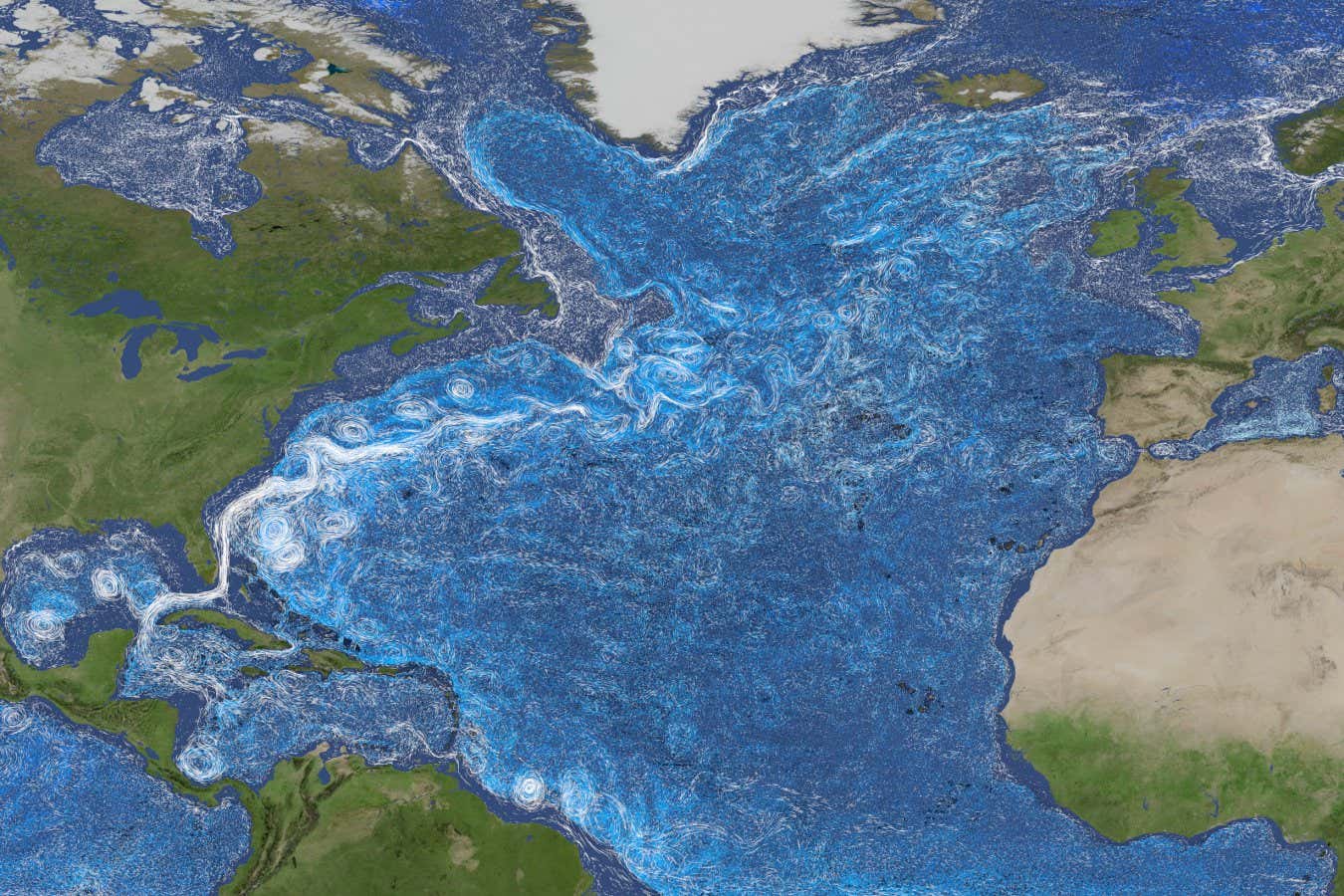
The Gulf Stream ocean current carries warm water from the Gulf of Mexico up the US east coast
NASA’s Scientific Visualization Studio/SCIENCE PHOTO LIBRARY
A gradual northward shift in the Gulf Stream has provided more evidence that the system of currents that keeps Europe warm is weakening. What’s more, modelling suggests that any abrupt shift in the Gulf Stream could signal an imminent, catastrophic collapse in the ocean current.
The Atlantic Meridional Overturning Circulation (AMOC) is the flow of warm, salty surface water from the tropics to north-western Europe, where it cools and sinks, returning south along the ocean floor. The part of this circulation running from the Gulf of Mexico up the US east coast to North Carolina, where it veers east into the Atlantic, is called the Gulf Stream.
The AMOC is expected to lose strength as the melting of the Greenland ice sheet dumps fresh water into the north Atlantic, diluting the dense, salty AMOC water and slowing the rate at which it sinks and flows southward. Some research suggests that this is already happening, but scientists don’t have direct proof.
Now, a modelling study by René van Westen and Henk Dijkstra, both at Utrecht University in the Netherlands, has shown that a weakening AMOC would shift the path of the Gulf Stream so it follows the US seaboard further north before it veers into the Atlantic.
Moreover, the study finds the Gulf Stream has already shifted northward by about 50 kilometres in 30 years, according to satellite data.
“This is something we can measure,” says van Westen. “So it is very likely that this reflects that the AMOC is indeed weakening.”
Reconstructions that estimate the AMOC flow rate based on historic sea temperatures suggest it has weakened 15 per cent since 1950. But its actual flow has only been monitored by moored instruments since 2004, not long enough to say whether observed changes are natural fluctuations or a trend.
“Therefore, we are trying to come up with some alternative approaches, such as the Gulf Stream path,” says van Westen.
The model in the study represents the world in 10-kilometre pixels rather than the typical 100-kilometre pixels, allowing the researchers to track the bulge where the Gulf Stream is carrying masses of water.
The path of the bulge changes because of the Deep Western Boundary Current, one of the arms of the AMOC carrying cold, salty water southward along the seafloor. This current normally flows down the coast of North America under the Gulf Stream, tugging it to the south. As the AMOC weakens, so does the Deep Western Boundary Current, and the curve of the Gulf Stream gradually shifts northward.
However, 392 years into the simulation’s future, the Gulf Stream jumps more than 200 kilometres to the north in just two years. Twenty-five years after that, the AMOC collapses. Previous research has shown that such a collapse would drastically cool Europe; London could see cold snaps of -20°C (-4°F) and Oslo, Norway, could reach -48°C (-54°F).
The modelling is an idealised scenario that does not suggest the AMOC will collapse in 400 years. But it does suggest an abrupt shift in the Gulf Stream could serve as an early warning of an impending AMOC shutdown, the only such prior indicator we know of. While it may be too late at that point to avoid AMOC collapse, Europe could prepare by insulating houses and finding more southerly places to grow food.
“There is now a very proper early warning indicator that actually goes off,” says van Westen. “You can measure this very easily.”
But it’s unclear in the real world how long after a Gulf Stream shift the AMOC could collapse. And projections of when the AMOC might shut down range from decades to centuries.
Dan Seidov, an oceanographer retired from the US National Oceanic and Atmospheric Administration, cautions that fresh water from Greenland could “hose” the AMOC at a different rate and in a different place from what the model assumes.
“How, when and why it may or may not happen is the big question,” he says. “If it happens as is prescribed in the model, then the Gulf Stream can be a precursor and provide a warning signal.”
While the link between the abrupt shift and AMOC collapse will need to be corroborated by other models, this study provides more evidence the AMOC is already slowing, says Stefan Rahmstorf at the University of Potsdam in Germany.
“This slowing is occurring earlier than in the global warming scenarios,” he says. “Climate models appear to underestimate the problem and thus potentially how soon an AMOC tipping point will be reached.”
Topics: