
Close Menu
    Trending
    • Billie Eilish Flaunts Results Of Fitness Journey In Plunging Top
    • Iran army warns it will ‘open new fronts’ against US if attacks resume
    • Why has FIFA not signed a World Cup broadcast deal in India? | World Cup 2026 News
    • Urban Meyer’s time with Jaguars officially ends with a whimper
    • Opinion | How to End the Gerrymandering Doom Loop Forever
    • Why Radical Transparency Is the New Competitive Advantage
    • Colossal claims an artificial eggshell will help it bring back the moa
    • EU Commissioner Blames Stagflation On War
    Benjamin Franklin Institute
    Tuesday, May 19
    • Home
    • Politics
    • Business
    • Science
    • Technology
    • Arts & Entertainment
    • International
    Benjamin Franklin Institute
    Home»Science»Saturn’s rings may have formed after a huge collision with Titan
    Science

    Saturn’s rings may have formed after a huge collision with Titan

    Team_Benjamin Franklin InstituteBy Team_Benjamin Franklin InstituteFebruary 25, 2026No Comments3 Mins Read
    Share Facebook Twitter Pinterest Copy Link LinkedIn Tumblr Email VKontakte Telegram
    Share
    Facebook Twitter Pinterest Email Copy Link


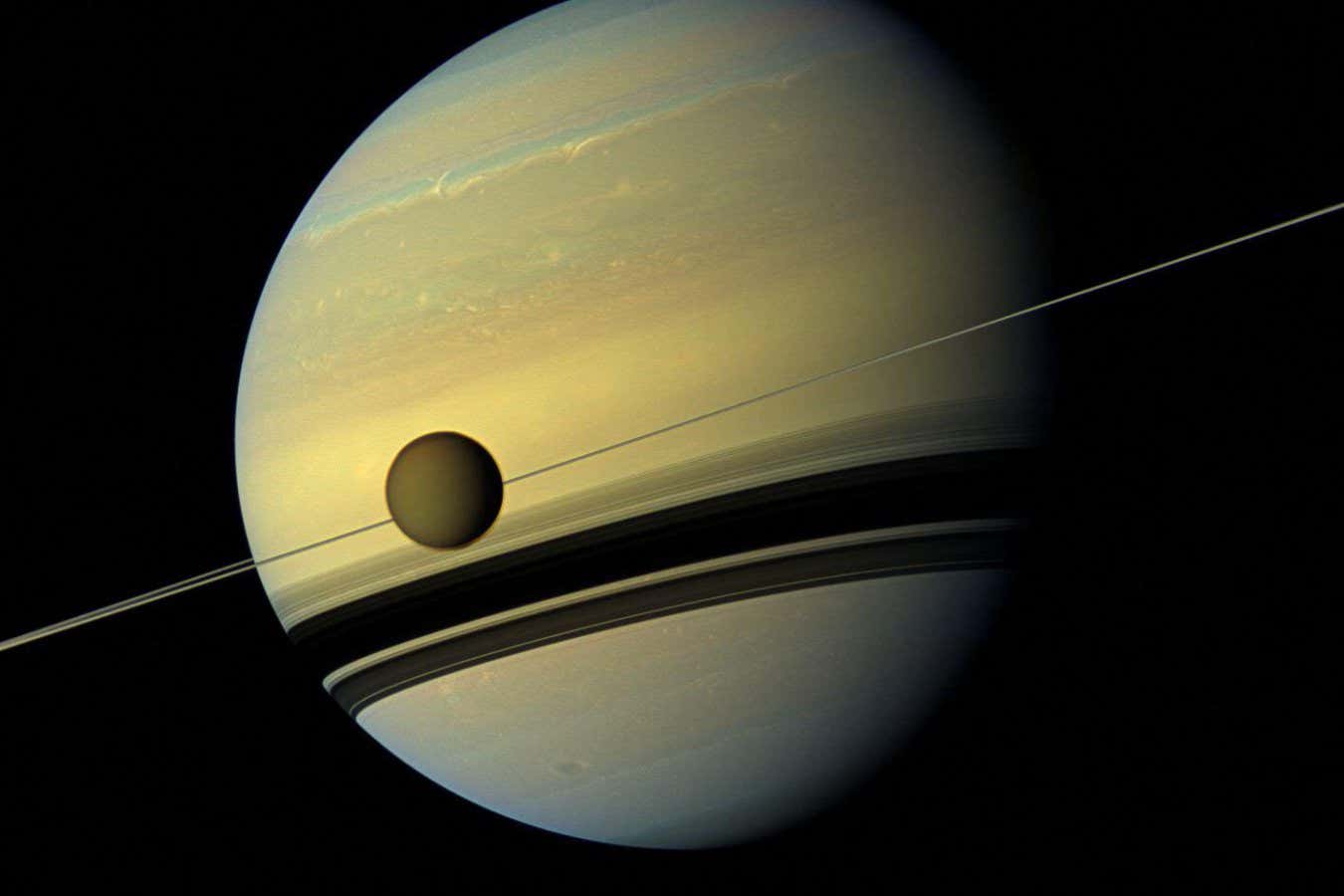
    Titan, Saturn’s largest moon, with the giant planet behind it in a view from the Cassini-Huygens spacecraft

    ZUMA Press, Inc./Alamy

    The story of Saturn, its rings and moons, may have started with its largest moon, Titan. A collision between an early proto-Titan and a smaller object about 400 million years ago could have set into motion the series of events that formed Saturn’s iconic rings and altered both the planet’s wobble and the orbits of its moons.

    The Saturn system is awash in mysteries. Its rings seem to be younger than expected, the planet’s wobble isn’t tied to the motion of Neptune as simulations have suggested it ought to be, and its small moon Iapetus has a strangely tilted orbit. Titan itself has strangely few craters and an oval, or eccentric, orbit.

    A huge collision that created the Titan we see today could explain all of these elements. “This is sort of a grand unified theory that covers all of the major problems,” says Matija Ćuk at the SETI Institute in California, who led the research team behind this work. “We had some idea about each of them, but this might be how they relate in one story that can be tested.”

    It starts with a hypothesised extra moon called Chrysalis in the outer reaches of the system, which was proposed in 2022 to explain how Saturn’s wobble got decoupled from Neptune. The idea was that Chrysalis got tossed towards Saturn and broke up to form the rings, destabilising Saturn’s wobble and Iapetus’s orbit in the process. However, Ćuk and his colleagues noticed that in simulations, the most likely outcome was that Chrysalis would collide with Titan.

    That’s a problem, says Ćuk. “If there was a collision with Titan, it could not have become the rings.” So he and his team went about calculating what would happen if Chrysalis did smash into Titan. They found that such a collision about 400 million years ago would erase Titan’s craters and push its then-circular orbit to become elliptical, as well as creating a shower of debris. The smaller moon Hyperion could be a piece of that debris, which would explain why it is so much younger than Saturn’s other moons.

    Then, over time, Titan’s changing orbit would have destabilised the small inner moons and sent them careening into one another, grinding each other down into the tiny particles that now make up Saturn’s rings. “It all starts from Titan and then trickles down to a second catastrophe in the inner system,” says Ćuk.

    “If a collision with Titan 1.0 can explain many other things about the Saturn system, then I think that would really centre Titan as being pivotal to how we see the system today,” says Sarah Hörst at Johns Hopkins University in Maryland. “I appreciate the elegance of how many Saturn system problems it would solve at once.”

    Evidence that could prove or rule out this scenario isn’t too far off. NASA’s Dragonfly mission, which is slated to launch in 2028 and arrive at Titan in 2034, will get a close look at Titan’s surface, which should help determine whether it did merge with Chrysalis. If so, we may finally understand some of the many oddities of Saturn.

    Topics:


    Source link

    Share. Facebook Twitter Pinterest LinkedIn Tumblr Email Telegram Copy Link

    Related Posts

    Science

    Colossal claims an artificial eggshell will help it bring back the moa

    May 19, 2026
    Science

    How I used psychology to come back from the worst year of my life

    May 19, 2026
    Science

    What is love? Even a meeting on the subject can’t find the answer

    May 19, 2026
    Science

    Mystery of the ancient giant stone jars of Laos may have been solved

    May 19, 2026
    Science

    Floatation tanks deployed to combat PTSD after devastating wildfires

    May 18, 2026
    Science

    The Ebola emergency shines a light on the urgent need for new vaccines

    May 18, 2026
    Editors Picks

    Tim Cook calls for deescalation but avoids criticizing Trump after Minneapolis death

    January 28, 2026

    How Trump’s federal architecture renovations go against ‘republican simplicity’

    April 15, 2026

    Maduro’s Arraignment Begins as U.N. and Protesters Speak Out

    January 6, 2026

    US to support Cambodian-Thai ceasefire with $45m aid pledge | Border Disputes News

    January 9, 2026

    Iranian delegation due in Islamabad ahead of US talks

    April 9, 2026
    About Us
    About Us

    Welcome to Benjamin Franklin Institute, your premier destination for insightful, engaging, and diverse Political News and Opinions.

    The Benjamin Franklin Institute supports free speech, the U.S. Constitution and political candidates and organizations that promote and protect both of these important features of the American Experiment.

    We are passionate about delivering high-quality, accurate, and engaging content that resonates with our readers. Sign up for our text alerts and email newsletter to stay informed.

    Latest Posts

    Billie Eilish Flaunts Results Of Fitness Journey In Plunging Top

    May 19, 2026

    Iran army warns it will ‘open new fronts’ against US if attacks resume

    May 19, 2026

    Why has FIFA not signed a World Cup broadcast deal in India? | World Cup 2026 News

    May 19, 2026

    Subscribe for Updates

    Stay informed by signing up for our free news alerts.

    Paid for by the Benjamin Franklin Institute. Not authorized by any candidate or candidate’s committee.
    • Privacy Policy
    • About us
    • Contact us

    Type above and press Enter to search. Press Esc to cancel.