
Close Menu
    Trending
    • Negotiations that enable Israel’s land-grabs | Israel-Palestine conflict
    • True-or-false for Round 1 of 2026 NFL Draft: Will Cowboys regret their trade?
    • Opinion | Stewart Brand, Silicon Valley’s Favorite Prophet, on Life’s Most Important Principle
    • Struggling to scale your company? Here are five things that could be holding you back
    • What happens if you’re hit by a primordial black hole?
    • When is London Marathon 2026? Start time and how to watch race for FREE
    • Pentagon Requests $54 Billion For AI War
    • Clavicular Hit With New YouTube Crackdown
    Benjamin Franklin Institute
    Friday, April 24
    • Home
    • Politics
    • Business
    • Science
    • Technology
    • Arts & Entertainment
    • International
    Benjamin Franklin Institute
    Home»Science»Rogue planet gains 6 billion tonnes per second in record growth spurt
    Science

    Rogue planet gains 6 billion tonnes per second in record growth spurt

    Team_Benjamin Franklin InstituteBy Team_Benjamin Franklin InstituteOctober 2, 2025No Comments3 Mins Read
    Share Facebook Twitter Pinterest Copy Link LinkedIn Tumblr Email VKontakte Telegram
    Share
    Facebook Twitter Pinterest Email Copy Link


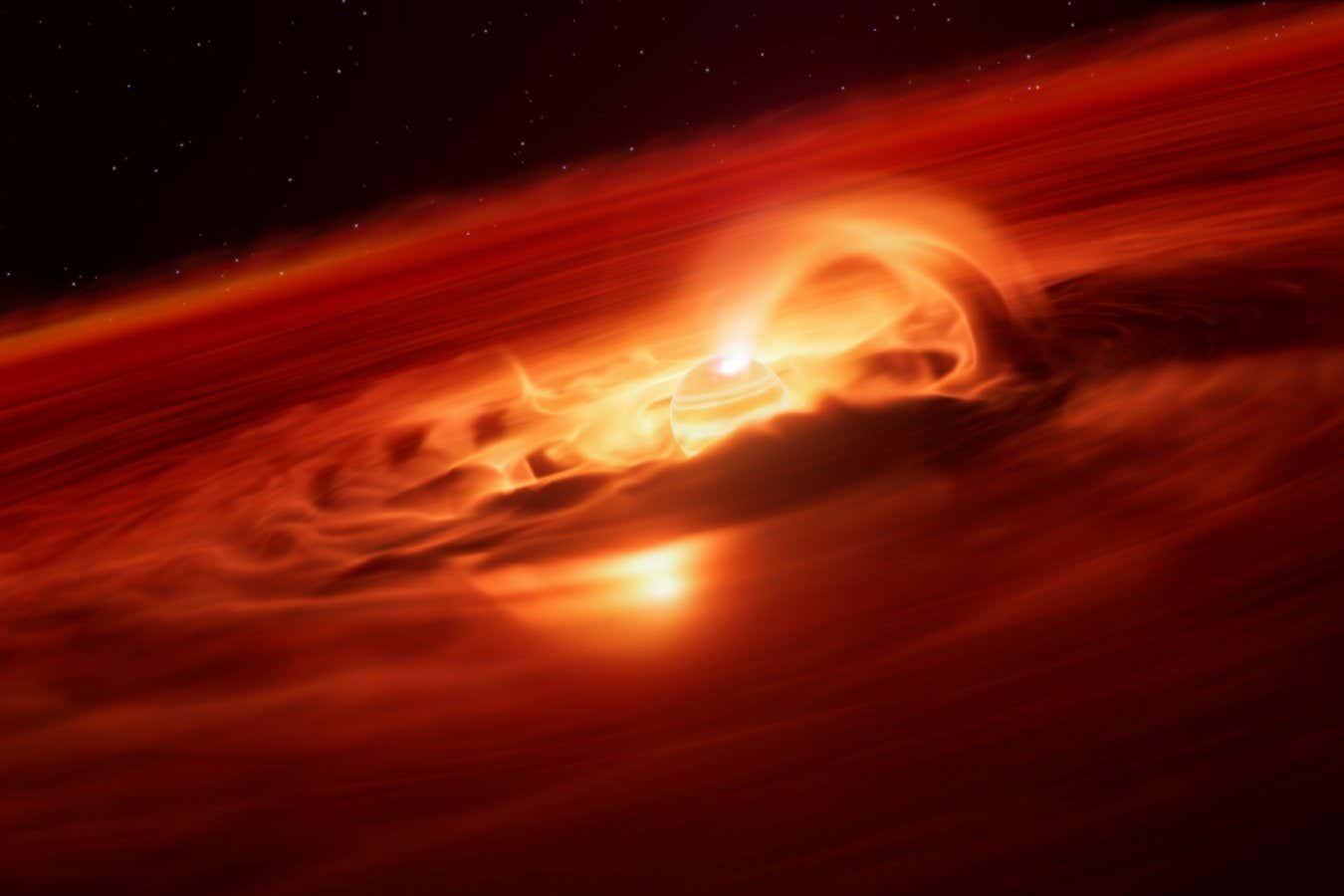
    Artist’s impression of Cha 1107-7626, a rogue planet about 620 light years away

    ESO/L. Calçada/M. Kornmesser

    A ravenous rogue planet has been caught eating 6 billion tonnes of gas and dust per second. This behaviour blurs the line between planets and stars, suggesting both can form in similar ways.

    Rogue planets, free-floating balls of gas unattached to any parent star, appear to be extremely common, and may even exceed the number of stars we see in the galaxy. But astronomers still don’t understand whether they form like planets in orbit around a star and are then banished to wander the galaxy alone, or if they can form like stars by themselves.

    Víctor Almendros-Abad at Palermo Astronomical Observatory in Italy and his colleagues have now seen a rogue planet called Cha 1107-7626 going through a phenomenal growth spurt.

    The planet first caught astronomers’ attention in 2008 because it had what looked to be a primitive planetary disc forming around it. Almendros-Abad and his team started observing the planet with the European Southern Observatory’s Very Large Telescope in Chile in April of this year, but in June it suddenly began consuming matter at nearly 10 times the rate it had before – and it kept this up for the next two months.

    It reached a growth rate that has previously only been seen in stars, like our sun, which have more than 100 times as much mass.

    “This tells us that the process that forms stars is very likely the same that forms these objects,” says Almendros-Abad. “This also means that when we think about star formation, we need to also think about these [rogue planets].”

    To account for this rate of growth, Almendros-Abad and his team think a mechanism similar to that found in stars must be at play, where strong magnetic fields funnel material through a narrow channel from the volume of gas and dust beyond. But it is unclear exactly how, or why, the planet suddenly began consuming so much more mass.

    Such similar growth processes suggest stars and planets are even more alike than we thought, says Almendros-Abad. “Every time that we look at these [rogue planets], it tells us we don’t really know where the difference between stars and planets is. There must be some chemical imprint, but we haven’t yet found the Rosetta Stone of how to differentiate between formation scenarios.”

    New Scientist. Science news and long reads from expert journalists, covering developments in science, technology, health and the environment on the website and the magazine.

    The world capital of astronomy: Chile

    Experience the astronomical highlights of Chile. Visit some of the world’s most technologically advanced observatories and stargaze beneath some of the clearest skies on earth.

    Topics:


    Source link

    Share. Facebook Twitter Pinterest LinkedIn Tumblr Email Telegram Copy Link

    Related Posts

    Science

    What happens if you’re hit by a primordial black hole?

    April 24, 2026
    Science

    How do earthquakes end? A seismic ‘stop sign’ could help predict earthquake risk

    April 24, 2026
    Science

    ‘Kraken’ fossils show enormous, intelligent octopuses were top predators in Cretaceous seas

    April 24, 2026
    Science

    Largest ever octopus was great white shark of invertebrate predators

    April 24, 2026
    Science

    Do you need to worry about Mythos, Anthropic’s computer-hacking AI?

    April 23, 2026
    Science

    How many dachshunds would it take to get to the moon?

    April 23, 2026
    Editors Picks

    Impending Josh Hader IL stint still good news for Astros

    March 12, 2026

    Excessive Taxation Penalizes Workers | Armstrong Economics

    January 7, 2026

    Egypt Goes Dark Amid Energy Crisis

    April 8, 2026

    North Carolina turns to NBA champion Michael Malone as next HC

    April 7, 2026

    Israel says it launched pre-emptive attack against Iran

    February 28, 2026
    About Us
    About Us

    Welcome to Benjamin Franklin Institute, your premier destination for insightful, engaging, and diverse Political News and Opinions.

    The Benjamin Franklin Institute supports free speech, the U.S. Constitution and political candidates and organizations that promote and protect both of these important features of the American Experiment.

    We are passionate about delivering high-quality, accurate, and engaging content that resonates with our readers. Sign up for our text alerts and email newsletter to stay informed.

    Latest Posts

    Negotiations that enable Israel’s land-grabs | Israel-Palestine conflict

    April 24, 2026

    True-or-false for Round 1 of 2026 NFL Draft: Will Cowboys regret their trade?

    April 24, 2026

    Opinion | Stewart Brand, Silicon Valley’s Favorite Prophet, on Life’s Most Important Principle

    April 24, 2026

    Subscribe for Updates

    Stay informed by signing up for our free news alerts.

    Paid for by the Benjamin Franklin Institute. Not authorized by any candidate or candidate’s committee.
    • Privacy Policy
    • About us
    • Contact us

    Type above and press Enter to search. Press Esc to cancel.