
Close Menu
    Trending
    • Singapore responds to US probe, says it does not condone forced labour in supply chains
    • France’s Ekitike to miss World Cup after Liverpool Champions League injury | Football News
    • Craig Albernaz suffered seven fractures in face after being struck by foul ball
    • Opinion | GLP-1 Experimentation Is Everywhere, and Science Can’t Keep Up
    • How Trump’s federal architecture renovations go against ‘republican simplicity’
    • The stunning physics of Project Hail Mary go back to ancient China
    • L.G.B.T.Q. Community Expresses Hesitancy About Hungary’s New Leader
    • The Next Banking Crisis And Withdrawal Restrictions
    Benjamin Franklin Institute
    Wednesday, April 15
    • Home
    • Politics
    • Business
    • Science
    • Technology
    • Arts & Entertainment
    • International
    Benjamin Franklin Institute
    Home»Science»Rice variant slashes planet-warming methane emissions by 70 per cent
    Science

    Rice variant slashes planet-warming methane emissions by 70 per cent

    Team_Benjamin Franklin InstituteBy Team_Benjamin Franklin InstituteFebruary 4, 2025No Comments2 Mins Read
    Share Facebook Twitter Pinterest Copy Link LinkedIn Tumblr Email VKontakte Telegram
    Share
    Facebook Twitter Pinterest Email Copy Link


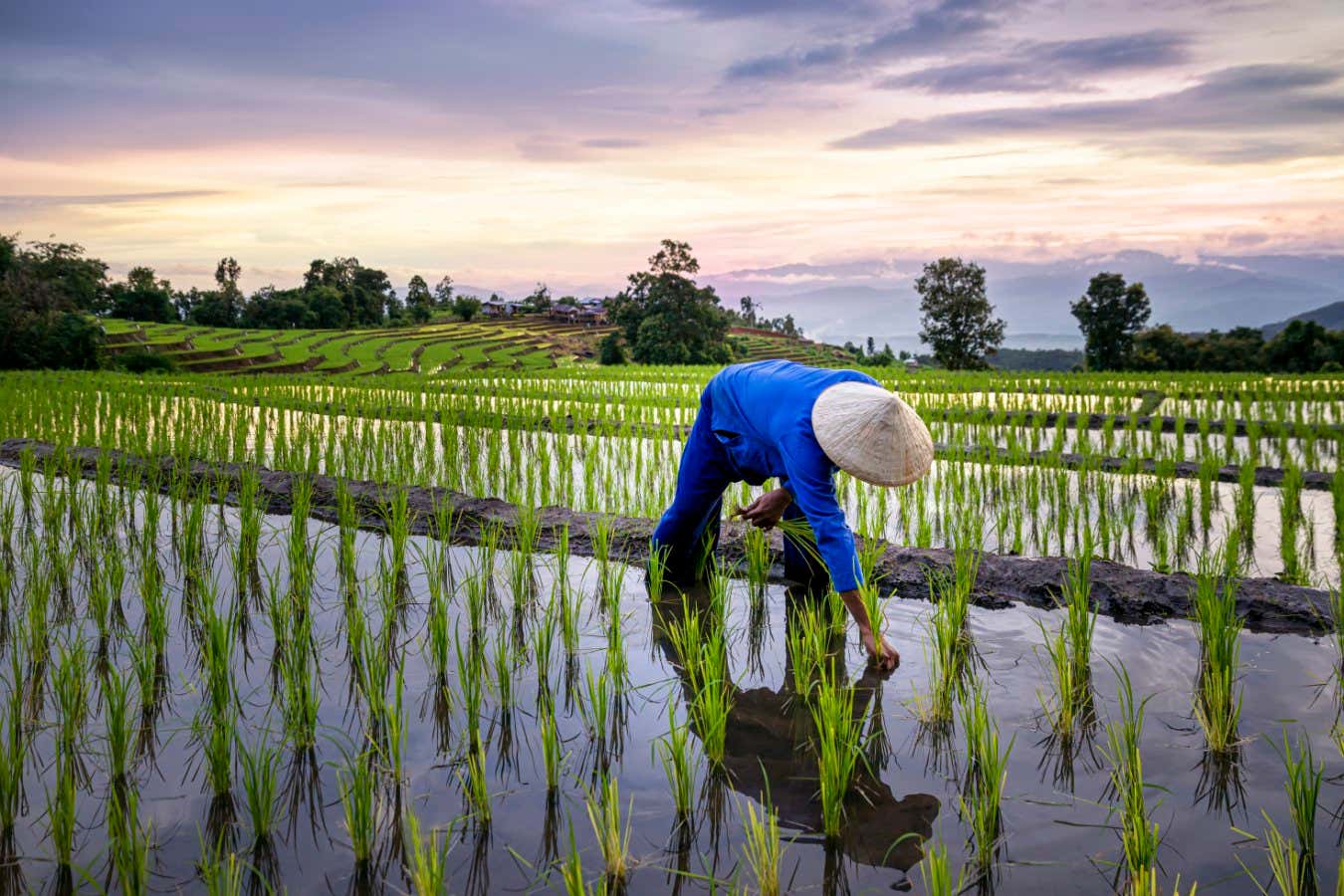
    Rice fields are a major source of methane emissions

    Thirawatana Phaisalratana/iStockphot​o/Getty Images

    A new variety of rice created by simple crossbreeding could reduce the crop’s emissions of methane, a powerful greenhouse gas, by nearly three-quarters.

    Rice growing is responsible for around 12 per cent of anthropogenic release of methane, a gas that has a warming effect 25 times stronger than that of carbon dioxide.

    The emissions come from soil microbes in the flooded paddy fields where rice is grown. These organisms break down chemicals known as root exudates released by the plants, producing nutrients that the plants can use, but also making methane in the process.

    To learn more about factors affecting the production of methane from rice roots, Anna Schnürer at the Swedish University of Agricultural Sciences and her colleagues grew two strains of rice in a laboratory: a Japanese cultivar called Nipponbare with average methane emissions and a genetically modified strain with low methane emissions called SUSIBA2.

    SUSIBA2 produced less fumarate, a root exudate known to be a key driver of methane emissions, than Nipponbare. But when both strains were treated with oxantel, a chemical that inhibits the breakdown of fumarate by bacteria, the SUSIBA2 strain still produced less methane. This meant there must be another factor causing the difference between the varieties.

    It turned out that the SUSIBA2 crop was secreting high levels of ethanol, which also seemed to be suppressing methane emissions.

    The team then turned to traditional breeding techniques to produce a new rice strain by crossing a high-yield elite variety with the Heijing cultivar, a strain that produces low fumarate and high ethanol.

    Over two years of field trials in China, the new strain produced crop yields of more than 8 tonnes per hectare, compared with the global average of just over 4 tonnes, and it emitted 70 per cent less methane than the elite variety it was bred from.

    Johannes le Coutre at the University of New South Wales in Sydney, Australia, says the study is an example of well-executed research into the culprits behind the crop’s greenhouse gas emissions.

    “The core point of the study is they don’t use hard-core gene engineering or editing technologies or transgenic approaches,” says le Coutre. “They use traditional crossbreeding in order to create new rice lines which lower the synthesis of methane.”

    Topics:


    Source link

    Share. Facebook Twitter Pinterest LinkedIn Tumblr Email Telegram Copy Link

    Related Posts

    Science

    The stunning physics of Project Hail Mary go back to ancient China

    April 15, 2026
    Science

    Are Neanderthals descendants of modern humans?

    April 15, 2026
    Science

    Beef is making a comeback – does it fit into a healthy diet?

    April 15, 2026
    Science

    Is a super El Niño imminent, and what could the impacts be?

    April 14, 2026
    Science

    Antioxidant in mushrooms may target uterus cells to ease period pain

    April 14, 2026
    Science

    From autism to migraines, birth order may have wide-reaching effects

    April 14, 2026
    Editors Picks

    Take These 5 Steps to Future-Proof Your Business

    August 18, 2025

    Apple and Google clash with police and MPs over phone thefts

    June 4, 2025

    Todd Chrisley Threatened To Fight This Prominent Inmate In Prison

    July 2, 2025

    Meta urges Australia to change teen social media ban

    January 12, 2026

    The ‘SEC Players of the Year’ quiz

    March 11, 2026
    About Us
    About Us

    Welcome to Benjamin Franklin Institute, your premier destination for insightful, engaging, and diverse Political News and Opinions.

    The Benjamin Franklin Institute supports free speech, the U.S. Constitution and political candidates and organizations that promote and protect both of these important features of the American Experiment.

    We are passionate about delivering high-quality, accurate, and engaging content that resonates with our readers. Sign up for our text alerts and email newsletter to stay informed.

    Latest Posts

    Singapore responds to US probe, says it does not condone forced labour in supply chains

    April 15, 2026

    France’s Ekitike to miss World Cup after Liverpool Champions League injury | Football News

    April 15, 2026

    Craig Albernaz suffered seven fractures in face after being struck by foul ball

    April 15, 2026

    Subscribe for Updates

    Stay informed by signing up for our free news alerts.

    Paid for by the Benjamin Franklin Institute. Not authorized by any candidate or candidate’s committee.
    • Privacy Policy
    • About us
    • Contact us

    Type above and press Enter to search. Press Esc to cancel.