
Close Menu
    Trending
    • Trump tightens terms on Iran war deal, US media say | Donald Trump News
    • Chiefs could bring back Tyreek Hill under one condition
    • America’s HOAs are broken. This startup is trying to fix them
    • How smartphones and AI are reshaping our bodies and minds
    • Taylor Swift’s Brutal Wedding Invite Snub To Karlie Kloss Revealed
    • Malaysia slams ‘deafening silence’ over scrapped Norway missile deal
    • France arrests hundreds of rioters nationwide as PSG win Champions League | Football News
    • WCF winners, losers: Victor Wembanyama, SGA rise to the occasion, Chet Holmgren goes missing in Game 7 flop
    Benjamin Franklin Institute
    Sunday, May 31
    • Home
    • Politics
    • Business
    • Science
    • Technology
    • Arts & Entertainment
    • International
    Benjamin Franklin Institute
    Home»Science»Rare Saturn-sized rogue planet is first to have its mass measured
    Science

    Rare Saturn-sized rogue planet is first to have its mass measured

    Team_Benjamin Franklin InstituteBy Team_Benjamin Franklin InstituteJanuary 2, 2026No Comments3 Mins Read
    Share Facebook Twitter Pinterest Copy Link LinkedIn Tumblr Email VKontakte Telegram
    Share
    Facebook Twitter Pinterest Email Copy Link


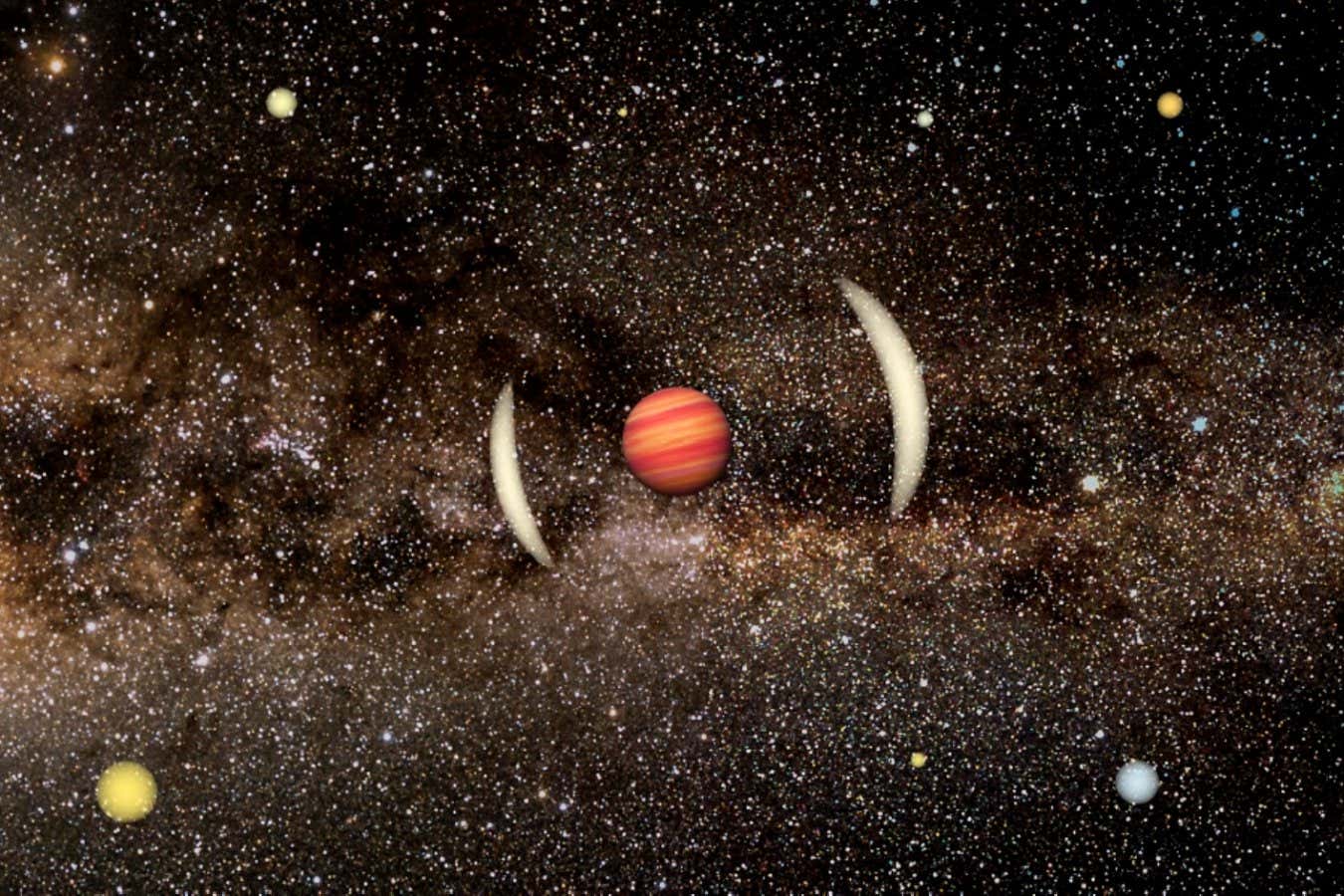
    Artist’s impression of the free-floating planet lensing light from a distant source

    J. Skowron/OGLE

    Nearly 10,000 light years away, a planet the size of Saturn is floating all on its own through empty space. In a stroke of luck, researchers were able to spot this strange, dark world using both ground-based telescopes and the Gaia space telescope, allowing them to measure the mass of a free-floating, or rogue, exoplanet for the first time.

    Most rogue worlds that have been found are either more massive than Jupiter or lighter than Neptune, leaving in the middle a gap in size that researchers refer to as the “Einstein desert”. This has generally been attributed to the idea that lighter-than-Neptune worlds are relatively easy to eject from pre-existing orbits around stars, whereas planets more massive than Jupiter don’t have to form inside traditional planetary systems, but can sometimes form similarly to stars in free space.

    That makes this newfound planet particularly rare. It has two names – KMT-2024-BLG-0792 and OGLE-2024-BLG-0516 – because Andrzej Udalski at the University of Warsaw in Poland and his colleagues spotted it independently with two different ground-based telescopes. But what’s even more unusual is the fact that they were able to measure its mass at about one-fifth that of Jupiter.

    “What’s really great about this one is that it’s the first one that we’ve got that has a mass measurement, and that was only possible because they got Gaia observations as well as Earth-based observations,” says Gavin Coleman at Queen Mary University of London. The researchers found this planet through a method called gravitational microlensing, which occurs when the light from a bright, distant object is bent by a planet’s gravitational pull, creating a sort of halo around the planet. That’s where the researchers got lucky: when the microlensing event was spotted from the ground, the Gaia space telescope happened to be pointed in the right direction, so it captured the event too.

    “Mass is the main parameter deciding on the classification as a planet,” says Udalski, so that makes this technically the first confirmed free-floating rogue planet. “This is the moment from which we may be sure that the candidate is a real planet, and free-floating planets indeed exist,” he says. NASA’s Nancy Grace Roman space telescope, planned to launch in 2027, is expected to find many more, though.

    “They should be very numerous and they may be crucial for our understanding of the processes during the formation of planetary systems, as the majority of them are ejected from planetary systems at the early formation stages,” says Udalski. That includes our own solar system, which some research hints may have ejected a planet in its early days.

    New Scientist. Science news and long reads from expert journalists, covering developments in science, technology, health and the environment on the website and the magazine.

    The world capital of astronomy: Chile

    Experience the astronomical highlights of Chile. Visit some of the world’s most technologically advanced observatories and stargaze beneath some of the clearest skies on earth.

    Topics:


    Source link

    Share. Facebook Twitter Pinterest LinkedIn Tumblr Email Telegram Copy Link

    Related Posts

    Science

    How smartphones and AI are reshaping our bodies and minds

    May 31, 2026
    Science

    How big can a galaxy get?

    May 31, 2026
    Science

    Why high-bandwidth memory is a bottleneck for AI chips

    May 31, 2026
    Science

    NASA’s Hubble captures gorgeous new photo of a spiral galaxy as it wanders through the Virgo Cluster

    May 30, 2026
    Science

    New protein-folding AI vastly expands on Alphafold’s efforts

    May 30, 2026
    Science

    Mirror life: Scientists clash over threat of lab-engineered bacteria

    May 30, 2026
    Editors Picks

    Feds Investigating Whether Comey Post Was Threat On Trump

    May 18, 2025

    The US labour market is holding up

    May 5, 2025

    Ben Affleck Reportedly ‘Frustrated’ By His Ex’s Presence Around His Kids

    January 9, 2026

    Meet the chief resource officer

    January 19, 2026

    Opinion | Melania Is the ‘Only Immigrant Trump Likes’

    February 7, 2026
    About Us
    About Us

    Welcome to Benjamin Franklin Institute, your premier destination for insightful, engaging, and diverse Political News and Opinions.

    The Benjamin Franklin Institute supports free speech, the U.S. Constitution and political candidates and organizations that promote and protect both of these important features of the American Experiment.

    We are passionate about delivering high-quality, accurate, and engaging content that resonates with our readers. Sign up for our text alerts and email newsletter to stay informed.

    Latest Posts

    Trump tightens terms on Iran war deal, US media say | Donald Trump News

    May 31, 2026

    Chiefs could bring back Tyreek Hill under one condition

    May 31, 2026

    America’s HOAs are broken. This startup is trying to fix them

    May 31, 2026

    Subscribe for Updates

    Stay informed by signing up for our free news alerts.

    Paid for by the Benjamin Franklin Institute. Not authorized by any candidate or candidate’s committee.
    • Privacy Policy
    • About us
    • Contact us

    Type above and press Enter to search. Press Esc to cancel.