
Close Menu
    Trending
    • Pentagon Requests $54 Billion For AI War
    • Clavicular Hit With New YouTube Crackdown
    • Beijing’s new supply chain rules deepen concerns for US firms in China
    • India denounces ‘hellhole’ remark shared by Trump | Donald Trump News
    • New photos of Mike Vrabel and Dianna Russini emerge
    • AI search demands a new audience playbook
    • How do earthquakes end? A seismic ‘stop sign’ could help predict earthquake risk
    • Trump Announces Cease-Fire Between Israel and Lebanon
    Benjamin Franklin Institute
    Friday, April 24
    • Home
    • Politics
    • Business
    • Science
    • Technology
    • Arts & Entertainment
    • International
    Benjamin Franklin Institute
    Home»Science»Quantum entanglement can be measured in solids for the first time
    Science

    Quantum entanglement can be measured in solids for the first time

    Team_Benjamin Franklin InstituteBy Team_Benjamin Franklin InstituteApril 8, 2026No Comments3 Mins Read
    Share Facebook Twitter Pinterest Copy Link LinkedIn Tumblr Email VKontakte Telegram
    Share
    Facebook Twitter Pinterest Email Copy Link


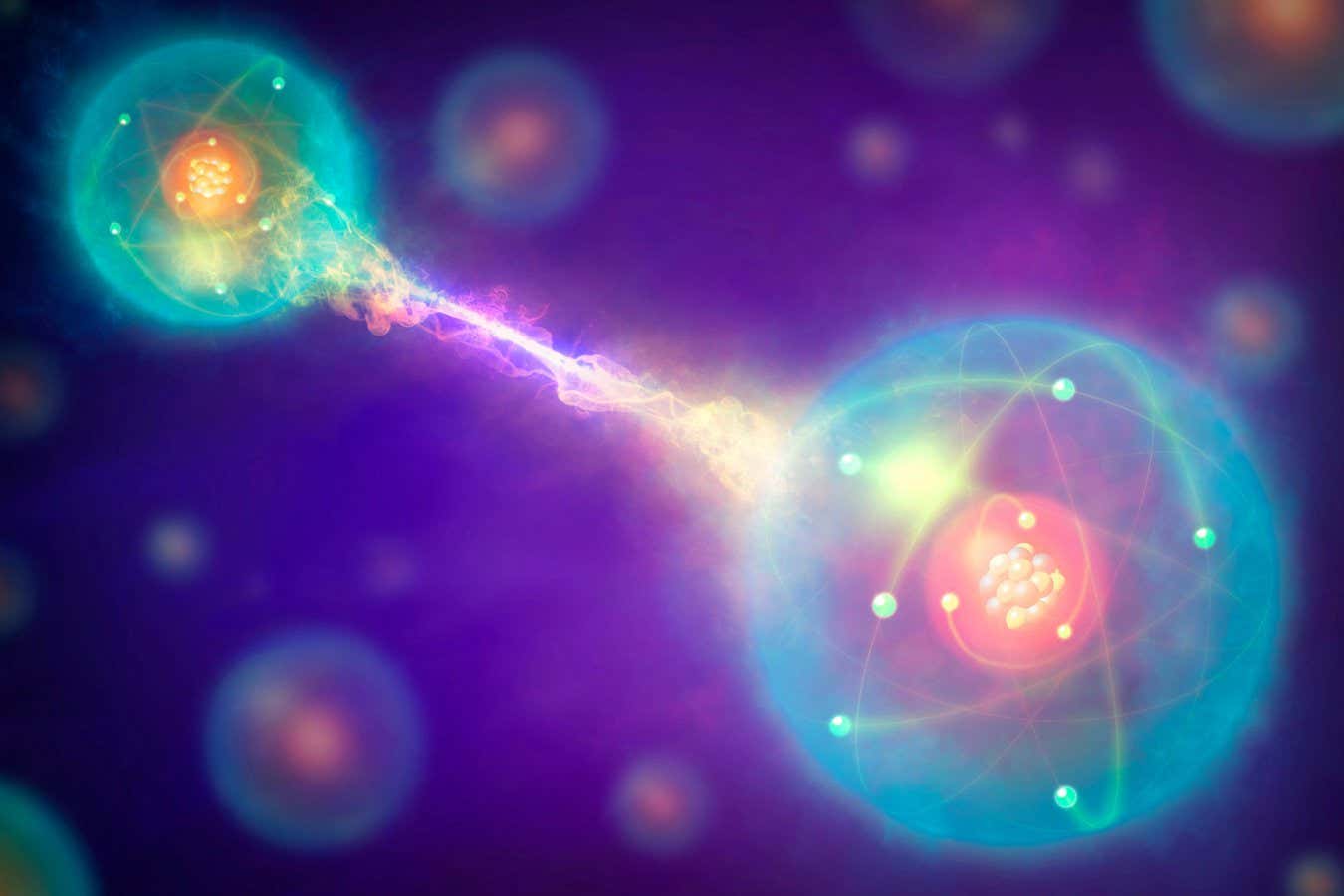
    The behaviour of two distinct particles can be linked by quantum entanglement

    Science Photo Library / Alamy

    We finally have a way to measure quantum entanglement of solids, which could lead to advances in both quantum technology and fundamental physics.

    When it comes to quantum entanglement – an inextricable link between quantum particles that keeps their behaviours correlated, even when they are extremely far apart – researchers have limited experimental tools. They can determine if two particles are entangled by using a procedure called the Bell test, for example, and purposely create entanglement between several objects within quantum computers.

    But finding out whether a piece of some material is full of entangled particles is more challenging. This is especially important for developing new and better devices for quantum computing and quantum communication, which require entanglement.

    Allen Scheie at Los Alamos National Laboratory in New Mexico and his colleagues have spent more than half a decade developing a technique to do just that – and now it works.

    “We’ve established that it works, 100 per cent, and now we’re establishing the procedures you need to go through to be able to do it in different materials,” says Scheie.

    The team’s method involves pelting a sample of a material with neutrons, which are then collected on a detector. Since the 1950s, researchers have known that analysing these neutrons’ properties can reveal the arrangement and behaviour of quantum particles inside the material. Scheie and his colleagues used them to calculate quantum Fisher information (QFI), a number that indicates the minimum number of quantum particles within the material that must be entangled to have affected the neutrons in the detected way.

    The researchers tested their method on several magnetic materials, including a well-studied crystal made from potassium, copper and fluorine. Team member Pontus Laurell at the University of Missouri says that in this case, the findings could be directly compared to a computer simulation of the crystal’s quantum innards in order to verify the new method. “It was a remarkably close agreement between the experimental and theoretical curves.”

    Laurell says other researchers have previously studied QFI and similar numbers as possible experimental “entanglement witnesses”, but his team is the first to establish a clear, reliable and generally applicable way to measure it. Much of the work has been in getting the details just right, which has now opened the door for the researchers to try all sorts of materials, including those that could eventually be used to build new devices.

    Notably, the team’s method works regardless of whether a good mathematical model for the material already exists, and it is effective even when the samples are imperfect. “That’s the cool thing about it. You can measure quantum Fisher information no matter what,” says Scheie. He presented the work at the American Physical Society Global Physics Summit in Denver, Colorado, on 17 March.

    In a month’s time, the researchers will take their method to the next level by measuring the QFI of a material as it approaches a phase transition – the quantum equivalent of the point where water becomes ice. Theoretical models often break down at this point or predict that entanglement will go through the roof, so there is a chance for a real quantum discovery, says Scheie.

    Topics:

    • materials/
    • quantum physics


    Source link

    Share. Facebook Twitter Pinterest LinkedIn Tumblr Email Telegram Copy Link

    Related Posts

    Science

    How do earthquakes end? A seismic ‘stop sign’ could help predict earthquake risk

    April 24, 2026
    Science

    ‘Kraken’ fossils show enormous, intelligent octopuses were top predators in Cretaceous seas

    April 24, 2026
    Science

    Largest ever octopus was great white shark of invertebrate predators

    April 24, 2026
    Science

    Do you need to worry about Mythos, Anthropic’s computer-hacking AI?

    April 23, 2026
    Science

    How many dachshunds would it take to get to the moon?

    April 23, 2026
    Science

    The Age Code review: Can you slow ageing with your diet? A new book gives it a go

    April 23, 2026
    Editors Picks

    Tomlin gives Steelers fans positive Watt news ahead of Ravens game

    December 30, 2025

    Katie Holmes Breaks Silence on James Van Der Beek’s Passing

    February 12, 2026

    Vince Zampella, Call of Duty co-creator, dies in California car crash

    December 23, 2025

    Trump border czar Homan says ICE in Minneapolis will be more ‘targeted,’ drawdown possible

    January 29, 2026

    The Strait Of Hormuz | Armstrong Economics

    March 16, 2026
    About Us
    About Us

    Welcome to Benjamin Franklin Institute, your premier destination for insightful, engaging, and diverse Political News and Opinions.

    The Benjamin Franklin Institute supports free speech, the U.S. Constitution and political candidates and organizations that promote and protect both of these important features of the American Experiment.

    We are passionate about delivering high-quality, accurate, and engaging content that resonates with our readers. Sign up for our text alerts and email newsletter to stay informed.

    Latest Posts

    Pentagon Requests $54 Billion For AI War

    April 24, 2026

    Clavicular Hit With New YouTube Crackdown

    April 24, 2026

    Beijing’s new supply chain rules deepen concerns for US firms in China

    April 24, 2026

    Subscribe for Updates

    Stay informed by signing up for our free news alerts.

    Paid for by the Benjamin Franklin Institute. Not authorized by any candidate or candidate’s committee.
    • Privacy Policy
    • About us
    • Contact us

    Type above and press Enter to search. Press Esc to cancel.