

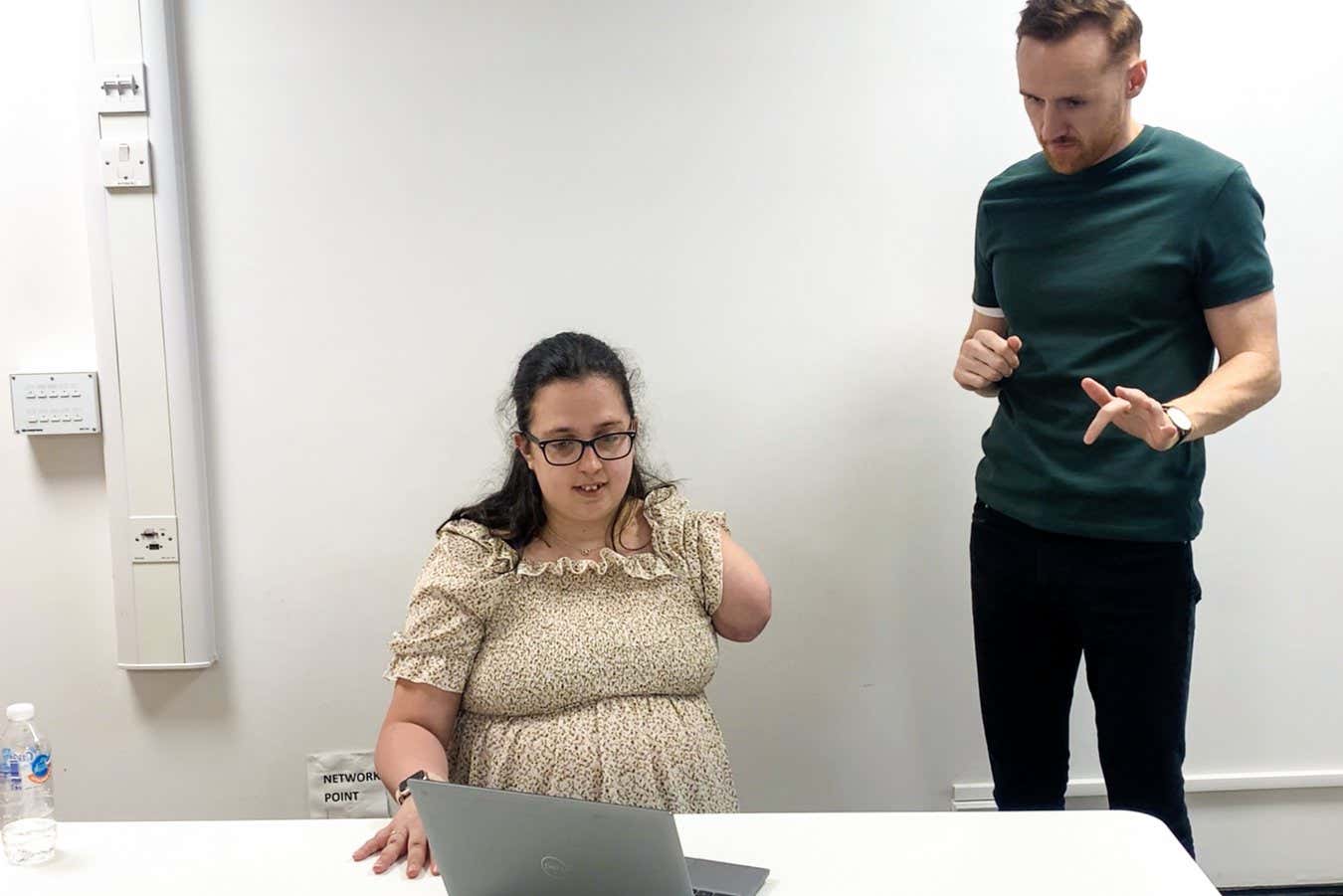
Trial participant Emily Wheldon with one of the researchers as she practiced attempting to move the lost fingers from her amputated arm before going into an MRI scanner
Tamar Makin/Hunter Schone
Our brain may not be as capable of rewiring following an amputation as we thought, which could have serious implications for how we treat a common complication called phantom limb pain.
A part of the brain called the somatosensory cortex receives and processes sensory information across the body, such as touch and temperature. Some studies suggest the areas of the cortex are mapped to different parts of the body, so a different area will light up if you burn your hand versus your toe, for instance.
It has also been suggested that the somatosensory cortex reorganises itself in the case of an amputation or severed nerve. For example, in a study of macaques whose arm nerves had been severed, neurons in the somatosensory cortex that normally respond to stimulation of the hand were instead activated by touching the face. The researchers concluded that some of the area of the cortex that responds to the hand being touched had been reallocated to the face.
But for the first time, Tamar Makin at the University of Cambridge and her colleagues have compared the brain activity of people before and after an amputation – and found it doesn’t actually change.
The researchers used MRI to scan the brains of three people before their arms were amputated for medical reasons. During the scans, they were asked to purse their lips and tap their fingers.
When the team repeated this three and six months post-amputation and asked the participants to try moving the fingers they no longer had, their brain signals remained the same. “As far as we can measure, they are identical,” says Makin.
Two of the participants were also followed up at 18 months and five years, respectively, post-amputation, with neither showing any significant change to their brain signals from before.
The researchers validated their findings by first training an AI model to recognise which pre-amputation brain scans were linked to the participants moving each finger. When they returned post-amputation and imagined wiggling each finger in a random order, the model could identify from brain activity which finger they were trying to move, demonstrating it remained constant.
In another part of the experiment, the researchers measured the somatosensory cortex activity of the participants as they moved their lips and tried to move their fingers post-amputation. This was also done for 26 people whose arms were amputated an average of 23 years ago, and the researchers found the activity was comparable.
“This study confirms in a definitive way that this idea that the brain is capable of remapping, rewiring or reorganising – that the cortex can simply do a switcheroo – is incorrect,” said John Krakauer at Johns Hopkins University in Maryland.
The researchers argue the findings could change the treatment of phantom limb pain, a common condition among people who have undergone an amputation where they still perceive pain or discomfort in an arm or leg that is no longer there.
Some efforts to treat the condition involve using visual cues, like virtual reality, to prompt the brain into reorganising itself. This has mixed results, with any benefit possibly being due to the placebo effect, says Makin.
Instead, the researchers say the condition could possibly be prevented by grafting nerves into new tissue that is sometimes added during amputations. Otherwise, the remaining parts of the nerve that are cut off from their target can grow and cause nerve tissue to thicken, which may contribute to phantom limb pain.
“The maladaptive plasticity theory of phantom limb pain was based on the idea that the brain can reorganise in a way that it doesn’t,” says Krakauer. “In a sense, the way that people think of treating phantom limb now will change just because the theory upon which it was based is wrong.”
Topics: