

What could you do if you could make a circuit trace by just bending a piece of paper? How about bridging modern technologies and traditional handicrafts while providing opportunities for learning skills in both.
As part of our interdisciplinary research into digital craftsmanship at the MEI Lab at the School of Creative Media, City University of Hong Kong, we came across research that demonstrated how to impregnate paperlike material (technically a “nonwoven textile”) with the kind of liquid metal used to make conductive ink. Initially, the impregnated material is nonconductive because an insulating oxide layer forms that encapsulates microscopic droplets of the liquid metal. However, applying pressure via shaped molds will crack open the insulating layer, allowing neighboring particles to merge, and thus creating conducting regions in the shape of the mold.
Both of us were introduced as children to origami and kirigami (similar to origami, except that cutting is allowed in addition to folding). We, along with our colleagues, decided to see if those traditional techniques could be used on the new material to eliminate the need for molds. Our goal was to allow crafters to make hybrid papercraft creations that contained easily integrated elements such as LEDs and motors.
In particular, we were interested in the possibility of combining the separate stages of creating a papercraft object and adding electrical conductors. Previous approaches to creating electrified papercraft objects relied on adding a separate flexible conductor—such as adhesive copper tape—to the paper. This increases the effort required and runs the risk of creating open circuits as the conductive material conforms to the object’s shape.
Isopropanol and a gallium-indium liquid material are used to impregnate a paperlike material that is 55 percent polyester and 45 percent cellulose. Electronic components such as LEDs and motors are held in place with masking tape. James Provost
Our first step was to see if the pressures involved in bending and cutting alone would be sufficient to create conductive traces. We became frequent visitors to our university’s materials science and engineering department to fabricate samples and then to borrow equipment to characterize their behavior.
We soon confirmed that the pressures involved in folding and cutting—ranging from 2.5 to 100 megapascals—were enough to create conductive traces. We also confirmed that normal handling of the paper didn’t accidentally create conductive paths.
We made a number of changes to the original method for creating the impregnated paper. For example, instead of immersing the paper in a mixture of isopropanol and liquid metal, we used an airbrush to spray the mixture onto the paper. That allowed us to vary how much was deposited on the paper and to use cardboard stencils to mask some areas from being impregnated, allowing folding and cutting in those regions without creating unwanted conductive traces. We also experimented with the ratios of isopropanol and liquid metal.
We became frequent visitors to our university’s materials science and engineering department.
After optimizing the mixing ratios and amount applied via airbrush, we were left with a material that reliably conducts with a resistance of 23.18 ohms per centimeter for cut edges and 4.4 Ω/cm for folded edges. The folded edges retain their conductivity even if later flattened out, and the conductivity is the same on either side of the paper. We estimate the combined cost of the paper and liquid metal (available from many online vendors) is about US $1.80 to make a 10- by 10-cm piece.
The next step was attaching electronic components to the traces. To make the connections more flexible, we cut down the rigid leads of LEDs and attached conductive thread to the stumps. We then held the threads in place using masking tape. Similarly, we connected conductive thread to the terminals of a power supply.
As our goal was to use this material educationally, we now needed to make it easy for a beginner—whether in papercraft or electronics—to try it out. We created a toolkit, dubbed LiqMetCraft. This consists of all the required materials, plus a browser-based software tool that lets the user select or create designs and then gives guidance on physical construction.
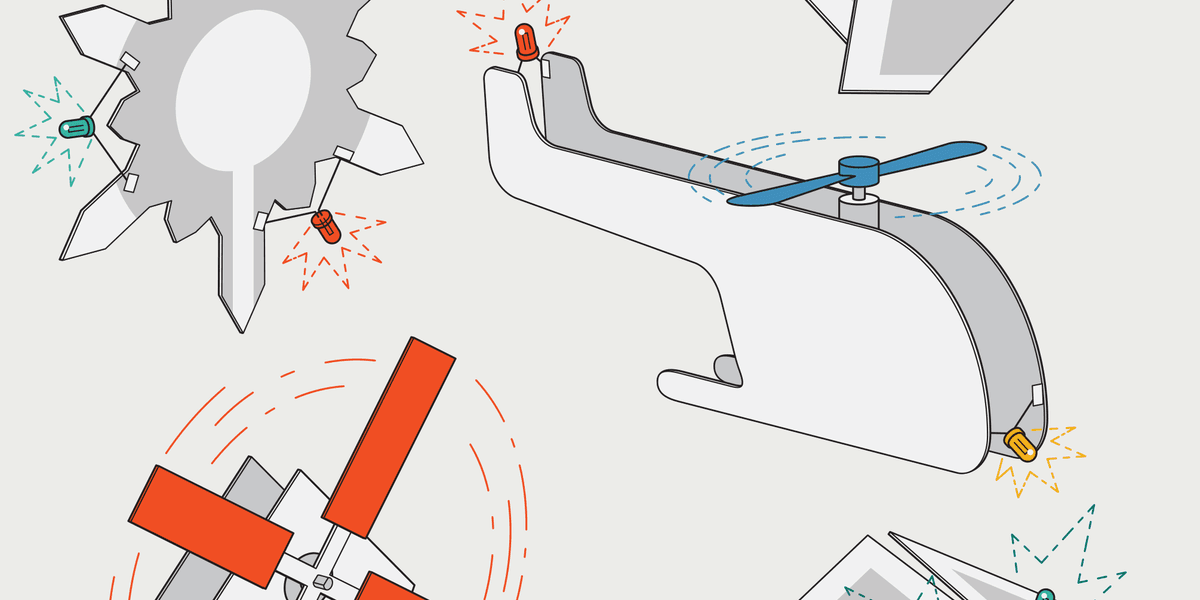
We created three versions of LiqMetCraft. The first is based on Chinese papercraft in which a piece of paper is folded into a fanlike segment and then cut to create a radially symmetric design. We provided circles of paper with a doughnot-shape impregnated region, with an untreated region that created a gap in the donut. We attached positive and negative terminals to either side of the gap. The user could specify in the software how many times they wanted to fold the disk and then draw potential cuts, receiving immediate feedback on what the unfolded disk would look like, as well as guidance on how to place LEDs.
 To make our paper sample, isopropanol and liquid metal are mixed in specific ratios while being cooled by an ice bath. Sonic waves are used to ensure the liquid metal breaks up into microscopic droplets. The mixture is then applied via airbrush, while stencils prevent some areas being covered for different papercraft templates. James Provost
The second version of LiqMetCraft was based on origami. We supplied rectangular pieces of paper with two conductive regions separated by a border down the middle. The software tool provided templates for 12 origami designs, with step-by-step instructions for folding them. Once the project was completed, the user could add components, such as a motor, by taping them to the folds.
The final version supported 3D paper model making. In this case, the initial paper supplied was a rectangle with an untreated rectangular central area. By cutting this paper in half and then further cutting the halves into patterns separated by a spacer, the user could make various self-standing models. The software allowed the user to draw a pattern on screen, and then have a cutting machine produce a template for cutting the impregnated paper.
We had 42 participants, evenly divided into three groups, try out the different versions. All found it easy to use, and we were pleasantly surprised that some participants moved beyond the supplied designs to their own creations.
For full details of the current process, see our open access LiqMetCraft research paper published in CHI ‘26: Proceedings of the 2026 CHI Conference on Human Factors in Computing Systems. In the future, we plan to try different substrates for the impregnating solution, as well as explore further types of papercraft, such as pop-up books. We’re also interested in developing ways to use the material to support inputs as well as outputs by constructing switches and potentiometers directly out of the material. Imagine traditional papercraft creations becoming interactive devices!
This article appears in the July 2026 print issue.
From Your Site Articles
Related Articles Around the Web