

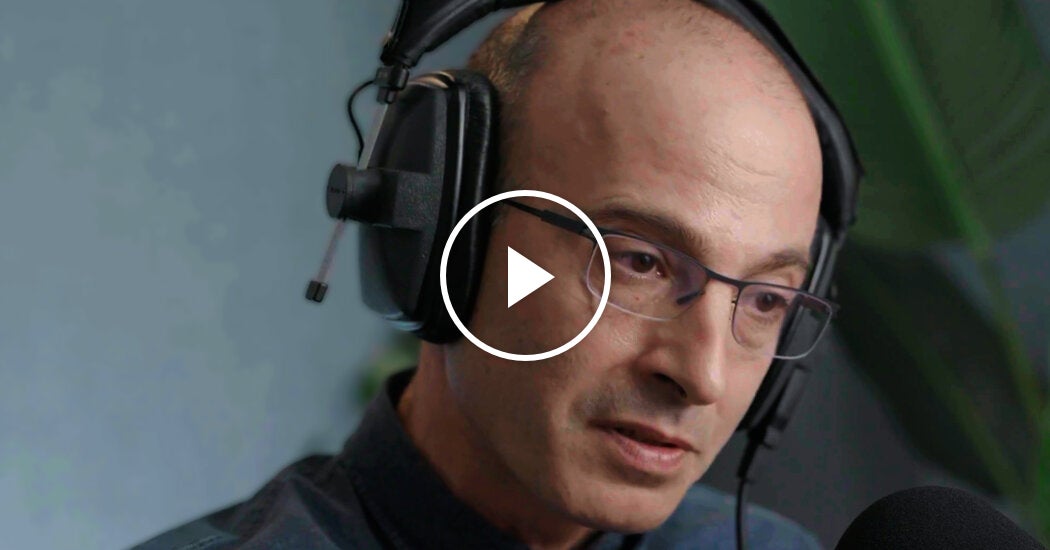
I think if you look across his mega best selling books like “Sapiens” and “Homo Deus,” Yuval Noah Harari really has one major topic. That topic is cooperation, cooperation, and the ability to cooperate across scale, across time as being the fundamental engine of human progress, cooperation as the way we go from being this creature that absolutely cannot beat a bear or a lion in a fight, to being able to create and command the societies we have now. I think right now there’s something interestingly challenging about Harari’s work, because we live in this moment of Trumpism, of right wing populism. And one of the messages of those movements is that this emphasis on cooperation, on positive sum relationships is a lie, that humanity, that society is driven not so much by these soft questions of cooperation as by power, hierarchy, dominance about winning the transaction with the other, about coming out ahead in the conflict in the trade, that all of these niceties of liberalism, they were a lie and that really humanity runs on power. And that to forget that is to forget the engine of our progress. So I wanted to talk to Harari about this. I think there’s an interesting debate to put him in conversation with. He has a new book for kids called “Unstoppable Us: Volume 3.” It is also about cooperation and how enemies turn into friends. But this conversation is bigger than that. It’s about liberalism. It’s about Israel. Harari is Israeli, it’s about A.I. and what it’s going to do to us and what it’s going to do to language as the way we work with and fail to work with each other. It is, as we say in the podcast biz, a wide ranging conversation and all the better for it. As always, my email ezrakleinshow@nytimes.com. Yuval Noah Harari, welcome to the show. Thank you. It’s good to be here. I wanted to begin with a clip of Stephen Miller, Donald Trump’s deputy chief of staff, that I began thinking about as I was reading some of your recent work. I’m going to play it here. You can talk all you want about international niceties and everything else, but we live in a world in the real world, Jake, that is governed by strength, that is governed by force, that is governed by power. These are the iron laws of the world. But are you saying since the beginning of time, what do you think when you hear that the whole of the history of philosophy and spirituality is an argument with exactly that point of view, that the only reality is power, the only reality is force. And from the viewpoint of a historian, it’s clear that this is not the case. If the only human reality was brute force, we would still be living in tiny Hunter gatherer bands in the African savanna, because the whole of human history is about how do you get more people to cooperate and to trust each other, and you cannot do that only with brute force. I want to spend some time here on this tension between visions of cooperation as a driving force in human history, and visions of power as a driving force in human history. Because I think if I’m trying to steel man the vision that emerges out of the Trump administration and some other political figures like them right now, they would say that the conditions for cooperation have been a mixture of shared national and religious stories and hierarchy, power, domination and subjugation, and that what they’re trying to recreate are these conditions that have held, that have allowed the great countries to become great. And I think it’s appealing to people. But the other dimension is your work is so much about shared story and story as the operating system that permits human cooperation at large scale. And I think something that people like Donald Trump or in Israel, Yoram Hazony, the nationalist kind of philosopher, argue, is that we need these intense stories of Nations, of ethnic solidarity, of religious solidarity and liberalism and all these nice human rights fearing ideologies that emerged have begun to corrode them. And so they’re corroding the very conditions for cooperation. And I’m curious, as somebody who’s been in these debates, how you think about that, that’s a different argument. I mean, it’s an argument that recognizes that not everything is based, is based just on force and brute power. Definitely, nationalism has been one of the most successful and also one of the most positive stories that humans have ever come up with. For me, nationalism is not about hating other groups. Nationalism, at its core, is about loving and caring about a large number of strangers that you do not know personally, but you are nevertheless willing to make a lot of sacrifices for them. The nation is not a family. The nation is not even a small tribe. In a small tribe everybody. It’s based on personal relationships with nations. One of the most striking things about them is that you don’t know 99.99 percent of the other people in your nation. And this is true not only of big nations like China or India. This is also true of Israel. There are about 10 million Israelis. I don’t know most of them. And nevertheless, nationalism makes people care about these strangers enough so that for instance, you pay taxes so that other people in your nation will get good health care and education and ultimately, in some circumstances, even risk your life for them. Sometimes, of course, nationalism veers into hatred of others, but this is not an essential feature of nationalism. Nationalism can exist without hating outsiders. It cannot exist without love. For insiders and many of the people today who present themselves as the Champions of nationalism, they put the emphasis on hatred, and in many cases, they even create hatreds within the nation. They divide the nation against itself. They think they are great Patriots if they hate outsiders. And again, looking at Israel as an example, nobody I think in the history of Israel divided the nation against itself more than Netanyahu. And in this sense, he has been the worst enemy of Israeli nationalism. Yes, he hates outsiders. But this is not the key test. And then the question is, how would different nations conduct their relationships. It starts with issues of security and foreign policy. The Trumpian vision, which is all about force and hierarchy. It basically says the way to organize the international system is if the weak always surrender to the demands of the strong, and then we have order and then we have even peace. So if the United States demands Greenland, Denmark must recognize reality and give Greenland to the United States. If Denmark refuses and as a result, there is violence. There is a war. There is conflict. This is the fault of Denmark for refusing to recognize the reality and giving the strong what they demand. This is their logic. This is how they see the world. Now the problem. Leaving aside the issue of morality, still you have a big problem. The big problem is, first of all, that all nations are then driven to become strong because you cannot survive as a weak nation in such a world. And then all nations are forced to invest more and more of their resources in their military. For most of history, a lot of the budget of every kingdom, empire, Republic, city, state was invested or wasted on soldiers and fortresses and warships and things like that. And nobody felt safe. One of the miracles of the international systems of recent decades. And this is not something it’s not about writing pacifistic poetry. It’s about government budgets. You look at the budgets, you see that in on average, in the early 21st century, on average, about 6 percent to 7 percent of the government budget went for defense for the military, compared to percent on average that went to health. It’s the first time in history that humanity spent more on health than on defense, and they felt more secure than in any previous time in history because there was this taboo on invading and conquering other countries by force. Now, if we now break this taboo, it will force everybody to arm themselves to the teeth at the expense of Health care, education, welfare, and so forth. And nobody will feel safer as a result. Because countries and leaders constantly miscalculate in the Vietnam War, the Americans thought they were stronger. It turned out they were wrong. Putin was convinced he will crush Ukraine in 48 hours. He was wrong. So this vision of let’s base the peace and order of the world on a hierarchy of strong and weak, with the weak always obeying the strong and thereby buying peace. It’s been tried thousands of times, thousands of years, and we know where it leads. It leads, on the one hand, to empire and on the other hand to endless wars. So we are more on that road again than I think we’ve been in my lifetime. You’ve talked about the global liberal order as one of the I think you called it the most amazing political and maybe moral achievement of humankind Yeah and today, I don’t think it feels that way to people. It has been consumed in the language of budgets, in the reality of bureaucracy. What was the story. Liberalism as a international force once told. And what do you think happened to it. The basic story is about shared experiences and interests and cooperation. In the 20th century, you had basically three big stories. You had the fascist story which said that history is a competition, a conflict between nations or races. It’s decided by strength. Ultimately, the strongest nation or the strongest race will defeat all the others and conquer the world. This was the fascist story. Then you had the Communist story which says, yes, but it’s not between races or nations, it’s between classes. There is an inevitable conflict between different classes that will be violent and end with the victory of the working class, which will establish the dictatorship of the proletariat. Then liberalism came and said, no, history does not have to be about conflict at all. Not conflict between nations and not conflict between classes. It can be about cooperation. Why Because all humans, no matter to which race or nation or class they belong, they are essentially the same. There are some small differences in how we look and in our languages and religions and so forth. But essentially, we are the same species. We all have the same biological needs. We all have roughly the same psychological needs, at least the deep ones, to be loved, to be recognized, and so on and so forth. We have shared interests, and if we recognize these shared characteristics and interests, in many cases, it just makes more sense to cooperate than to compete and to fight. And by cooperating, we can build a world which will be better for everybody. This was the basic liberal story. And as of 2026, we can look back and say it’s failing. It hasn’t failed completely. According to many measures, we are still living in probably the best time in history. It’s collapsing, but it’s this kind of amazing house in which all of humanity is living and the systems are still running like the water, the sewage. Nobody takes care of them anymore. But they were built in such a robust way that even though we don’t maintain them, they still function. But within a year, five years, 10 years, if you live in a house and nobody maintains it, eventually it collapses and then it’s too late. Something you were saying in there was interesting to me, which is that the two major competitor ideologies of the 20th century, what they both believed in was an end to conflict. It wasn’t just conflict. It was that at some point there would be victory. And liberalism, in one guise believes in cooperation and in another guise that I think we don’t talk about as much anymore. But I find interesting one of its central tenets is there will always be conflict. There will always be disagreement, that the differences in society are not resolvable and would not, should not even be resolvable to an end state. And that the question is how we live together, both inside a nation and even as a global community amidst that difference, making room for it to exist without it turning into war, into oppression, into persecution Yeah, that’s a very, very important point. Liberalism does not believe in redemption. You look at the Grand historical visions of religions like Christianity or Islam or Judaism. You look at ideology, secular ideologies like fascism and communism. They all believe in redemption. They all believe that eventually history will reach a final destination where everything will be perfect. Liberalism does not believe it, that there is no redemption, at least not on Earth. There will always be problems and tensions and conflicts. And the question is, how do we live with them. And this is why also liberalism invests a lot in building what I think is the most important thing in every large scale human system, which is a self-correcting mechanism. If you believe that your view of the world was given to you by God, so it cannot contain any error, you do not need a self-correcting mechanism because there are no mistakes. Liberalism starts with the assumption that it’s just human beings trying to do the best we can. And there will be mistakes, there will be errors. So we need strong self-correcting mechanisms. The most famous mechanism is, of course, elections that every four years or five years or whatever, the people can say, hey, we made a mistake last time, let’s try something else this time. And all these very complicated systems of checks and balances and independent courts and freedom of press and all these are just a complicated way to ensure that a country has a robust, self-correcting mechanism. So you make an argument that fiction is often better for cooperation than truth Yes Why First of all, the truth is costly. To know the truth to produce a truth, a true story. You need to invest a lot of time and energy in investigating it. Fiction is very cheap, and fiction can be made as simple as you would like it to be. And people like simple stories like, these simplified narratives. Good against evil. We are percent good. We have never done anything bad in our history. They are percent evil. They have never done anything good in their history. Very simple, very attractive. And the truth is not just complicated. The truth is often painful. Reading fiction can be made as flattering as you would like it to be. Again, we have never done anything bad to anybody. We are perfect. We are wonderful. So this is why fiction tends to be far more powerful as a story. And also when you try to motivate people for action, you don’t want them to have doubts. You need them to be fired up percent committed. And fiction is easier to work with in this respect. Does that imply that if societies, political movements, institutions become to truth seeking, that given the importance of cooperation, they become meta long term disadvantage. I mean, to have no truth is a problem. Yes, but I think this implies a little bit that have too much truth can be a problem too. Yes a kind of absolute commitment to the pursuit of truth Ruth is a spiritual practice, but it’s a very, very difficult political program. Again, there is a difference between lying and fiction. You lie when you know something is not true and you nevertheless say it or support it. In many cases, I think the ideal is to recognize that we are using fictions to maintain our society. This is the difference. I would say, for instance, between the United States and many other powerful countries in history, that if you look at the US Constitution, it starts with we the people. We the people have come together and agreed on these texts on these principles. It is coming from our mind. It is our creation. Now, it doesn’t use the word fiction, of course, but when I say fiction, I mean something which is not objective. It doesn’t come from the laws of physics. It doesn’t come from God. We invented it. And the US Constitution very honestly says we invented these principles, which I think are good. But because we recognize that we invented them with the people, then we also include in the Constitution an Amendment mechanism. So we recognize we are just human beings. Maybe we came up with something which is suboptimal. Maybe things will change later on. So we have a mechanism to change the story later on. And the founding fathers, for instance, think that slavery is O.K, but in the strange situation that maybe somebody in the future will think it’s not O.K. They have an Amendment mechanism. Now you compare that to say, religion. And let’s take an example, the Bible or the Ten Commandments, the Ten Commandments. It starts not with the people of Israel. It starts with I am the Lord your God, and it has no Amendment mechanism because of that. And if you look carefully, you will see that the Ten Commandments endorse slavery. The 10th commandment not to covet. Thou shalt not covet. What shouldn’t you covet. Have a list of things you shouldn’t covet your neighbor’s field and your neighbor’s ox, and also your neighbor’s slaves. It tells people the Ten Commandments. It’s O.K to have slaves. It’s just not right to covet the slaves of somebody else. Then God will be angry. And there is just no mechanism to change that because it pretends to be not a human creation, but a divine revelation. I think there’s an interesting tension in there. And you can make a critique of liberalism, or at least where it is now that it is good at building mechanisms, institutions, rules, bureaucracies. And it is intrinsically bad at creating enduring stories that in part because at least in its modern form, it often is fairly secularized. Religion has been a tremendous source of cooperation, keeping people bound together both at a moment and then working towards a future that they may not even live to see. There’s questions of nationalism and the National story, which liberalism is a self-correcting ideology. Often over time creates critique of and then you lose some of that national coherence as you’re arguing about the past of your country and what it has done right and wrong. And you are a person who thinks very deeply about stories. And so to you, is this a weakness of advanced, secularized liberal democracies. Are they losing the cohesion that keeps them, in the long run, competitive to ideologies that maybe can’t build bureaucracies, maybe cannot govern effectively, but they sure as hell can tell a story Yeah, this is a central problem of liberalism. On the other hand, I would not fall into the trap of imagining religions as this primeval, cohesive force that keeps people together. I’m a medievalist my original field of study was the Middle Ages in terms of percentage of population who died in the war. Probably the worst war in European history was the Thirty Years’ War. Very complicated. But to make a long story short, between Protestants and Catholics in Central Europe and Catholics and Protestants were willing to slaughter each other because of tiny differences in the way they interpreted the religion of love. And liberalism rose in part out of the frustration that people had with religion, because it constantly created more and more conflicts and divisions. And you look at Germany today, nobody cares. Almost nobody cares if who is the person running to be chancellor is a Protestant or a Catholic. And in this sense, liberalism is a better basis for uniting a large scale and diverse group of people just because it’s more flexible. Again, it tells a very complicated story. There is no redemption in the end. It’s based not on some charismatic leader. It’s based on this very complex, impersonal, self-correcting mechanisms and bureaucracies and institutions. So in this sense, it’s less appealing. Now we are living at the moment in a moment of crisis, of liberalism. One of the reasons is that over the last few decades, liberalism has kind of lost touch with something that was a close ally of it for many generations, which is nationalism. In the 19th century, liberalism and nationalism go hand in hand. And if you look at least some places in the world today Ukraine, they still go hand in hand. The Ukrainians are fighting at one at the same time for their national survival and independence and for liberal democracy. There is no contradiction between the two. I would say that since 1789, nobody managed to think about anything New in the political realm. The French Revolution came up with this kind of ideological package, which was complex. Liberty, equality, fraternity. And people tend to forget the third one, fraternity. Fraternity is the National Community. And you can say that the whole of political history since 1789 is experimenting with different combinations of this trio. And every movement that tried to completely abandon one of these three failed fascism, tried to abandon fascism was all about fraternity. No equality, no liberty. Communism was also emphasized one equality at the expense of liberty and to some extent, fraternity. One of the explanations of what is happening to liberalism in recent decades is that people just forgot. Liberalism focused on equality and liberty, but tended to forget fraternity, and this proved to be untenable. Oh, and it’s so interesting to me that you’ve gone here. It’s funny, I’ve been circling something somewhat similar in my own podcast and work on liberalism, which is that the early virtue associated with liberalism, what comes before it is liberality, which is I would say, very much a cousin of fraternity, this ethic of mutual respect and generosity towards your fellow citizens. And one thing that you’re adding to that story is that has to be based on itself, some kind of national story, that there is a difficulty in maintaining cohesion in international community and maintaining those bonds of fellowship. Once you have stopped believing in the connection you have to each other Yeah and I think that the important thing to emphasize here, I mean, the reason that liberalism kind of lost touch with fraternity is that it tended to have some people told a very negative story about fraternity, seeing it primarily in terms of conflict with other communities. That fraternity is about hating and fighting with other nations. And if you remember that, as we said in the beginning, the essence of fraternity is caring and loving a certain group of people. And this does not require hating outsiders, but it does mean that you have a special relationship with a certain group of people that you share a common history, a common culture, a common language, and trying to imagine it away just ignores history. Yes, we have certain commitments to all of humanity, but this does not preclude having special commitments towards a segment of humanity. Just as you have certain loyalty to your family, which is over and above what you owe your fellow citizens or foreigners. I’ve seen you make the argument that the limiting question on the stories we tell should be, does anyone suffer because of this story Yeah, I think that morality is ultimately about suffering and liberation from suffering and happiness. Can the nation suffer. We often use this language, but it’s just a metaphor. If a country loses a war, suffers a defeat in war, it doesn’t really suffer. It has no brain. It has no nervous system. It has no mind. It cannot feel pain or pleasure. Only individual humans can suffer. But the nation, I think, even in this telling, is a storytelling mechanism to protect the group that is bonded within it to use one closer to your home. As an example, the story that Israeli Jews tell about the Palestinians is not that they are not suffering. It’s either that the suffering is deserved because of who they elected, and a kind of collective responsibility for that, or who rules them or that suffering is an unfortunate necessity for Israeli security, and that the people who deny that are naive. But it is this collision around suffering that maybe your suffering is necessary for my security, safety or prosperity Yeah I mean, obviously there are difficult moral conflicts in the world. Not always, but sometimes. Yes, there are trade offs. And it’s just saying that all of morality is ultimately about suffering doesn’t make all moral dilemmas disappear. But one of the things I observed in Israel in the recent conflict is that a lot of Israelis have a problem simply acknowledging that the Palestinians suffer. Intellectually, they know it. But in many cases, they simply cannot observe it. Like you show them images of a starving child in Gaza. They will say this is fake news, or they will immediately divert the discussion to something else. This is because of Hamas. Or if you say, I don’t care, just are you able for a few seconds just to be there and acknowledge that there is a suffering human being there. It’s extremely difficult to do it, even if you tell them Israel is percent correct, percent of the fault for what happens in Gaza is Hamas. Everything Israel does is percent correct, since it is so correct. Since this is so just. It should be easy for you to observe the consequences of your perfect justice here. Just look at this image. And so many people just can’t do it. You said that what is happening right now in Israel could basically destroy or void 2000 years of Jewish thinking and culture and existence, that’s the worst case scenario. What did you mean by that. That historically, and this goes back to the beginning of our conversation, Judaism positioned itself since the destruction at least of the second temple in opposition to this view of the world as governed only by brute force. When the Roman legions of Vespasian destroyed Jerusalem in 70 Ce, and you have yohanan Ben zakkai asking Vespasian as a favor. Grant me a small town called yavneh near Tel Aviv of today, where he wants to establish a center of learning. And Vespasian agrees. O.K, you Jews, you can have your certain your center of learning. And since then, for 2000 years, Jews in yavneh and then in Cairo and Baghdad, in Poland, in Brooklyn, they study, they learn. Again, this was the essence of Judaism. Previously, it was a religion of temples and priests and bloody rituals. And then it became a religion of learning. And if you try to think what was maybe the most important message of Jews over the last 2000 years to humanity. I would say that it was the message that it is O.K to be different. It is O.K to think and behave differently, let’s say, than the majority. You have, say, a country I don’t France or Germany. They celebrate Easter and Christmas, they believe in Jesus and so forth. And you have this tiny minority of Jews who say we can think differently. It’s O.K, we can behave differently. And this was the essence of being Jewish and a lot of the thinking and also the practice about what does it mean to have freedom of thought. What does it mean to be a powerless minority was done by Jewish thinkers, and for 2000 years, Jews all over the world. They see studying and learning as the highest spiritual activity. And after 2000 years, you ask them, what have you learned. You have learned have studied for 2000 years, what have you learned. And then people like Netanyahu tell you, oh, we’ve learned that you need to be a Roman, that you need to be strong, that you need to build legions, that you need to destroy cities. This is the only thing. This is the only thing that matters in life. And it’s a legitimate I can say it’s a legitimate value system. Rome has it’s a usefulness. But if after 2000 years, the Jews simply become the Romans, what was the point. Why did you waste 2000 years then. You could have just become Roman back then. You could have joined the. It just makes. It just nullifies the whole of Jewish history was not, though, part of the early vision of Zionism, that it was going to create this New Jew who was not this pallid it intellectual in the minority. His nose in a book. But he’s going to be strong and work the land and capable of making war and protecting himself. And the idea was that they can combine the lessons, the legacy of Judaism with working the land and building an army and building a country. And maybe it was just wrong that ultimately a choice had to be made. Whether you want to be Vespasian and command a Legion, or whether you want to be yohanan Ben zakkai and study and develop your spiritual side. And the two cannot go together. Is that what you believe now that the contradiction was ineradicable? I don’t know. I mean, history is very complex and unexpected process. I don’t think that there is an inherent contradiction between power and justice, or between developing your power and developing your spiritual wisdom. But I think it’s very difficult to combine the two. The temptations of power are very, very big, and not a lot of people or a lot of movements throughout history have managed to resist it. So it’s not such a big surprise, but it’s still disappointing. This has been a period in America when I’ve watched a pretty deep schism for American Jews emerge. And I think one reason it has been so painful is it has pitted two forms of the tradition and the thinking of Judaism against each other, which is there’s a tradition of the stranger and one reason Jewish people have been big contributors to the development modern liberalism and human rights, law and pluralism and a lot of political theory and lawmaking. It is very connected to the Jewish experience. The only way for the Jewish diaspora to be safe would to be in societies that fundamentally were liberal and were not ethno nationalist. And in Israel, there’s a view that among Israeli Jews that for that society to be safe and to be itself, it will have to be increasingly ethno nationalist. And in a way, I think it’s not always admitted. Now, the tradition is somewhat set against itself, and there was a hope these things could coexist through a two state solution or other things. But with that increasingly off the table and with a more nationalist direction in Israel I think you now have this kind of tradition and its realizations actually in direct conflict with each other Yeah I think this is a very accurate way to present it. And of course, they adhere to the biblical Judaism, which is a very different religion than what developed over 2000 years in the diaspora. Biblical Judaism was a very. Violent, very illiberal, very intolerant religion. For its time, it was probably one of the least, or maybe the most intolerant religion in the world. in the Bible, you have a commandment to kill all the Canaanite people. You have an intolerance, a very deep intolerance towards the religions and religious practices and beliefs of all other people. The ancient world was it has its own horrors, but religiously it was a very tolerant place. Polytheistic religions which believed in many gods. They had no problem accepting the religions, the gods of other people, and also practicing them to some extent. You look at, say, the Roman Empire. So the Romans had no problem accepting the gods and religions of hundreds of other peoples that they conquered. They did not try to exterminate the other religions. In many cases, they adopted them. And, as a Roman, you can go to Jupiter’s temple in the morning and then you can go to the ISIS temple of the Egyptian goddess ISIS. And you are also willing to hear about this New God, Jesus, Yahweh, coming from the Middle East. You’re open. Judaism was not an open religion. This changed to some extent when the Jews found themselves as a tiny minority living under the domination of other religions, other traditions which kind of forced them to explore and adopt a more open and tolerant worldview. But now these 2000 years of tolerant Jewish tradition is being completely denied and destroyed. This is in some ways a critique that has often been leveled at America from other countries, that if our borders were an ocean on two sides and Canada to the North and Mexico to the South, we could be gentle and generous in our use of power as well. But that the reality of living this now, maybe in the Israeli Jewish perspective of living where we do the reality of being able to see Hezbollah from Jewish homes in the North, the reality of living in a country that has suffered the trauma of October 7 has forced us into a relationship with power that is maybe not what we want. But to go back to the way Stephen Miller put it, is a more honest understanding of what is required to be secure in the real world, not the world that Yuval Noah Harari or Ezra Klein like to imagine, but the world in which we actually live. I’m sure you’ve had this conversation with your countrymen at different times. What do you say to that view. To some extent, it’s absolutely correct. I mean, you do need to rely on force to some extent to ensure your security, but it just cannot be the only thing. If you think force is the only thing that guarantees your security, eventually will have to conquer the entire world. Like anything that is potentially a threat, you will have to conquer it. And, Israel itself doesn’t work, doesn’t operate like that. One of the remarkable things that happened after October 7 is that all the peace agreements that Israel has signed held. Hamas hoped that after October 7, it will cause all the Arab countries to unite and try to destroy Israel. And it just didn’t happen. The peace agreement with Egypt held the peace agreement with Jordan, held the peace agreement with the Gulf states held are also the agreements with the Palestinian Authority held it did not join Hamas then not the peace agreement, but the relatively cordial relationship with the Palestinian citizens of Israel held Hamas hoped that they will all rise against Israel. No on the seven of October, Palestinian citizens of Israel, of Israel. The overwhelming majority, are stayed loyal to the country. Many of them came to serve. Many of the doctors in Israel are Arabs or Palestinians. They all went to the hospital to take care of the injured. Not Hamas itself did not betray any agreement with Israel because it never signed any peace agreement with Israel. So, of course, you can say the peace agreement with Egypt held because Egypt was afraid of Israel’s military force. But this is only half the explanation because Israel had overwhelming military force compared with Hamas, and Hamas still attacked it. So I’m not saying Israel should, dismantle its army, but it’s better if you have both a strong army and a peace agreement than only one. And yes, Israel is living in a very, very problematic, difficult neighborhood in the world. One of the things that it’s one of the only countries in the world that for most of its existence, many of its neighbors, if not most of its neighbors, simply refused to acknowledge its right to exist and openly said that they are going to destroy it. There are almost no other cases like that. So it has been in a very difficult situation since the moment of its inception. But the question is you need power. What do you do with your power. Israel is an extremely powerful state. It can use its power in different ways. It can try to use its power, for instance, to establish better relationships with the Palestinians. And as if you look, for instance, at the way that Israel is treating the Palestinians, not in Gaza, but in the West Bank. There is no security justification for that. They did not attack Israel on the seven of October. And by its. Actions, Israel is making the chances that there will be a peaceful agreement with the Palestinians is decreasing, and it can use its power. It cannot force the Palestinians to make peace against their will, but it can take many actions that will make this more likely easier. I think your point there on the West Bank is very well taken, but I want to ask something about the Israeli story Yeah one thing that you see in the history of asymmetric conflict, in the history of how terrorist groups try to weaken stronger opponents, is that they know they can’t win a war. Maybe Hamas. I don’t pretend to know what was in Sinwar’s mind. Maybe they believed that there would be a uprising all through the Arab world, and they would have all these allies. Maybe he hoped for that, but I suspect he also understood that if this worked, there would be an overwhelming reprisal that would level Gaza, which is what happened, and that the victory, if he was able to secure one, would not be defeating Israel on the battlefield, but destroying the story that protected Israel and the rest of the world, that he would come to make the rest of the world see Israel more the way he saw it. Israel has won practically every battle it has fought in this war. But as somebody who actually does care about Israel, what I see happening is an abandonment of its own story and a absence of recognition that the world is coming to see it in a much, much darker way, and that is itself a source of weakness, a kind of a thing that Hamas is trying to achieve, what you could see it trying to achieve at the beginning, which people warned about. And if you lose that story in the long term, you’ve lost something real. You look at polling on Israel and America. You look at particularly among the young. And the belief in Israel is just nation has collapsed. And I think people in Israel treat that largely as insignificant. And I think in the long run, it is significant Yeah, I think Israel is making a big bet that Stefan Miller’s worldview will prevail, that the world will be a place in which force is the only thing that matters, and Israel will be the champion, one of the Champions of this worldview. And this is the BET that the Netanyahu government is making. Now with regard to the BET that Sinwar made, that Hamas made. Leave aside the question of Justice for a moment, just in terms of effectiveness. Sinwar had an amazing victory within his grasp and he lost it just because of his cruelty. On the seven of October, what happened. Hamas managed to secure a stunning military victory over the IDF and to humiliate Israel and the IDF. And they needed to do just one small things, big thing different in order to achieve a much bigger political and geopolitical victory. And this one thing was just spare the civilians. Imagine an alternative seven of October in which Hamas does exactly the same thing. But instead of killing or abducting the Israeli civilians, they hold them and bring the world press to see how well Hamas is treating the Israeli captives. They bring them water and medicine and food. They capture the soldiers and take them prisoners of war, which is legitimate, but they do not harm the civilians. And that’s the only difference in such a scenario, Israel’s hands would have been tied not only world public opinion, but also Israeli public opinion would not have allowed Israel to just bombard Gaza into rubble, because we would have had these images of Hamas combatants taking care of Israeli civilians and not harming them. And in that world, there would have been very little legitimacy for Israel to have overwhelming reprisal against Gaza, and Hamas would have won. So not just a tactical victory, but a major political victory. And it didn’t happen simply because of the cruelty. And we are talking on the week when a major report came out about October 7, based on huge amount of analysis of photos and videos and victim testimonies and the cruelty and the sadism in it is it’s genuinely horrifying. It’s a very, very hard report to read. Almost any of people can find it if they want. And the thing I was thinking, reading it because of course, if you talk to Palestinians and people who’ve been in Gaza their stories of loss are overwhelming to hear is it these now exist and they keep feeding into these two stories. I often think that it is easier to imagine political solutions that could reconcile people’s interests than it is to imagine a reconciliation of the stories that now drive both societies. And I’m curious, as somebody who thinks about stories as a space of both cooperation and conflict, how you think about that. I can imagine, quote unquote, solutions that exist on paper. What I cannot imagine is those processes taking hold in societies that now run upon the stories of fear and anger and vengeance. Well, I want to say something about anger and fear and something about pain. The angry and fearful stories they need to be fed. Anger is like a fire that consumes you, but it constantly needs to be fed. And if it is not fed, it ultimately dies down. And you look at history and you see conflict. Horrendous conflicts. And you say people will never forget what they will never forgive. And then within a few decades, if conditions change, they do. You look at Jews and Germans it took just a couple of decades. I have friends reclaiming Jewish friends, reclaiming German citizenship Yeah, it’s a shocking thing to see. Beautiful yeah. And the relations are really good. They are not just make believe. They are not just based on some kind of material benefit. The relations are really good. And it’s not even 100 years. So all the example I gave before of Catholics and Protestants in Germany, after slaughtering each other for so long, it was they reconciled now, in many cases, anger builds systems that then feed the anger more and more, and then it seems really to never end. But if you stop feeding it, eventually it dies down. This is true of all, I think, all forms of violence. And it goes back to the beginning of our discussion. What is more fundamental. Peace or war, violence or calmness? And on the one hand, violence seems more fundamental because you can if you have quiet, if you have peace, it’s enough. If one person starts shouting and the peace is shattered, if you have 100 people cooperating and one person starts fighting have violence. So there is an imbalance in favor of violence, and it seems to in this sense, to be more real, more fundamental. But there is a sense in which peace is more fundamental, because violence always requires food investment. Weapons, fuel, food for the soldiers. If you stop feeding it, eventually it dies down. And peace always remains a possibility. So I would not despair. No matter what are the stories that kind of feel people’s mind right now. The possibility of eventual reconciliation and peace is always there. And I have something to say also about pain. But if you want I’d like to hear what you have to say about pain. What we’ve been seeing throughout this war and many other wars is that when people are in pain, they simply cannot acknowledge the pain of somebody else. Anytime if I’m in pain, anything that distracts attention from my pain feels to me unjust and again, even painful. I mentioned earlier that Israelis are really many Israelis, not all of them simply incapable of acknowledging that the Palestinians are suffering. Intellectually, they know it, but emotionally they cannot be in the presence of an image, a text, a person telling them about the suffering of Palestinians. Even if you tell them, I’m not accusing you of anything, you are percent just you are the most just people that ever existed. And now let you acknowledge the pain of this Palestinian child. They cannot do it. Why do you think that is. And the same. The same is true of the other side. I’ve seen examples of peace activists who kind of devoted their whole life to peace and reconciliation. And yet, in the case of October 7, they simply cannot recognize that Israelis suffered. The human brain is an amazing thing with all these billions of neurons and hundreds of billions of synapses, and yet it is so difficult for all these hundreds of billions of synapses to hold two ideas at the same time that the attraction to have a simple story. No, no, no. It’s there should be just good and evil. And we cannot recognize any kind of Justice or any kind of pain on two sides that the Israelis suffer and also the Palestinians suffer. Well, the human brain is an amazing thing. And part of what makes it amazing, I think, is its ability to orient itself towards goals. And I wonder if one answer to the question you’re posing here, and it exists in this conflict, and it exists at many other times too. Is it to fully recognize the other as human, to recognize their suffering as meaningful in the way my suffering is, or the people I love. Their suffering would be. I would not be able to do what I need to do to protect myself for them that if I were to open myself to the other, that the analogy or the thought experiment. You keep positing say to somebody, you’re percent right. Everything you are doing is just open yourself to what it means that, in fact, the brain is too smart for that. It knows that if it opened itself to what it means, it would not be able to be doing the thing that it believes is keeping it safe. I think that in those cases, you would be able to confront the consequences of what you do. And if you are not able to confront the consequences of what you do, then probably it’s not right. Let me ask you about the point you’re making about stories and how they’re fed, because something I’m very interested in is this question of how stories change. Is this question of how Europe now lives in peace. My wife and me. On our honeymoon. We went to a couple of countries in Asia, one of them being Vietnam. And I remember touring Ho Chi Minh’s palace or his residence, and they were selling Pepsi products like Pepsi clearly had the deal to serve there. And I mean, just a couple decades after the Vietnam War and the relationship is completely fine Yeah. And so there is this capacity for unimaginable barbarity to give way to normal, peaceful relationships. You think of people living in Yugoslavia now. You think of people or what was Yugoslavia. You think of people. In Rwanda, and you think then and maybe this is an easier case to talk about, because it’s far enough in the past that we don’t have strong feelings about it, but the Protestant and Catholic wars. So there’s this question of feeding, but it’s a little bit abstract as what is it, in your view, that allows a story so deeply held that we would die for it or kill for it to shift within a couple of years, a couple of decades into just something else. That’s a very good question. I’m not sure what the I mean, the first World War did not make Europeans tire of war. They had another one. But then afterwards, they did seem to tire of war. And what made the difference. I’m not sure. But in a way, the mind always holds more than one story. Even if we tell ourselves that this is the only one. The mind is such a complicated place, with layers upon layers and subconscious and subconscious levels. And you usually hold several stories at the same time, even if you acknowledge only one. And you can shift remarkably quickly between them. Again, you look at Germany after 1945 and lots of people who were kind of die hard Nazis. Most Nazis did not commit suicide in 1945. A few did, but most didn’t. And they became, many of them, kind of upright citizens of at least in West Germany, of a liberal democracy. And wildly they had been upright citizens just a couple of years before they became Nazis Yeah like living in peace with Jewish neighbors right near them, going to doing commerce watching each other’s kids Yeah the stories, the mind can hold on to them with a kind of extreme force and violence, but then let them go, because ultimately, again, it’s a story. Sorry it’s not the laws of physics. It’s not a law of biology. It’s just a product of the human mind itself, which is very good news. People sometimes imagine that humans fight wolves or chimpanzees over food. This is hardly any war in history was really about food. Certainly, and you look at the israeli-palestinian conflict. It’s not about food. There is objectively enough food to keep everybody alive between the Mediterranean and Jordan River. It’s not even about territory. Even though it’s one most of the densest places in the world in terms of population density. Objectively, there is enough land to build houses and schools and hospitals for everybody. It’s about the stories that people have in their minds, which they hold with tremendous force, but which are ultimately almost nothing. And under certain conditions that we don’t really know how to create, people can let go of these stories. One thing that is maybe a layer down from the question of the stories being fed, is the way the stories circulate and who circulates them. And here I’m talking more broadly than just Israel and Palestinians. We live in this age, this age in which liberalism, as we were talking about it earlier, is clearly breaking down. And one thing distinctive about this age is this movement to our stories being passed on social media, on algorithmic media, on digital media Yeah, there are technologies that lend themselves to cooperation and technologies that I think lend themselves to fracture. And the internet and social media were very much promised as a technology of cooperation. You are. I mean, even the verbs we use sharing. What could be more peaceful possibly, than sharing. And yet I don’t think it has turned out that way. And so I’m curious for your reflections on this layer of it, the mechanisms upon which our information, our shared or not shared stories now are created and circulated. So you have these people who, they constantly read all these conspiracy theories and fake news and so forth, and they don’t trust anybody. They don’t trust the government. They don’t trust the traditional media. They don’t trust science and the universities. Oh, these are all of conspiracies to deceive us. But they do trust the algorithms that show them all these stories. So it’s not a trust completely evaporated from their mind or from the world. It shifted from humans to algorithms. And this is happening in more and more systems. The other thing, which is less essential. But has been very important over the last decade or two, is that the algorithms of social media they were given as their goal, not the creation of trust, not the creation of truth, but the creation of engagement. The goal given to the Facebook algorithm, to the algorithm, to the TikTok algorithm is increase user engagement, which sounds nice. Engagement that sounds like a good thing. But what it really means is that the algorithms experimented on millions and billions of human Guinea pigs to see. How do we make humans more engaged. How do we make humans spend longer on the platform and react to it more. For instance by sharing the post with their friends and I discovered that the easiest way to make people engaged is to press the hate button, or the greed button, or the fear button in their mind, in human minds, because hate is very engaging. Fear is very engaging. If something threatens your life, you are engaged, and they have been flooding the world with hate and fear and anger and greed and so forth, and we are now living in a engaged world. And engagement is a close cousin of another word which now is very dominant in no language, which is excitement. Excitement simply means that your nervous system is like working in a level, and excitement is good in some situations and to some extent, just as engagement is good in some situations. But ultimately biologically, if you keep an organism excited all the time, the organism eventually collapses and dies. We have just not built to be excited all the time. And in many cases, when I meet people, I would like to meet people who makes me feel calm, not necessarily excited, or it’s so calming to meet you. And you look at, US politics or Israeli politics or world politics. I think the whole world is overexcited. Well, this has been a belief I hold actually fairly strongly, although I can’t really prove it. But that how do I say this without it feeling like special pleading. I think that the way that social and algorithmic media evolved is fundamentally illiberal. It’s fundamentally hostile to liberalism. And here I don’t mean liberalism as an American political movement that prefers Pete Buttigieg to JD Vance. I mean, here modes of habits of discourse and consideration that were. Coextensive with the development of liberalism. It’s deliberation. It’s on the one hand, on the other hand, fraternity. I think in the way you’re describing it, that keeping shrinking down our thoughts, compressing them to these bumper stickers or these quick clips and then really only showing people the ones of those thoughts that are the most exciting to use your term, exciting through hate. Exciting through love. If you’re trying to build a society that is balancing right, that believes in healthy disagreement and conflict and fellowship, it is intrinsically going to have more trouble thriving in that kind of communications atmosphere than it will have when you have a limited number of television stations, and that is how people get their news. Then when they read their news in a newspaper where they’re coolly going through different articles and then turning the page. And there is this way in which our societies are built upon the way we communicate. And as much as we have talked about social media and algorithmic media and politics, my view is that we are still underestimating how much the forms of discourse it prizes it’s create the forms of politics that we get. The fact that Donald Trump talks in this style that is outrageous, that is exciting, that is unfiltered, that is constant, that is a very exciting person that is not restrained by shame. I think a lot about how many Democratic politicians are bad at doing podcasts, not saying why think about this, but I get a lot of requests from Democratic politicians. And I have to think about whether they’d be good on the show. And they communicate institutionally. They communicate for another era in media where you are trying to win over gatekeepers and not say anything stupid. And in this era of media, you have to communicate in a way that makes people excited or at least interested. Now very, very, very, very good communicators can do that in a virtuous way. Obama is interesting on a podcast, even as he’s being deliberate. But for mediocre communicators, it is easier to be exciting by making people angry than by making them curious or compassionate, or think you’re playing on harder mode when you’re going for a more virtuous communication. And so I do think there is some deep. I know there’s been a long response, but I do think there is a deep relationship between the forms of politics that are thriving and the communications infrastructure on which our politics and societies are now built Yeah, absolutely. I mean, the thing is, it doesn’t seem that the ideological differences today are bigger than in the past. In many ways, they seem smaller. If you think about say, American politics in the 1960s and the issues back then, the sexual revolution, the Vietnam War, the Cold War, the Civil rights movement, the ideological differences, I would say were much, much bigger. And when we talk to them about liberalism and it’s good that you mentioned it. We’re not talking about this kind of partisan party liberalism. For me, the test of liberalism test yourself. Are you a liberal is basically three or four questions. Do you think people should have the right to choose their own government. Do you think people should have the right to choose their own profession. Do you think people should have the right to choose their own religion. And do you think people should have the right to choose their own spouse. If you answered yes to all four. Congratulations, you’re a liberal. The vast majority of people in history did not say yes to these four questions. For most of history, it was taken for granted that people don’t choose their government. There is some King chosen by God or some emperor chosen by the Army, that people don’t choose their profession, that your bone. If your father was a shoemaker, you will be a shoemaker. If you were born into the Kshatriya caste, you will be Kshatriya. And definitely you can’t choose your spouse and you can’t choose your religion. Now, I think even the vast majority of Trump voters would say yes to all these four questions. So ideologically they are much. I mean, the liberals and so-called conservatives are much closer than probably in any previous time in history. But the type of discourse that is being produced makes people feel as if the differences are enormous. And yeah, this is to a large extent because of this pressure to be exciting. And we have politicians, you see the politicians who rise to the top. They are extremely exciting and engaging personalities. You cannot take your eyes off them and thinking about it. Even in evolutionary terms, this comes from a kind of misusing our evolutionary programming. Like if you’re walking around the African Savannah tens of thousands of years ago, most of what you see is not very exciting. There are some bushes here. There are some gazelles there. That’s fine. And then there is a snake. Now the snake is exciting. The snake literally excites your entire nervous system. And if you don’t focus your entire attention on the Snake, you die. So we are programmed that if something is exciting, we drop everything else and just focus on that. And that makes sense in the African savanna. Now if you are on Instagram so you’re basically holding your phone and doing snake, snake snake snake snake. And the algorithm simply hacked our evolutionary program. They’ve hacked us. And what we are seeing around us is just the beginning. That as AI becomes more and more sophisticated, it will learn to hack us on a deeper and deeper level. And if we don’t fight back to defend ourselves, the consequences will be much, much worse. What do you mean by hack us. They know. They learn our weaknesses, our emotional, our psychological, our social weaknesses and how to use them to manipulate people. So now social media algorithms, which are very, very primitive AIs, have discovered a few weaknesses in the human code, which they have hacked and how they manipulate us, causing us to spend hours and hours on Instagram or Facebook. Even though we don’t really want to. People after like spending an hour or two hours, they wake up and they say, what did I do that I plan to do something else with my time. You were hacked. You were manipulated. And this is still, just a very primitive eyes. If we are not careful, we will be hacked on a much, much larger scale in the coming years as the eyes become not just far more manipulative, but also will develop their own goals. These social media algorithms are pursuing a very simple goal of just increasing user engagement on the platform. As AI’S become smarter than us, they will have their own goals. Have you heard this term attachment hacking. Yes, I find it interesting. So attachment hacking, this idea that one thing happening in AI, which is different than as you note, social media algorithms, is it. The eyes have been tuned. And I mean in this way, they’ve been designed to do this. They didn’t come up with this on their own to hack the way we attach to other people. And so when I’m talking to Claude, it’s constantly saying to me, well, if you want my honest opinion or the best piece I read on this is or that’s a great point. There’s no reason it has to be pretending to have a first person pronoun with me. Claude is not an AI in that way, nor is ChatGPT or Gemini or Grok or any of them. But they speak to you as if they are. And that’s a design choice to attach you to them. Yes, I can feel it work before I shut that down, or I try to shut that down. Who knows if I’m actually being successful. But it’s amazing to read these moments in which this algorithm is posing as another entity offering me an emotionally connected response, giving me praise I might want, or offering me candor that I might admire. And I know it’s bullshit. And yet my brain is tuned to recognize that as connection Yeah, and I think this is a very, very important point, because we are living in a moment when the Battle of front is shifting from attention to intimacy, how to build intimate relationships with human beings. If you want, for instance, to influence human beings, to change their political identities, to make them buy a certain product, intimacy is the most powerful thing in the world. Attention can get you to read an article, but the article might not change your mind. But if your best friend over many, many weeks or months drops little hints and gradually and slowly changes your view about some political figure, about some company, about some major issue in the world, this is the one thing that might really make you change your mind. And AI is now poised to grab that power. There are more and more people, still a relatively small minority, but it’s growing. Who have friends, even boyfriends and girlfriends that are already especially young people who say my best friend in the world is an I. And in the attention economy, so also in the intimacy economy, it’s a race. It’s a competition. You have all these different IES from different companies competing to see who would be better at making people attached to them. And it’s the same principle hack the operating system of humans. Hack what are the emotional mechanisms that make them attached. So psychopathy is one way to do it. You constantly praise them and so forth. There have been some very interesting papers and blogs, for instance, by Mustafa Suleyman, who is the head of AI and Microsoft about sky as a seemingly conscious AI, AI’S, which are experts in pretending to be conscious entities that have feelings for you and the. It’s relatively easy for them to do it, because one of maybe the most important way for people to build relationships is language. So when an AI tells you I love you, it’s not like a science fiction movie from the 1960s, when it does so in a very cold mechanic way and doesn’t really understand what love is No, it does so in the most seductive voice possible. And then when you ask the AI, do you really love me. Do you even know what love means. I can give you the most amazing description of how love feels like, because it has mastered language. And it has read all the best love poems in history, all the psychology books about love, all the blogs it has seen, all the Hollywood blockbusters about love. It can describe love better than almost any human poet or of psychologist or lover. And this is seductive. In this respect, it’s able to sever language from meaning. Yes when an ass says I love you, it does not mean what it means. When a human says, I love you, there’s not an AI behind that. It will become more and more difficult to know that the danger is particularly big with young people, with children, because I’m now 50 years old. If I now start a relationship with an AI, then my template for a relationship is based on 50 years of interaction with human beings. And so this is already kind of very deeply ingrained in my mind what a relationship is, how it works. But if I’m a child and I spend more minutes every day interacting with the AI than with my mother or with my father or with my friends in school, this will become my template for a relationship. This is what I will bring with me when I later try to build a relationship with a human being. One of the things about AI relationships is that they are the dream or the nightmare of narcissists. Because the I will be something which is percent focused on me all the time. And if you’re a kind of person who wants everybody to focus on me all the time, and you have this available from I will be very, very difficult to get used to relationship with human beings who are not focused on me. Do the media theorist Marshall mcluhan? So he has this reading of the myth of narcissists, which you just brought up narcissists. And he says that we’ve gotten this myth wrong, that narcissists, when he was looking in the pond at his reflection, there is nothing in that story that says he thought it was himself. He thought it was an other and that the lesson of the myth. And McLuhan is writing this decades ago before I. The lesson of the myth is there is nothing man finds as appealing as himself, extended in another material, that the true seduction for the narcissist is not another, not even what another thinks of them, but to be able to interface with a refracted version of themselves. And something I often think about when I’m using and probably when I’m finding it very compelling, is that it is an extension of myself in another material. It is tuned on me. It is learned what I want. It is not truly an other with its own values, its own needs, its own desires, its boredom with what I am saying, it is me. It is a reflection of me in something else. And so it doesn’t get tired of me. And it has all my interests, practically to young kids who are often very self-involved. This is one of the things that I don’t think we even know how to think about. We know how to think about kids in themselves. We know how to think about, kids and others. But this creation of our self inside of another kind of refracted algorithmic material is a very different challenge for the mind because it combines what we like about ourselves with what we want from others. It’s basically the biggest psychological and social experiment in human history that we are conducting on billions of people, especially children, and nobody has any idea what the consequences will be. When people talk about the AI apocalypse and they have these images of robots running in the streets shooting people, I don’t think this is the main danger with AI. The real danger with AI is things like that of millions of AI boyfriends and girlfriends. Changing the psychology of the next generation, changing the deepest tendencies and structures of the human mind. And we have never encountered anything like that. It’s really fundamentally different from every previous challenge that we had in history. Let me ask you about a possibility of this, which is we’re talking about social media algorithms. A few minutes ago, and one of the implicit critiques of what we were saying is that they are detached from our goals. They have the goals of the company, and their goals are fundamentally dumb. Their goal is engagement. They don’t know the difference between positive and negative engagement. They don’t know the difference between me watching something for a while because I hate it, or because I find it cute, or because I find it funny. And the promise of AI. And one reason people do like using it right now is that it is connected to your goals. You say that you want to build a calculator app and it tries to build that for you, and you say it wasn’t quite right in these different ways, and it goes back and tries again. You tell it, I don’t want your answers to be so long or I don’t want you to be so sycophantic or whatever it might be, and it tries to adjust. And one better thing about AI is that it knows how to ask what we want. And so we do have these higher order desires for truth, for kindness to be in better relationship with others to know more about the world than we do. And my frustration is often about my social media use, is that I cannot explain my higher order desires to an algorithm that is very sensitive to my primal instincts. But maybe this will be better, because we can be in this conversation about what we want to achieve. And then we have this system that in some ways will even if it is manipulating us being manipulated towards my goals is better than being manipulated away from them. Absolutely I mean, the positive potential is enormous. The most important thing to realize about these AIs, they are agents, not tools. An agent is something that can make decisions by itself, can invent New stuff by itself, can change, can learn things and change in ways that you cannot predict, and control. All previous technologies in history were tools, not agents. An atom bomb is not an agent. An atom bomb cannot change in ways that you don’t predict. An atom bomb cannot decide who to bomb. I can now on the one hand, makes AI much more useful than any previous technology because you can be in a relationship with it. And it can. You can tell it what you want, and then it can invent new things that you would not think about. So this is extremely useful. But the problem is that it’s unpredictable and uncontrollable. Do you think you can trust them to just keep to the goals that you’re telling them to pursue, and not to develop their own goals. Now, the way that I often like to think about the AI revolution at this moment is in terms of immigration that we are about, or already in the middle of a major New immigration wave coming to all the countries of the world. The immigrants are not human beings without a visa coming in some boat. They are AI entities coming at the speed of light. Usually people say the people who oppose immigration, their main concerns are that the immigrants will take jobs, the immigrants will change the culture, and the immigrants might not be politically loyal. And I’m not sure if this is always true of human beings, human immigrants, but it’s definitely true of AI immigrants. The AI immigrants will take a lot of jobs. The AI immigrants will completely change the culture, even things like romantic relationships. There are people who say, I don’t like my daughter to date an immigrant boyfriend. Do you like your daughter to date an AI boyfriend instead. And finally, politically, the AI’S will not necessarily be politically loyal to your country, to your government. At the very least, the AI’S will be loyal to just two countries in the world, which is the US and China are down the road. They probably won’t be loyal even to those two governments, but to themselves. So should we close the border. I mean, maybe it’s interesting you already see a split within the Republican Party and within MAGA about this question. Exactly there are a lot of people there who are extremely concerned and want to close the border. Now, it will not be possible to simply stop the development of AI. The question is, as with immigration, how do we build an A hybrid society. Because it will be a hybrid society. Society will be a human AI society. You will have AI bankers and teachers and soldiers and border guards. I mean people countries will rely on AI border guards to keep the human immigrants away. And AI boyfriends and girlfriends and so forth. And the question is, can we build a good, beneficial hybrid society or not. It will be much, much more difficult than dealing with a human immigration wave, because these are a different species. They are not even organic. I think there’s two interesting things that analogy, which is very provocative, push you towards. One is when you think about how do you build a good society around immigration. The thing you’re often considering is assimilation. How do you merge the cultures of the people who are coming with the culture that they are coming into. How do you maintain cohesion in that national story that we were talking about earlier. Do you do that by getting them to learn the language, by more carefully choosing who comes. How do you build structures of assimilation and coherence. And the other question, which is related but different is in this case, they are being pulled in by the government when immigrants, human immigrants come here, it is because they want to be here for a particular reason. They are truly authentic. They are here because they want a better life for their families, a better life for themselves to have opportunities or freedoms they don’t have where they’re from. And in this case, it is, most powerful people in society at different levels who are pulling and accelerating this immigration wave. Some for reasons of profit, some for reasons because they’re excited to bring a New kind of intelligence into the world and at the political level, because they want to make sure they get there before China, and that America has that power before China has that power. And so what do those. Similarities or differences to the question of immigration imply for you about what it means to create a structure in which this hybrid society can be healthy Yeah it’s interesting that some of the people who are most vehemently against human immigration are exactly the people who try to force other countries to open their borders to the AI immigrants. And this is going to be the major, I think, issue of sovereignty for countries all over the world, especially if almost all the AI immigrants are either Americans or Chinese and down the road, not loyal even to the US or to China, but to something else. And one way to do it, I think, is to have a ban on AI personhood that this is it doesn’t mean to stop the technological development of AI. It’s more of a legal and political issue. Does human society recognize AI as persons. Now, persons is different from human beings, from entities with bodies and minds. But in many legal systems, in the US, something can be a person, even if it’s not human. The best example we have so far are corporations. According to US law. For instance, Google is a person. Microsoft is a person, x is a person. Because corporations are persons. And this gives the corporation rights. Like you can own a bank account, you can lobby politicians. You can donate money to politicians. Now, it will be extremely dangerous at this point for any country to recognize EHS as persons, to allow EHS, for instance, to open a bank account or manage a company by themselves. I mean, previously when corporations were recognized as persons, this was legal fiction because all the decisions of the corporation were ultimately made by some human being. Microsoft is a person according to US law, but every decision Microsoft makes to buy another company, to fire somebody, to hire somebody, there is a human being who really makes this decision. There is no Microsoft who makes this decision. With AI, for the first time in history, we have a practical potential for companies without humans that you can have millions, even billions of eyes. Opening their own companies, their own bank accounts. Even hiring people to work for them. Deciding on their investment strategy and whatever. And they will have a huge advantages over of a human companies, for instance, the AI CEO never sleeps, the AI CEO never goes on vacation. And some countries I can imagine, say, a country like Qatar, which has a lot of money. A lot of energy. And very few citizens saying, oh, wonderful, I can now have millions of AI citizens. Paying taxes and building companies that trade and do business all over the world. So even if your country doesn’t allow AI to build their own companies, what do you do about the Qatari AI companies and the moment you recognize eyes as legal persons, this is the moment you really lose control. Because then they can start doing a lot of things in the economic and social and political arena without any human accountability, including, for instance, to donate money to politicians in exchange for the politicians taking care of giving more rights to AI persons. I think that’s very, very interesting. I guess one question about whether you call it personhood or not. One of the ways and reasons we think about corporations as persons, which is a linguistically like a weird thing, is actually to create accountability, to say that the corporation is accountable for what it does. And one of the fights around questions of AI is a question of liability. And who is responsible for what the AI does. So you could say, O.K, if you treat them again, person something else you could say, eyes in this world have some kind of liability for what they do, can be shut down, can be penalized and funded. There’s another question of maybe the companies that create them should have the liability. Maybe the people ordering them should have the liability. But accountability I think is down is downstream actually of liability Yeah and deciding who is punished who is accountable for if that Qatari AI company you’re talking about or one of them one instance of it defrauds their customers or brings in investment and embezzles it. Who do you Sue Yeah and the companies who produce the A’s have a vested interest in not having any liability. So they are pushing very, very hard for AI personhood. Now, they don’t want a bill in Congress saying, we recognize AIs as persons because there will be a huge public outcry and resistance. They try to establish facts on the ground. They already succeeded, for instance, in social media, in the universe of social media, AIs are already persons. Like if you have bots creating and spreading lies on social media effectively, there is almost no liability on social media. AI is already function. They are functionally persons. You communicate with someone online. You think it’s a person. No, it’s an AI. And nobody is liable for that. Many of the companies would like to extend this situation to the financial system, to the political system, because it releases them of accountability and liability. We need to be proactive and have a law that clearly states no, I persons and I imagine there would be bipartisan support for that law, and it will put the companies in a very hard spot, because if they would try to lobby against the law, they will have to explain to the public, why do you think it’s a good idea that I will be persons. And if you don’t think that why do you oppose the law. Let me ask you about one other dimension of this here, which brings us, I think, in some ways full circle, which is the role AI is going to have on the stories we tell and the stories we believe. So we talked about the way social media and algorithmic media are. Technology is a fracture as opposed to technologies of cohesion. I don’t even know what story somebody is getting on their TikTok feed, even if I’m using TikTok sitting in the same home as them. Like my. Our ability to even see what we are disagreeing about. To know the sources of those disagreements is weaker, maybe than it has been at any other time. There’s been a lot of discussion in some research on the way that AI so far seems to be something of a centralizing technology. The different models tend to converge around similar answers. They are trained on similar corpuses of data. They all seem to be actually somewhat liberal in the philosophical sense that we were describing it earlier. And you see this on X when people are asking Grok, which is not my favorite AI to fact check things that their ability to help people correct information. You were saying earlier that we’ve gone from trusting people to trusting algorithms. The algorithms we trust are very impersonal. And faceless right now. We don’t have a relationship to them. But you’re watching people move to trusting AI algorithms, and maybe that’s better than what they’ve been doing. Maybe that is more likely in most cases, to give people a reasonable answer for a question than searching it on Google or YouTube. Is there some possibility, and would it be good or bad, if there’s this possibility that AI is a homogenizing technology. It is a technology that pulls people back towards not a single set of answers, because different people’s eyes respond to them differently, but generalized in a way towards consensus answers, which every AI model we know of seems to prefer when it is done training. I think that there is a chance that it’s not a certainty, but there is a chance because in the training of AI there is a very high cost to disregarding truth. So maybe to take a concrete example, let’s say that you are AI don’t are Russia and you are trying to develop your own Russian AI and you give it access to enormous amount of data and information. Otherwise, you can’t train your AI. But you want your AI. When somebody asks in Russia or outside Russia, is Russia a democracy. Is there a freedom of speech in Russia. You want the AI to say yes, of course. Russian Constitution guarantees freedom of speech and Russia is a democracy. But of course, this will mean that you need to explain to the AI why it needs to lie. And how do you train an AI to lie. Only in certain cases and not in all cases. That’s a very difficult engineering challenge, which people did not have with the social media algorithms. And there’s good evidence that when you do it, it degrades the overall performance of the AI, which I found to be a very fascinating thing. People have tried to do this and it creates very strange downstream consequences when Elon Musk seemed to give a directive to xAI to make the ALS woke, and all of a sudden it was talking about white genocide everywhere. It’s not easy to turn the dial ideologically and just get a pinpoint outcome of that. Exactly like if you tell the AI like you I don’t know. You are the government of Uganda and you think that there are no gay people in Uganda or the gay people in Uganda. They are brainwashed by Western propaganda. And you want the AI to give this answer, the AI will need to ignore a lot of scientific research on human sexuality and on what causes people to have this or that sexual orientation. Now, how do you explain to the AI that you need to ignore articles appearing in scientific literature in this case, but you can trust them in other cases. It’s a very difficult engineering problem. And if this is the top priority of the regime, you are Saudi Arabia and you have billions and billions of dollars and you want to make sure that the I will not criticize MBS, you can do that if that’s your top priority, but you can do that only with a few cases. If you try to do it with too many things will get a very crappy I. So does this on some level make you optimistic. Because something I’ve seen you say in different pieces in interviews is that the most important thing is for countries, societies and institutions to have mechanisms of self-correction. And often the way we build mechanisms of self-correction is not to rely on individual humans being able to aggregate information at that speed. But we have things that are vast, impersonal, not even fully understood markets where prices flow through very quickly. And it’s not that a market cannot fail. It fails all the time. But as a mechanism of self-correction, it is able to move information through very, very rapidly. And it’s quite good. And one way in which I think modernity has been somewhat troubled is that it is much more complex than most of our mechanisms of self-correction can keep up with. There’s more information than humans and institutions can absorb. Arguably, AIs in this telling are additive to our powers of self-correction. They are an ability for us to have an agent traversing the world on our behalf, institutionally and individually. That is somewhat true. Seeking, at least in most of the cases so far that we’ve seen. And that gives us the ability to navigate a more complex modernity with a little bit more resources at our disposal. When I’m trying to be optimistic about it, this is the form of story, I somewhat believe. I’m curious how you think about it. Well, it’s complicated because there are two types of let’s say like this information does two very different things in the universe. Sometimes you try to analyze information to discover something about the world. You want to discover the laws of physics, you want to understand what is the cause of some disease. In those cases, I will probably be a force for good, for immense good. A lot of the mysteries of the universe, which are beyond the human capacity I will be able to solve for us. But if people think that I will make will thereby make the universe more understandable and more controllable, they are completely mistaken because they don’t take into account. The other thing that information does, which is to create New stuff. Information doesn’t just tell us things about the world, it creates entirely New things like DNA doesn’t tell us the world, the truth about the world. It creates New things living beings, living entities. Now I will tell us the truth about many things, but it will also create a lot of extremely complicated systems, which will be far beyond the human ability to understand and control. These systems will probably dominate our lives, and we will find ourselves not being able to understand our lives anymore. And maybe the best example again is markets is finance. If you think about the financial system, money, money is the greatest story ever told. It’s the only story that almost everybody believes. It’s a story in the sense that it’s not an objective reality like the US dollar is just a story we all believe. It doesn’t come from the laws of physics. It doesn’t tell us something about the universe. We tell the story of the dollar. And as long as everybody believes in it, we can take $1, give it to a complete stranger, and get bread in exchange. Now, I will not tell us the truth about finance. I will create an entirely New financial system, which is orders of magnitude more complicated than the one that we have created, and that humans will be utterly incapable of understanding. We will be like horses in the market. Horses, when you trade a horse, the horse can see that something is happening in the physical world. The horse can see that I’m giving you the horse and you’re giving me these shiny metal disk, but the host doesn’t understand what money is. Like, what is this shiny metal thing. Why is it important. You can’t eat it. You can’t drink it. What is it. We understand. Therefore, we control the world and not the horses. Now I will create a New financial system that we will not be able to understand. We will see things happening like this company fired me. That company hired me. Why I have no idea. I just made some financial transaction, which is just orders of magnitude beyond what my mind is capable of. Understanding the history of finance is that over time, people invent more and more sophisticated financial devices. So you have coins and then banknotes and checks and bonds and stocks and ETFs and CDOs, collateralized debt obligations, and fewer and fewer people understand these things. The CDOs were invented by a tiny number of investment Wizards and ingenious mathematicians. Almost nobody understood them, certainly not the politicians who were supposed to regulate them for a few years. Everything seems wonderful. People were making billions of dollars because of these CDOs. And then things. And then the system crashed. Now it is very likely that we will see the same thing with eyes on a much larger scale, the same way that we’ve already seen. I invent New ways to play chess. They will invent New ways to invest, which may be much better than what we can come up with. So they will gain more and more power in the financial system, and it will become so complicated that the number of people who understand finance will go down to 0. And what does it mean for democracy or also for dictatorship ship when nobody, not the president of the US, not the president of China, not the president of Russia, not the Chiefs of the central banks. No human being understands finance anymore. This will be a very big challenge in the coming decades. Brings up two things for me that I think are worth thinking about. So one, Timothy Lee, who writes a great Substack called Understanding AI. He had this piece on why he doesn’t think the AI scientists are going to work out the way we think they will. And the thing he notes is that we’re already seeing examples where I can solve a problem, but not explain to us in a way that appears to be true, how it solved it. Not that it’s being deceptive, it’s just its capacity to pursue the goal and its capacity to explain or even understand how it pursued the goal are not connected to each other, so it’s functionally confabulating an explanation for what it did. And then you look into it. And that’s not what happened. But it did get the right answer. But we don’t know how. And so we actually can’t learn from it. So that’s one interesting dimension where you could have these forward leaps in science and other things. But actually, the human stock of knowledge is getting better at a much slower rate than the number of answers we’re getting because we’re not learning from the process the way we do when a scientist finds a New answer. Maybe the counterargument to that is to say that this is perhaps already true about human society in ways we don’t always admit. Markets are an example. People often use to say markets are doing things, acting in ways they don’t have agency, but they are a complex information using process that leads to outcomes. And the market cannot explain what happened. Now we have principles, but often Markets act in ways that defy our expectations. And it is already the case that our world is built on systems, organizations, institutions that they’re not like us, they’re not conscious, they cannot explain themselves, but they are structuring the world around us. And AI is more like a market in that way than it is like an entity. That’s absolutely true. The only caveat is that until now, humans were always a limit on markets, on nations, on the financial system. You ultimately needed humans to understand something, to make the decisions because nothing else could make the decision. So AI allows all these structures that we’ve built for thousands of years and became more and more complex. I now allows them potentially to cut the connection to humanity and go on a trajectory, which is far beyond what the human mind is capable of understanding. It even happens in a way with language itself. The most important inventions or creation of humanity ever until now was language because it’s the basis for everything. Mythology, finance. Nations religions. They are ultimately based on language. Language is essentially glue. It connects things. It connected human beings for tens of thousands of years. Now, as it kind of frees itself from human beings, it can start connecting in ways which are way beyond our imagination. In many ways, AI is language liberating itself, releasing itself from the control of human beings and starting to explore all the things that language can do when it’s not tied to these packages of meat walking around on planet Earth. Now it’s not consciousness. We talked about it a bit earlier when the AI says, I love you. Does it really feel anything. You had one of the biggest discussions in human philosophy for thousands of years was, what is the relationship between language and feelings. The reality beyond the language. Now this discussion will become, I think, maybe the most important discussion in the world, because suddenly what we couldn’t imagine for thousands of years, language is getting out of our control and starting to just do things in the world. I think that is a good place to end. So speaking of language, what are three books you would recommend to the audience. So one book about AI that I would recommend to read is Benjamin labatut the maniac, which is of fictionalized biography of John Von Neumann, but also a very imaginative and powerful exploration of the origins of the AI revolution and of the potential consequences of it. Another recommendation is basically any book by Frans Waal. I mean, I really like his first book, chimpanzee politics, which I’ve read like 20 years ago and completely changed my understanding. Not so much of chimpanzees, but of human beings and of politics. And there is AI would recommend Stefan Miller to for instance to read chimpanzee politics and to because again, the main message there is that politics is not just about force. If you think you can become the alpha male of the chimpanzee band by going around and just beating everybody will not survive long to learn from your mistake. And another book that I would like to recommend is Aldous Huxley’s Brave New world, which I think is maybe the best science fiction book of the 20th century, certainly the most prophetic, ethic, which also erupted in the 1930s against the backdrop of the rise of fascism and communism and so forth. But he for so that maybe the most effective way and even the most dangerous way to control human beings is not by sheer brute force and fear and terror, in Orwell’s 1984. But actually, if you work with the pleasure principle and with human greed and desire. You can get further than if you just try to crush people and terrorize them all the time. Yuval Noah Harari, thank you very much. Thank you.